Loading
Form preview
  • US Legal Forms
  • Other Templates
  • Legal Forms
  • Pennsylvania Legal Forms
  • Pa Psrs-248 2012

Get Pa Psrs-248 2012

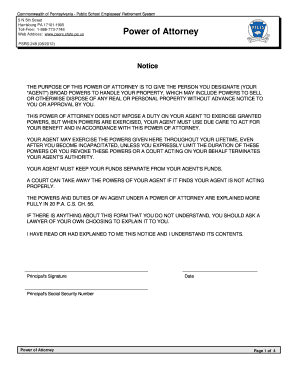
Health Insurance Program Instructions PSRS-248 (08/2012) General This Power of Attorney authorizes your agent to perform on your behalf any transactions with the Public School Employees' Retirement System (PSERS) that you could request yourself. This form is intended for use with PSERS only. Every Power of Attorney document is subject to review and approval by PSERS. You may revoke this Power of Attorney at any time by providing written notice of your revocation to PSERS and to your designate.

How it works

  1. Open form

    Open form follow the instructions

  2. Easily sign form

    Easily sign the form with your finger

  3. Share form

    Send filled & signed form or save

How to fill out the PA PSRS-248 online

The PA PSRS-248 form serves as a Power of Attorney for the Public School Employees' Retirement System in Pennsylvania. This guide will assist you in understanding each section of the form and provide clear, step-by-step instructions to ensure a smooth completion.

Follow the steps to fill out the PA PSRS-248 online.

  1. Click ‘Get Form’ button to obtain the form and open it for completion.
  2. Carefully read the notice section at the top of the form. This section outlines the purpose of the Power of Attorney and your responsibilities as the principal. You must sign and date this section to indicate your understanding.
  3. In Section A, fill in your full name, municipality, county, and state in the provided fields. Designate one or more agents by writing their names, addresses, telephone numbers, and their relationship to you. If you are appointing multiple agents, state whether they must act together or may act individually.
  4. Move to Section B and select whether your agent is allowed to name themselves as a beneficiary or survivor annuitant. You must check one option.
  5. Complete Section C only if your spouse is named as an agent. Indicate whether the Power of Attorney should remain valid in the event of a divorce.
  6. In Section D, specify if the Power of Attorney should become void upon your disability or incapacity. If you leave this blank, it will be assumed that it remains valid.
  7. Proceed to Section E if you are physically able to sign. Sign and date the form in the designated area and have a witness sign and provide their address below.
  8. If you are not physically able to sign, complete Section F instead. Make your mark in the space for 'Principal's Mark.' Have someone write your name in the designated area, and ensure two witnesses observe you and sign in the appropriate spaces.
  9. Review all entries for accuracy. Once you have completed and signed the form, you may save changes, download, print, or share the completed document as needed.

Complete your documents online for a seamless experience.

Get form

Experience a faster way to fill out and sign forms on the web. Access the most extensive library of templates available.

Related content

Power of Attorney
This Power of Attorney (“POA”) authorizes your agent to perform on your behalf any...
Learn more
Chemkin Theory Manual
Reaction Design provides an allotment of technical support to its Licensees free of...
Learn more
PSR-S550 Owner's Manual
This product utilizes batteries or an external power supply (adapter). DO NOT connect this...
Learn more

Related links form

MD DR-49E 2013 MD DRIN 7 2001 MD Ethics Commission Form 26 2014 MD Form 13F 2014

Questions & Answers

Get answers to your most pressing questions about US Legal Forms API.

Contact support

To give someone power of attorney in Pennsylvania, start by drafting a power of attorney document that specifies the powers you wish to grant. Then, ensure that both you and the agent sign the document in the presence of a notary. For easy access to legally compliant templates, consider checking out US Legal Forms, which can assist you in adhering to the PA PSRS-248 guidelines.

To create a valid power of attorney in Pennsylvania, you need to meet several requirements which include having a competent principal, specific language in the document, and proper signatures. Additionally, notarization is typically necessary to ensure the document's legitimacy. Utilizing resources from US Legal Forms can simplify this process and align your document with PA PSRS-248 standards.

The new power of attorney law in Pennsylvania, effective in 2015, introduced several important changes designed to protect individuals granting these powers. It emphasizes the importance of clear language and requires witness signatures in some cases. For comprehensive information on navigating these changes, the PA PSRS-248 guide can be incredibly helpful.

The PA teacher retirement multiplier refers to a calculation used to determine the retirement benefits for Pennsylvania teachers. This formula considers your years of service and your final average salary. Understanding this multiplier is key for those considering retirement under the PA PSRS-248, as it directly influences your financial planning.

To acknowledge a power of attorney agent in Pennsylvania, you typically need to sign the document in front of a notary. The notary verifies your identity and confirms that you understand the powers you are granting. For further assistance with the PA PSRS-248 process, you can visit US Legal Forms for a range of templates and resources.

Yes, in Pennsylvania, a power of attorney document generally needs to be notarized to be valid. This requirement helps ensure that your intentions are clear and that the document has legal standing. It's crucial to consider the PA PSRS-248 guidelines when preparing the document, as this ensures compliance with state regulations.

To file for power of attorney in Pennsylvania, begin by selecting a trusted individual to act on your behalf. Next, draft a power of attorney document outlining the powers granted. Finally, sign the document in front of a notary and make copies for relevant parties. Utilizing forms provided through PA PSRS-248 can streamline this process and ensure all required elements are included.

In Pennsylvania, the costs of a partition action are typically shared among the co-owners of the property. However, the specific division of costs can vary based on the court’s ruling and agreements among the parties. It’s essential to consult with a legal expert knowledgeable about PA PSRS-248 to understand the financial responsibilities involved.

To start a partition action, gather all relevant details about co-owners and the property. You will then draft a complaint and file it with the local court. After filing, make sure to notify all parties involved as required by law. Resources like PA PSRS-248 can assist you in completing this initial step efficiently.

The process of a partition action involves several key steps. First, you must file a complaint in the appropriate court, detailing the co-owners and the property. Following this, the court will schedule a hearing to determine how to divide or sell the property. Using PA PSRS-248 simplifies understanding these steps and ensures compliance with local laws.

Get This Form Now!

Use professional pre-built templates to fill in and sign documents online faster. Get access to thousands of forms.
If you believe that this page should be taken down, please follow our DMCA take down processhere.
Get PA PSRS-248
  • Adoption
  • Bankruptcy
  • Contractors
  • Divorce
  • Home Sales
  • Employment
  • Identity Theft
  • Incorporation
  • Landlord Tenant
  • Living Trust
  • Name Change
  • Personal Planning
  • Small Business
  • Wills & Estates
  • Packages A-Z
  • Affidavits
  • Bankruptcy
  • Bill of Sale
  • Corporate - LLC
  • Divorce
  • Employment
  • Identity Theft
  • Internet Technology
  • Landlord Tenant
  • Living Wills
  • Name Change
  • Power of Attorney
  • Real Estate
  • Small Estates
  • Wills
  • All Forms
  • Forms A-Z
  • Other Templates
  • Legal Hub
  • About Us
  • Help Portal
  • Legal Resources
  • Blog
  • Affiliates
  • Contact Us
  • Delete My Account
  • Site Map
  • Industries
  • Forms in Spanish
  • Localized Forms
  • State-specific Forms
  • Forms Kit
  • Real Estate Handbook
  • All Guides
  • Notarize
  • Incorporation services
  • For Consumers
  • For Small Business
  • For Attorneys
  • USLegal
  • FormsPass
  • pdfFiller
  • signNow
  • altaFlow
  • DocHub
  • Instapage
Form Packages
  • Adoption
  • Bankruptcy
  • Contractors
  • Divorce
  • Home Sales
  • Employment
  • Identity Theft
  • Incorporation
  • Landlord Tenant
  • Living Trust
  • Name Change
  • Personal Planning
  • Small Business
  • Wills & Estates
  • Packages A-Z
Form Categories
  • Affidavits
  • Bankruptcy
  • Bill of Sale
  • Corporate - LLC
  • Divorce
  • Employment
  • Identity Theft
  • Internet Technology
  • Landlord Tenant
  • Living Wills
  • Name Change
  • Power of Attorney
  • Real Estate
  • Small Estates
  • Wills
  • All Forms
  • Forms A-Z
  • Other Templates
Customer Service
  • Legal Hub
  • About Us
  • Help Portal
  • Legal Resources
  • Blog
  • Affiliates
  • Contact Us
  • Delete My Account
  • Site Map
  • Industries
  • Forms in Spanish
  • Localized Forms
  • State-specific Forms
  • Forms Kit
Legal Guides
  • Real Estate Handbook
  • All Guides
Prepared for you
  • Notarize
  • Incorporation services
Our Customers
  • For Consumers
  • For Small Business
  • For Attorneys
Our Sites
  • USLegal
  • FormsPass
  • pdfFiller
  • signNow
  • altaFlow
  • DocHub
  • Instapage
Social Media
Call us now toll free:
+1 833 426 79 33
As seen in:
© Copyright 1999-2026 airSlate Legal Forms, Inc. 17 Station Street, Ste. 203, Brookline, MA 02445
  • Your Privacy Choices
  • Terms of Service
  • Privacy Notice
  • Content Takedown Policy
  • Bug Bounty Program
PA PSRS-248
This form is available in several versions.
Select the version you need from the drop-down list below.
2019 PA PSRS-248
Select form
  • 2019 PA PSRS-248
  • 2012 PA PSRS-248
Select form