Loading
Form preview
  • US Legal Forms
  • Other Templates
  • Legal Forms
  • Kansas Legal Forms
  • Ks Motion Alleging Violation Of Conditional Release 2013

Get Ks Motion Alleging Violation Of Conditional Release 2013-2026

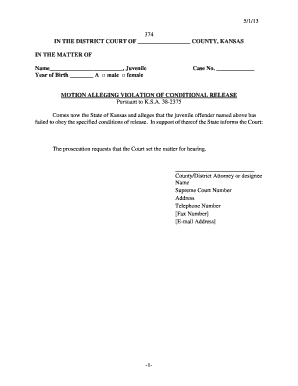
MOTION ALLEGING VIOLATION OF CONDITIONAL RELEASE Pursuant to K.S.A. 38-2375 Comes now the State of Kansas and alleges that the juvenile offender named above has failed to obey the specified conditions of release. In support of thereof the State informs the Court: The prosecution requests that the Court set the matter for hearing. County/District Attorney or designee Name Supreme Court Number Address Telephone Number Fax Number E-mail Address -1- 5/1/13 Autho.

How it works

  1. Open form

    Open form follow the instructions

  2. Easily sign form

    Easily sign the form with your finger

  3. Share form

    Send filled & signed form or save

How to fill out the KS Motion Alleging Violation of Conditional Release online

This guide provides clear instructions for individuals looking to fill out the KS Motion Alleging Violation of Conditional Release online. Whether you have prior experience with legal documents or not, this comprehensive guide will assist you in navigating each section effectively.

Follow the steps to fill out the KS Motion Alleging Violation of Conditional Release

  1. Press the ‘Get Form’ button to access the form and open it in your preferred editing tool.
  2. Begin by entering the name of the juvenile offender in the designated section marked ‘Name’.
  3. Fill in the year of birth for the juvenile offender in the ‘Year of Birth’ field.
  4. Indicate the gender of the juvenile by checking the appropriate box for either 'male' or 'female'.
  5. Enter the case number in the ‘Case No.’ field to associate this motion with the relevant legal proceedings.
  6. In the body of the motion, detail the specific violations of the conditions of release that the juvenile has allegedly committed.
  7. Include the name, title, and supreme court number of the county or district attorney or designee who is filing the motion.
  8. Provide the address, telephone number, and optional fax and email address of the attorney or designee.
  9. Review the completed form for accuracy and completeness to ensure all necessary information is provided.
  10. Save your changes. You can choose to download, print, or share the document as needed.

Start filling out your document online today!

Get form

Experience a faster way to fill out and sign forms on the web. Access the most extensive library of templates available.
Get form

Related content

Article 9.-- PAROLE, POSTRELEASE SUPERVISION, AND...
(b) ''Conditional release,'' for offenders serving indeterminate sentences for offenses...
Learn more
Kan. Admin. Regs. § 44-9-502 - Final revocation...
The final revocation hearing shall be held without unnecessary delay and shall be...
Learn more
Annual Financial Statements 2019 Daimler AG
Dec 31, 2019 — The 2019 Daimler AG financial statements include a Balance Sheet, Income...
Learn more

Related links form

NY DTF IFTA-101-MN 2008 NY DTF IFTA-105.1 2018 NY DTF IFTA-105.1 2015 NY DTF IFTA-105.1 2013

Questions & Answers

Get answers to your most pressing questions about US Legal Forms API.

Contact support

A conditional release violation refers to any breach of the conditions that allow an individual to live outside of jail. This can involve failing to meet curfew, not attending mandatory programs, or having contact with prohibited individuals. If you receive a KS Motion Alleging Violation of Conditional Release, consider leveraging platforms like uslegalforms to better understand your rights and options.

Violating conditional release means not following the specific terms laid out by the court, which can lead to serious repercussions. This violation can trigger a hearing, where the individual may face the possibility of being sent back to jail. If confronted with a KS Motion Alleging Violation of Conditional Release, it is important to seek the right legal resources to address the situation.

An example of a conditional release is when a person convicted of a non-violent crime is allowed to live at home under supervised conditions. They may need to report to a probation officer weekly and pass drug tests. Knowing these examples can help you navigate your situation effectively if you find yourself facing a KS Motion Alleging Violation of Conditional Release.

A conditional release allows an individual to serve their time outside of jail under specific conditions set by the court. These conditions might include regular reporting to a probation officer, attending counseling, or refraining from certain activities. Understanding how a conditional release operates is essential, especially if you are involved in a KS Motion Alleging Violation of Conditional Release, as it affects your legal standing.

Violating a condition of release occurs when an individual fails to adhere to the terms set by the court upon their release. This can include missing scheduled check-ins, committing new offenses, or violating specific restrictions outlined in the release order. If you face a KS Motion Alleging Violation of Conditional Release, it is crucial to understand the implications and potential legal consequences involved.

In a criminal hearing, most people know that the defendant can be released from jail if they post bail. In some instance, the judge may let the person out of jail without them having to pay bail money. This procedure is known as a Release on Recognizance and may be available for defendants in certain criminal trials.

Release on your own recognizance means you don't have to pay bail. Simply put, OR release is no-cost bail. Defendants released on their own recognizance need only sign a written promise to appear in court as required. No bail has to be paid, either to the court or to a bail bond seller.

When a criminal suspect is arrested, booked and granted release on their "own recognizance," or "O.R.," no bail money is paid to the court and no bond is posted. The suspect is merely released after promising, in writing, to appear in court for all upcoming proceedings.

A release on your own recognizance (ROR), also known as an own recognizance (OR) or personal recognizance (PR), is a written promise signed by the defendant promising that they will show up for future court appearances and not engage in illegal activity while out on an ROR.

Release On Ones Own Recognizance Law and Legal Definition. To release on one's own recognizance means for a judge to allow a criminal defendant to be released from custody without posting bail. Often called "O.R." or "R.O.R," it is commonly granted in traffic matters, minor and technical crimes.

Get This Form Now!

Use professional pre-built templates to fill in and sign documents online faster. Get access to thousands of forms.
Get form
If you believe that this page should be taken down, please follow our DMCA take down processhere.
Get KS Motion Alleging Violation of Conditional Release
Get form
  • Adoption
  • Bankruptcy
  • Contractors
  • Divorce
  • Home Sales
  • Employment
  • Identity Theft
  • Incorporation
  • Landlord Tenant
  • Living Trust
  • Name Change
  • Personal Planning
  • Small Business
  • Wills & Estates
  • Packages A-Z
  • Affidavits
  • Bankruptcy
  • Bill of Sale
  • Corporate - LLC
  • Divorce
  • Employment
  • Identity Theft
  • Internet Technology
  • Landlord Tenant
  • Living Wills
  • Name Change
  • Power of Attorney
  • Real Estate
  • Small Estates
  • Wills
  • All Forms
  • Forms A-Z
  • Other Templates
  • Legal Hub
  • About Us
  • Help Portal
  • Legal Resources
  • Blog
  • Affiliates
  • Contact Us
  • Delete My Account
  • Site Map
  • Industries
  • Forms in Spanish
  • Localized Forms
  • State-specific Forms
  • Forms Kit
  • Real Estate Handbook
  • All Guides
  • Notarize
  • Incorporation services
  • For Consumers
  • For Small Business
  • For Attorneys
  • USLegal
  • FormsPass
  • pdfFiller
  • signNow
  • altaFlow
  • DocHub
  • Instapage
Form Packages
  • Adoption
  • Bankruptcy
  • Contractors
  • Divorce
  • Home Sales
  • Employment
  • Identity Theft
  • Incorporation
  • Landlord Tenant
  • Living Trust
  • Name Change
  • Personal Planning
  • Small Business
  • Wills & Estates
  • Packages A-Z
Form Categories
  • Affidavits
  • Bankruptcy
  • Bill of Sale
  • Corporate - LLC
  • Divorce
  • Employment
  • Identity Theft
  • Internet Technology
  • Landlord Tenant
  • Living Wills
  • Name Change
  • Power of Attorney
  • Real Estate
  • Small Estates
  • Wills
  • All Forms
  • Forms A-Z
  • Other Templates
Customer Service
  • Legal Hub
  • About Us
  • Help Portal
  • Legal Resources
  • Blog
  • Affiliates
  • Contact Us
  • Delete My Account
  • Site Map
  • Industries
  • Forms in Spanish
  • Localized Forms
  • State-specific Forms
  • Forms Kit
Legal Guides
  • Real Estate Handbook
  • All Guides
Prepared for you
  • Notarize
  • Incorporation services
Our Customers
  • For Consumers
  • For Small Business
  • For Attorneys
Our Sites
  • USLegal
  • FormsPass
  • pdfFiller
  • signNow
  • altaFlow
  • DocHub
  • Instapage
Social Media
Call us now toll free:
+1 833 426 79 33
As seen in:
© Copyright 1999-2026 airSlate Legal Forms, Inc. 17 Station Street, Ste. 203, Brookline, MA 02445
  • Your Privacy Choices
  • Terms of Service
  • Privacy Notice
  • Content Takedown Policy
  • Bug Bounty Program