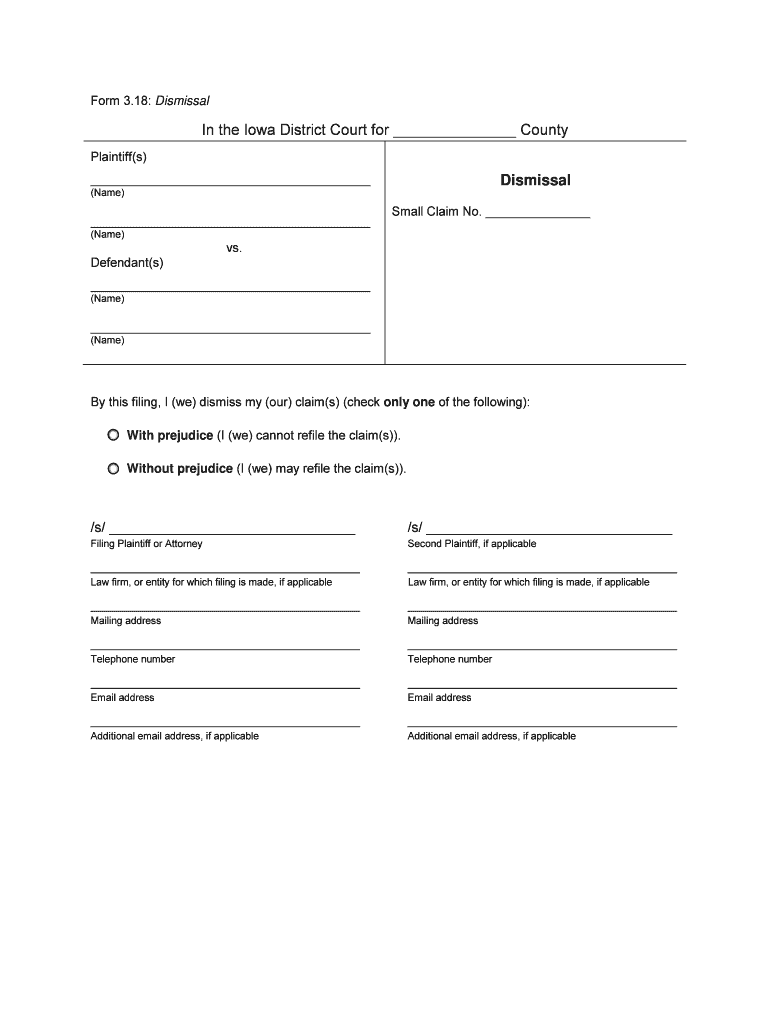
Ourt for County Plaintiff(s) Dismissal (Name) (Name) Defendant(s) Small Claim No. vs. (Name) (Name) By this filing, I (we) dismiss my (our) claim(s) (check only one of the following): With prejudice (I (we) cannot refile the claim(s)). Without prejudice (I (we) may refile the claim(s)). /s/.
Loading

Open form follow the instructions

Easily sign the form with your finger

Send filled & signed form or save
How to fill out the IA eForm 3.18 online
The IA eForm 3.18 is an essential document used for filing a dismissal in the Iowa District Court. This guide provides clear, step-by-step instructions for accurately completing the form online, ensuring you understand each component involved.
Follow the steps to accurately complete the IA eForm 3.18 online
- Click the ‘Get Form’ button to obtain the IA eForm 3.18 and open it in your preferred editing tool.
- In the section titled 'In the Iowa District Court for ________________ County', enter the name of the county where the case is being filed.
- In the 'Plaintiff(s)' section, provide the full names of the individuals or entities filing the dismissal.
- In the 'Defendant(s)' section, similarly, enter the full names of the individuals or entities against whom the claim was made.
- Fill in the 'Small Claim No.' with the appropriate case number related to your claim.
- Indicate whether you wish to dismiss the claim 'With prejudice' (which means you cannot refile the claim) or 'Without prejudice' (which permits you to refile the claim) by checking the corresponding box.
- In the 'Filing Plaintiff or Attorney' section, write your name or the name of your attorney, if applicable.
- Provide the mailing address, telephone number, and email address for the filing plaintiff or attorney.
- If applicable, fill in the fields for a second plaintiff, including their name, law firm, mailing address, telephone number, email address, and any additional email address.
- Once all fields are completed, review the form for accuracy. You can save changes, download, print, or share the form as required.
Make sure to complete your IA eForm 3.18 online today and ensure all required documents are filed accurately.
Experience a faster way to fill out and sign forms on the web. Access the most extensive library of templates available.
Related content
Form 3.18 is used to dismiss a claim, either with prejudice (cannot refile) or without...
In this episode of TechTank, co-host Nicol Turner Lee and Tom Wheeler discuss how the...
It provides applications programmers coding the assembler language with the information...
Get answers to your most pressing questions about US Legal Forms API.
How to file an appearance and answer in Iowa?
Filing an appearance and answer in Iowa involves submitting specific documents to the court. You must complete the paperwork accurately and file it within the time frame set by the court. The IA eForm 3.18 can help you create these documents correctly, ensuring you meet all requirements. This proactive approach can significantly enhance your chances of a favorable outcome.
What is the maximum amount for small claims court in Iowa?
In Iowa, the maximum amount you can sue for in small claims court is $6,500. This limit can vary, so it is essential to check the latest regulations before proceeding. The IA eForm 3.18 provides you with the necessary templates to prepare your claim while staying within these financial constraints. Knowing this limit can help you decide if small claims court is the right option for your dispute.
Is it worth taking someone to small claims court?
Taking someone to small claims court can be worthwhile, depending on the situation. It allows you to seek resolution for a dispute without the high costs of formal litigation. Utilize the IA eForm 3.18 to streamline your court documents, which helps simplify the process. Assess your case and consider whether the potential outcome justifies the effort.
How long is a judgment enforceable in Iowa?
In Iowa, a judgment is typically enforceable for ten years from the date it is entered. This means you have a decade to collect on the judgment if necessary. If you need help with this process, consider using the IA eForm 3.18, which simplifies legal documentation and serves as an efficient tool for managing judgments. Staying informed about the enforceability period empowers you to take timely actions.
How to file appearance and answer in Iowa?
To file your appearance and answer in Iowa, you must complete the appropriate forms and submit them to the court. It's crucial to respond within the specified timeframe to avoid default judgment. You can use the IA eForm 3.18 to easily access and fill out these necessary forms. This platform simplifies the filing process and ensures that you meet all legal requirements.
Can a non US citizen sue in small claims court?
Citizenship is not a requirement to sue or be sued in either the federal courts of the United States or the courts of any US state. ... Again, citizenship is not required. For the most part, the nationality of the parties to a lawsuit in a US court is irrelevant; residency (where the person resides) is far more important.
Can I sue someone if I don't know where they live?
Yes, you can sue someone without knowing their address or full name. However, you will have to properly serve them with the complaint and summons of your lawsuit and this will obviously be very difficult.
Can you sue someone from a different state?
If you are suing someone from a different state, a court in your state may not have power or "jurisdiction" over that person. In that case, you might have to sue the defendant in his or her location, which will probably be more expensive and inconvenient for you. 9.
Can you take someone to small claims if they live out of state?
However, sometimes you may need to file a small claims lawsuit against a defendant who lives in another state. Not every jurisdiction will allow you to sue an out-of-state defendant in small claims court. ... If that person never comes to the state, you may not be able to sue them in small claims court.
Can you take someone to small claims court if they live in another state?
That's why most small claims cases are local. However, sometimes you may need to file a small claims lawsuit against a defendant who lives in another state. ... If that person never comes to the state, you may not be able to sue them in small claims court.
Use professional pre-built templates to fill in and sign documents online faster. Get access to thousands of forms.
If you believe that this page should be taken down, please follow our DMCA take down process here.