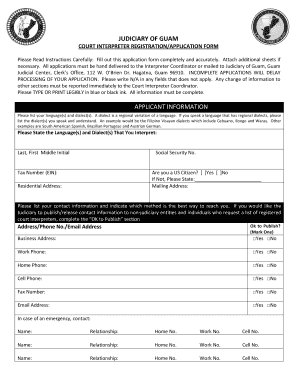
All applications must be hand delivered to the Interpreter Coordinator or mailed to Judiciary of Guam, Guam Judicial Center, Clerk s Office, 112 W. O Brien Dr. Hagatna, Guam 96910. INCOMPLETE APPLICATIONS WILL DELAY PROCESSING OF YOUR APPLICATION. Please write N/A in any fields that does not apply. Any change of information to other sections must be reported immediately to the Court Interpreter Coordinator. Please TYPE OR PRINT LEGIBLY in blue or black ink. All information must be complete.
Loading
Open form follow the instructions
Easily sign the form with your finger
Send filled & signed form or save
How to fill out the GU Court Interpreter Registration/Application Form online
Filling out the GU Court Interpreter Registration/Application Form online is a crucial step for individuals aiming to become registered court interpreters. This guide provides clear, step-by-step instructions to help you accurately complete the form and submit it efficiently.
Follow the steps to complete the online registration application.
- Click ‘Get Form’ button to download the application form and open it in your preferred document editor.
- Begin by providing your applicant information. Include your name, social security number, tax number, and your citizenship status. Ensure all fields are filled accurately.
- List the languages and dialects you interpret. Remember to include any regional variations in your responses.
- Fill out your mailing and residential addresses. Indicate your preferred contact method and whether you allow the Judiciary to publish your contact information.
- Provide emergency contact information, including the name, relationship, and phone numbers of multiple contacts.
- Detail your education history. Include the names of institutions, locations, languages of instruction, and degrees/certificates earned.
- Document your relevant work and volunteer experience related to interpreting or translating. Be specific about your duties and contributions.
- Record any formal training or workshops attended that enhance your interpreting skills. Name the institution, location, dates, and number of hours completed.
- Respond to the conviction section truthfully by checking ‘yes’ or ‘no’ and provide explanations if applicable.
- Read and sign the declaration under penalty of perjury, confirming the information is complete and accurate. Include the date of your signature.
- Once you have completed all sections, save your changes, download a copy of the form for your records, and prepare to print or share it as required.
Complete your GU Court Interpreter Registration/Application Form online today to become part of the registered interpreter community.
Experience a faster way to fill out and sign forms on the web. Access the most extensive library of templates available.
Related content
To become a registered interpreter one must apply, be trained in basic courtroom...
You are required to submit a Registrar's Certification Form, unless you are using the...
CITES provides a legal framework for regulating international trade in species threatened...
Get answers to your most pressing questions about US Legal Forms API.
How much does a court interpreter make in the US?
The average salary for court interpreters across the US varies, typically ranging from $40,000 to $80,000 annually. Earnings can increase with experience and specialization in certain languages. If you're aiming to enhance your career as a court interpreter, considering the GU Court Interpreter Registration/Application Form can be a great start.
How do I become a court interpreter in the US?
To become a court interpreter in the US, you usually need to obtain a bachelor's degree and pass a certification exam. It is also beneficial to complete training programs focused on legal terminology and courtroom procedures. Submitting the GU Court Interpreter Registration/Application Form is an important step in this process to ensure you meet all requirements.
How much does a court interpreter make in NJ?
In New Jersey, court interpreters typically earn between $45,000 and $85,000 per year, depending on their experience and the complexity of the cases. The demand for qualified interpreters is high, and those who complete the GU Court Interpreter Registration/Application Form may find more job opportunities and higher earnings.
What is the difference between a court translator and an interpreter?
A court translator focuses on converting written documents from one language to another, while a court interpreter deals with spoken language during legal proceedings. Both roles are crucial in ensuring clear and accurate communication in a courtroom setting. If you are interested in interpreting, you can apply through the GU Court Interpreter Registration/Application Form to start your journey.
How much do court interpreters make in the US?
Court interpreters in the US earn varying salaries based on factors like location, experience, and language proficiency. On average, a court interpreter makes between $40,000 and $80,000 annually. Those looking to become certified should consider using the GU Court Interpreter Registration/Application Form to understand certification requirements and improve job prospects.
Is a translator the same as an interpreter?
No, a translator is not the same as an interpreter, though both roles involve converting language. Translators work with written text, ensuring that the meaning and context are preserved in another language. In contrast, interpreters work with spoken language, translating conversations dynamically. This distinction is crucial when engaging with the GU Court Interpreter Registration/Application Form to choose the correct path for your career.
What is the difference between a court interpreter and translator?
Although both court interpreters and translators play critical roles in the legal system, their functions differ significantly. A court interpreter primarily handles the spoken word in real-time, while a translator focuses on written communications. This understanding is important when filling out the GU Court Interpreter Registration/Application Form, ensuring that you apply for the right certification based on your skills.
What is a court interpreter and translator?
A court interpreter facilitates communication in legal settings by translating spoken words between participants who speak different languages. Meanwhile, a court translator focuses on written documents to ensure accuracy in legal texts. Both roles are vital and require specific certifications, like those provided with the GU Court Interpreter Registration/Application Form, to ensure quality and compliance.
What are the three basic types of interpreter certification?
The three basic types of interpreter certification typically include certification for spoken languages, sign language, and court interpreting. Each type focuses on different skills essential for effective communication in legal settings. It's crucial to ensure that your application for the GU Court Interpreter Registration/Application Form aligns with these certification types to enhance your qualifications.
What are the three modes of interpretation?
The three modes of interpretation include consecutive, simultaneous, and whispered interpretation. In consecutive mode, the interpreter waits for pauses to convey the message. Simultaneous interpretation happens as the speaker talks, while whispered interpretation allows the interpreter to speak softly for a limited audience. Each mode has specific uses, highlighted in the GU Court Interpreter Registration/Application Form.
Use professional pre-built templates to fill in and sign documents online faster. Get access to thousands of forms.
If you believe that this page should be taken down, please follow our DMCA take down process here.