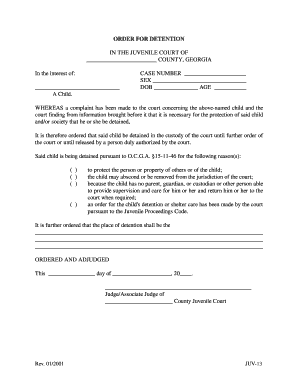
DOB AGE WHEREAS a complaint has been made to the court concerning the above-named child and the court finding from information brought before it that it is necessary for the protection of said child and/or society that he or she be detained, It is therefore ordered that said child be detained in the custody of the court until further order of the court or until released by a person duly authorized by the court. Said child is being detained pursuan.

How it works
  • Open form

    Open form follow the instructions

  • Easily sign form

    Easily sign the form with your finger

  • Share form

    Send filled & signed form or save

How to fill out the GA JUV-13 online

Filling out the GA JUV-13 form online is a vital step in addressing the needs of a child in the juvenile court system. This guide provides clear instructions to help you complete the form accurately and efficiently.

Follow the steps to effectively complete the GA JUV-13 form.

  1. Click ‘Get Form’ button to access the GA JUV-13 form. Once you have clicked the button, the form will open for you to fill it out.
  2. Fill in the child's name in the designated space under 'In the interest of:' to specify the individual to whom the order pertains.
  3. Enter the case number in the corresponding field to help identify the legal case associated with the juvenile.
  4. Complete the sections labeled ‘SEX,’ ‘DOB,’ and ‘AGE’ to provide critical identifying information about the child.
  5. Review the reasons for detention section. You need to check all applicable boxes to justify the need for the child's detention as outlined in the form.
  6. In the space provided, detail the specific place of detention where the child will be held. This information must be accurate and clear.
  7. Finally, date the form and add the name and signature of the Judge or Associate Judge responsible for the order.
  8. Once all fields are completed, save the form with your changes. You may also download, print, or share the document as required.

Complete your documents online to ensure prompt and efficient processing.

Get form

Experience a faster way to fill out and sign forms on the web. Access the most extensive library of templates available.

Related content

JUV-13 Order of Commitment

Petition(s) having been filed in this Court and, after hearing evidence, having determined...

Learn more
Página 1: Educação em contextos de justiça...

Julgado: Uma decisão formal emitida por um juiz. Delinquente: Um menor que comete uma...

Learn more
methanol in the l1551 circumbinary torus glenn j...

by GJ White · 2006 · Cited by 9 — ABSTRACT. We report observations of gaseous methanol...

Learn more
Questions & Answers

Get answers to your most pressing questions about US Legal Forms API.

Contact support

What are the three types of court cases?

Court cases generally fall into three categories: civil, criminal, and administrative cases. Civil cases involve disputes between individuals or entities, criminal cases address violations of law, and administrative cases deal with regulatory issues. Understanding these distinctions is important, especially when considering how they impact juvenile cases under GA JUV-13.

To obtain a Guardian ad litem in Georgia, you typically need to file a petition with the court requesting this assistance. The court will then appoint a qualified individual to represent the interests of the child. Engaging early with the GA JUV-13 process can streamline this request, ensuring that a child's voice is heard during legal proceedings.

Juveniles can be classified into three categories: status offenders, delinquents, and dependent children. Status offenders engage in acts that are not illegal for adults, delinquents commit crimes, and dependent children lack a stable home environment. This classification helps the legal system address the specific needs of each juvenile. Knowing these categories will aid in navigating the GA JUV-13 process more effectively.

The process of juvenile detainment generally begins with an arrest, followed by a detention hearing to determine whether the juvenile should remain in custody. If detained, the juvenile will undergo an assessment and a formal hearing. These steps can be overwhelming, but resources like GA JUV-13 provide guidance to ensure fair representation and proper handling of the case.

In Georgia, the age of majority is 18, which means individuals are no longer considered juveniles once they reach this age. However, if a person is charged with a crime before turning 17, that case will be handled in juvenile court. Understanding these age parameters can significantly impact the handling of cases, particularly within the GA JUV-13 framework.

Common juvenile cases include theft, assault, drug offenses, and truancy. These cases usually stem from behaviors that can lead to serious consequences for the youth involved. It's important to address these issues promptly and effectively. Utilizing the resources available through GA JUV-13 can assist in managing these challenging situations.

Juvenile courts primarily address cases involving three groups: delinquent juveniles, status offenders, and dependent children. Delinquent juveniles are those charged with criminal acts, while status offenders engage in activities illegal due to their age. Lastly, dependent children are those who require care and protection. Each group has unique needs, and understanding this classification is crucial when dealing with GA JUV-13 matters.

In juvenile court, cases typically fall into three main categories: delinquency cases, status offenses, and dependency cases. Delinquency cases involve minors accused of committing illegal acts, while status offenses include behaviors that are only considered illegal due to the age of the offender, such as truancy or underage drinking. Dependency cases relate to children's welfare when they may be neglected or abused. Understanding the types of cases can help you better navigate the GA JUV-13 process.

The juvenile justice process in Georgia consists of four main steps: intake, adjudication, disposition, and aftercare. During intake, the case is evaluated to determine the next steps. Adjudication involves a hearing where the case is heard, and disposition determines the consequences. Following these steps, aftercare assists the juvenile in reintegration. Understanding GA JUV-13 can provide insights into each stage of this process.

In Georgia, a 14-year-old has some rights regarding visitation, but they cannot unilaterally refuse visits. The court typically considers the child's wishes but ultimately decides based on the child’s best interest. Familiarizing yourself with GA JUV-13 and its stipulations can help navigate these personal situations effectively. Seeking legal counsel can provide clarity and support to families facing visitation issues.

Get This Form Now!

Use professional pre-built templates to fill in and sign documents online faster. Get access to thousands of forms.

If you believe that this page should be taken down, please follow our DMCA take down process here.

Get GA JUV-13