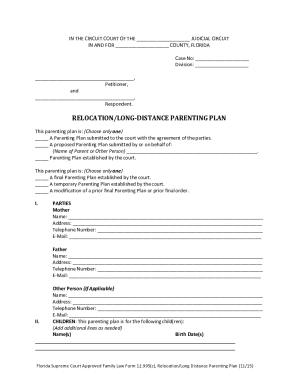
Time-sharing with minor child(ren), even when timesharing is not in dispute. The Parenting Plan must be developed and agreed to by the parents and every other person entitled to access or time-sharing with the child(ren) and approved by the court. Other Person means an individual who is not the parent, but with whom the child resides pursuant to court order, or who has the right of access to, time-sharing with or visitation with the child(ren). If the parties cannot agree to a Parenting P.
Open form follow the instructions
Easily sign the form with your finger
Send filled & signed form or save
How to fill out the FL 12.995(c) online
Filling out the FL 12.995(c) form, also known as the relocation/long distance parenting plan, is a crucial step for parents planning to relocate with their children. This guide will provide clear and supportive instructions to ensure you can complete the form accurately and effectively.
Follow the steps to fill out the FL 12.995(c) form online.
- Press the ‘Get Form’ button to obtain the FL 12.995(c) form and open it in your preferred document editor.
- Begin by selecting the type of parenting plan you are submitting. You can choose whether it is an agreed plan, a proposed plan, or one established by the court.
- Fill in your personal details in the 'Parties' section. Include the names, addresses, telephone numbers, and email addresses of each parent, as well as any other relevant individuals.
- Indicate the children involved by listing their names and birth dates in the 'Children' section.
- Complete the 'Jurisdiction' section by confirming the habitual residence and home state of the children.
- Detail the 'Parental Responsibility and Decision Making' preferences, including how major decisions concerning the children will be made.
- Outline information sharing protocols, ensuring both parties have access to medical and educational records.
- Create a 'Scheduling' plan that specifies how the child(ren) will spend time during the school year, breaks, and holidays.
- Clarify transportation and exchange details, including who will be responsible for pick-up and drop-off of the child(ren).
- Finally, save your completed form. You can print it, download it, or share it as necessary.
Start filling out your FL 12.995(c) form online today to ensure a smooth transition for you and your child(ren).
Experience a faster way to fill out and sign forms on the web. Access the most extensive library of templates available.
Related content
A Parenting Plan is required in all cases involving time-sharing with minor child(ren)...
... (c), Notice of Filing Return Receipt (--/08). INSTRUCTIONS FOR FLORIDA FAMILY LAW...
Chapter 3 - Transmit, Receive & Audio Circuit Boards. BTR-200 Instrument Disassembly. 3-1...
Get answers to your most pressing questions about US Legal Forms API.
Why would a judge deny relocation in Florida?
A judge in Florida may deny relocation if they believe it would not be in the best interest of the child. Factors considered include the child's stability, relationships with both parents, and how the move impacts their schooling and social networks. Judges prioritize the child's wellbeing, and any decision must reflect that. Familiarity with FL 12.995(c) and the associated legal criteria can help parents understand what to present during relocation requests.
What are examples of a substantial change?
Examples of substantial changes might include a drastic change in income, loss of a job, or a substantial health issue affecting a parent. Additionally, relocating to a different state or a child's needs changing as they grow can also serve as examples. Each situation is unique, so understanding how these changes relate to FL 12.995(c) can help parents navigate necessary legal adjustments. Being proactive and informed can facilitate smoother transitions during such changes.
What is substantial change in circumstances in Florida?
Substantial change in circumstances in Florida, referenced in FL 12.995(c), indicates noteworthy developments that can impact child custody or support orders. Courts look for objective changes that significantly alter the situation of one or both parents or the child. This could include factors like a parent's incarceration or a child reaching a critical developmental stage. Recognizing these changes is key for anyone involved in custody-related matters.
What is considered a change in circumstances?
A change in circumstances encompasses any significant event that affects the current living arrangement or custody decision. This could include changes in job status, health issues, or relocation of a parent. These factors must be substantial enough to warrant reconsideration of existing legal agreements. FL 12.995(c) provides guidance on how such changes can lead to modifications in court orders.
What is the new law for unwed fathers in Florida?
The new law for unwed fathers in Florida enables them to establish paternity more easily. Under this law, unwed fathers can assert their rights related to custody and visitation by formally acknowledging their parental status. This development allows fathers to participate more actively in their children's lives and ensures they have a voice in legal matters. It's essential for fathers to stay informed about FL 12.995(c) to navigate these changes effectively.
What qualifies as a substantial change in circumstances in Florida?
A substantial change in circumstances in Florida, as outlined in FL 12.995(c), typically refers to significant life events that impact child custody or support arrangements. This could include a parent losing their job, moving far away, or changes in the child's needs. Such changes must be relevant and material to affect the current agreement. Understanding these nuances is crucial for parents seeking modifications.
What forms do I need to file for child visitation in Florida?
To file for child visitation in Florida, you typically need to complete specific forms that outline your request for visitation rights. FL 12.995(c) provides essential documentation to help simplify this process. Resources available through platforms like uslegalforms can guide you in filling out these forms correctly. This can minimize potential delays and ensure that your application is processed smoothly.
Can a mother deny the father visitation in Florida?
In Florida, a mother cannot simply deny a father visitation without a legal reason. If there are concerns about safety or well-being, it is crucial to take legal steps to address those issues. FL 12.995(c) offers forms and procedures to formalize a visitation agreement, maintaining the child's best interests. It's always advisable to seek legal advice when facing custody disputes.
What is the new Florida law on 50/50 custody?
The new Florida law emphasizes the importance of 50/50 custody arrangements, promoting shared parenting. This legal shift encourages courts to favor this model when both parents can provide a stable environment. FL 12.995(c) outlines specific guidelines, helping parents understand their rights and responsibilities under this law. Following these guidelines can significantly help in navigating custody issues.
What are the disadvantages of 50/50 custody?
While 50/50 custody can offer balanced time with both parents, it may present challenges. The arrangement can be disruptive if parents live far apart or have conflicting schedules. In such cases, FL 12.995(c) provides a structured approach to clarify responsibilities. It's essential to assess whether this arrangement genuinely serves the child's best interests.
Use professional pre-built templates to fill in and sign documents online faster. Get access to thousands of forms.
If you believe that this page should be taken down, please follow our DMCA take down process here.