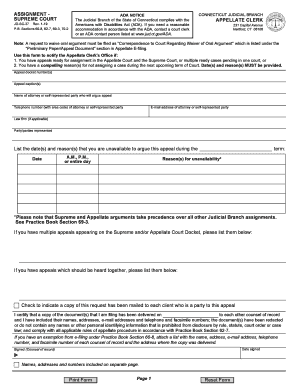
ASSIGNMENT SUPREME COURTJDSC37 Rev. 119 P.B. Sections 608, 627, 693, 702ADA NOTICE The Judicial Branch of the State of Connecticut complies with the Americans with Disabilities Act (ADA). If you need.

How it works
  • Open form

    Open form follow the instructions

  • Easily sign form

    Easily sign the form with your finger

  • Share form

    Send filled & signed form or save

How to fill out the CT JD-SC-37 online

The CT JD-SC-37 form is essential for notifying the Appellate Clerk's Office regarding appeals ready for assignment in the Appellate and Supreme Courts. This guide will assist you in effectively completing the form online, ensuring that all necessary information is accurately provided.

Follow the steps to complete the CT JD-SC-37 online.

  1. Click the ‘Get Form’ button to access the document and open it in the online editor.
  2. Begin filling out the appeal docket number(s) in the designated field. This number is crucial for identifying your case.
  3. Provide the appeal caption(s). This should include the title and details of the case.
  4. Enter the name of the attorney or the self-represented party who will be arguing the appeal.
  5. Input the telephone number, including area code, of the attorney or self-represented party.
  6. Include the email address of the attorney or self-represented party for correspondence.
  7. If applicable, list the law firm representing the party.
  8. Identify the party or parties being represented in the appeal.
  9. List the date(s) you are unavailable to argue the appeal, along with the reason(s) for your unavailability.
  10. If you have multiple appeals, list any that should be heard together in the appropriate section.
  11. Confirm that a copy of the request has been mailed to each client who is a party to the appeal by checking the provided box.
  12. Certify that a copy of the filed document(s) has been delivered to all other counsel of record and includes all necessary names, addresses, and contact details.
  13. If applicable, attach a list of counsel for any exemptions from e-filing.
  14. Date the form and include your signature as counsel of record.
  15. After reviewing the filled-out form, you can save your changes, download a copy, print it for physical filing, or share it as needed.

Complete your documents online for a smoother filing process.

Get form

Experience a faster way to fill out and sign forms on the web. Access the most extensive library of templates available.

Related content

ASSIGNMENT - SUPREME/APPELLATE COURT

JD-SC-37 Rev. 2-25. P.B. §§ 60-8, 62-7, 69-3, 70-2. If you have multiple appeals...

Learn more
sc-37-14-nanyumbu-tanzania.pdf

FOR SC 37-14. (WAC INDEX SHOWN IN BLUE). INDIAN OCEAN. SC 37.9 SC 37-10. 40°44'. SC...

Learn more
Mayo Adhesive Probability Score

Aug 21, 2014 — The Mayo Adhesive Probability Score is an image-based system to predict...

Learn more
Questions & Answers

Get answers to your most pressing questions about US Legal Forms API.

Contact support

How do I fill out an affidavit of financial information?

Filling out an affidavit of financial information requires careful attention to detail. Utilize the CT JD-SC-37 form, which is specifically designed to capture your financial status comprehensively. Be prepared to disclose your income, debts, and any monetary obligations, and always verify that your information is accurate. For those who prefer a streamlined process, the US Legal Forms platform is a valuable resource for completing this affidavit successfully.

Filling out a financial affidavit for divorce in CT involves completing the CT JD-SC-37 form accurately. Be sure to include all relevant income sources, monthly expenses, and financial obligations. It’s essential to provide a complete picture of your financial situation. You can take advantage of resources like the US Legal Forms platform to help ensure you fill out the form correctly and efficiently.

To complete a financial affidavit for divorce in Connecticut, start by gathering your financial documents, such as income statements, bank statements, and expense records. Use the CT JD-SC-37 form, as it outlines the necessary information clearly. You will need to provide details about your income, expenses, assets, and debts. If you find the process overwhelming, consider using the US Legal Forms platform for guided assistance.

An appellate judge is often referred to as a justice or judge on an appellate bench. These judges are responsible for evaluating the legality and appropriateness of lower court decisions. Knowing the roles of appellate judges can significantly impact how you prepare your case documentation and interaction, like that of the CT JD-SC-37.

An appellate court is a court that reviews the decisions made by lower courts. Its primary function is to ensure that legal standards and procedures were properly followed. You can rely on the appellate court to provide clarity in confusing cases. When preparing to engage with such courts, consider using tools like the CT JD-SC-37 for your filings.

Rule 36 of the Federal Rules of Appellate Procedure concerns the issuing of judgments without opinion. This rule permits appellate courts to dispose of cases without providing detailed explanations when no legal precedent is set. Familiarizing yourself with this rule will aid in your legal proceedings and optimize documentation efforts like the CT JD-SC-37.

Federal Rule of Appellate Procedure 37 provides guidelines for seeking rehearing in federal appellate cases. This rule outlines how parties can submit a request for the court to reconsider its judgments. If you engage with federal appellate processes, understanding Rule 37 will be vital, especially when utilizing standard forms such as the CT JD-SC-37.

Rule 37 of the NC Rules of Appellate Procedure focuses on the procedures that govern rehearing requests. This rule allows parties to seek a review of a decision made by the appellate court under specific circumstances. Knowing Rule 37 can significantly help when navigating appeals and enhance the effectiveness of your legal strategies, particularly when referencing documents like the CT JD-SC-37.

Rule 36 of the NC Rules of Civil Procedure deals with requests for admissions. This rule allows one party to request the other to admit or deny the truth of certain statements. By facilitating agreement on undisputed facts, Rule 36 helps streamline the litigation process. Understanding this process can enhance your approach to legal documents like the CT JD-SC-37.

To file an appearance in Connecticut court, you must complete the appropriate forms, including the CT JD-SC-37, and submit them to the court clerk. Make sure to follow all local rules regarding appearances to avoid any delays in your case. For guidance and easy access to forms, consider using uslegalforms to ensure that you meet all filing requirements.

Get This Form Now!

Use professional pre-built templates to fill in and sign documents online faster. Get access to thousands of forms.

If you believe that this page should be taken down, please follow our DMCA take down process here.

Get CT JD-SC-37