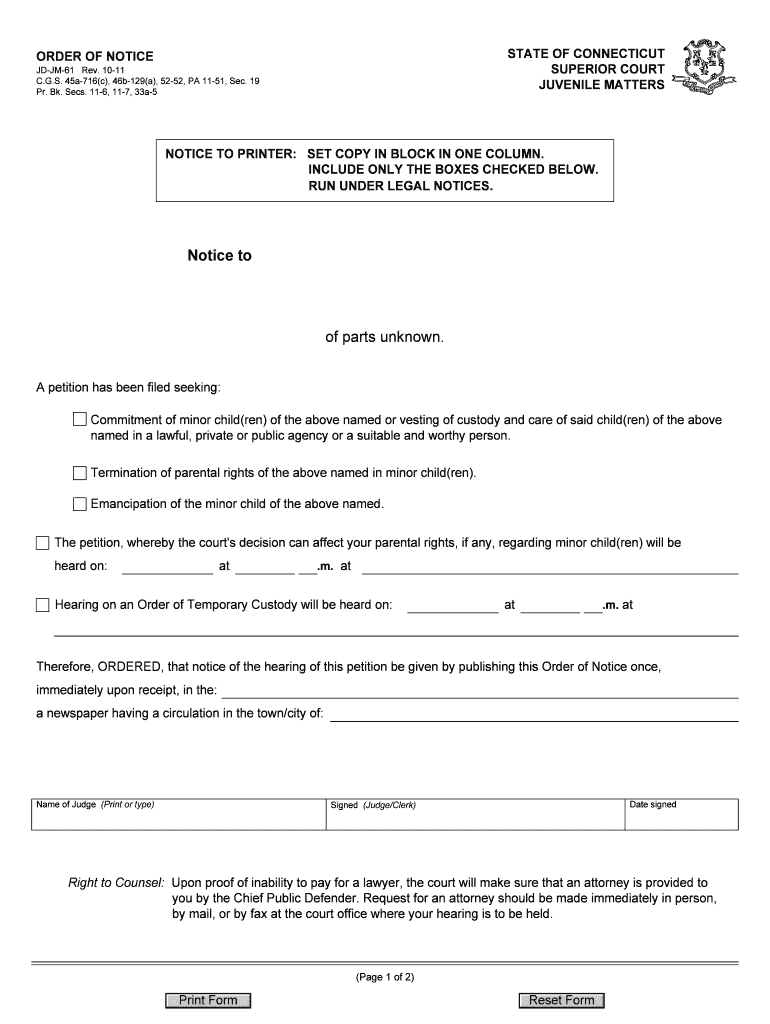
ER: SET COPY IN BLOCK IN ONE COLUMN. INCLUDE ONLY THE BOXES CHECKED BELOW. RUN UNDER LEGAL NOTICES. Notice to of parts unknown. A petition has been filed seeking: Commitment of minor child(ren) of the above named or vesting of custody and care of said child(ren) of the above named in a lawful, private or public agency or a suitable and worthy person. Termination of parental rights of the above named in minor child(ren). Emancipation of the minor child of the above named. The petition, whereby.
Loading

Open form follow the instructions

Easily sign the form with your finger

Send filled & signed form or save
How to fill out the CT JD-JM-61 online
Filling out the CT JD-JM-61 form is a crucial step in legal processes related to juvenile matters in Connecticut. This guide provides detailed, step-by-step instructions to help users complete the form accurately and effectively.
Follow the steps to fill out the CT JD-JM-61 form online
- Press the ‘Get Form’ button to access the CT JD-JM-61 form. This will open the document in the online editor for completion.
- Begin by identifying the section that notes the notice to the party involved. Ensure that you fill in the name of the individuals or parties with the appropriate details regarding their legal status.
- Next, specify the nature of the petition being filed. This can include the commitment of minor child(ren), termination of parental rights, or emancipation. Be thorough in your selection.
- Indicate the date and time of the hearing regarding the petition. This information is essential as it informs involved parties of when legal proceedings will take place.
- Fill in the details of the court's location for the hearing. Accuracy in this field is vital for proper legal notification.
- Provide the name of the judge presiding over the case. This information should be printed or typed clearly.
- Complete the section regarding the right to counsel. Include any pertinent details for individuals who may require legal representation due to financial constraints.
- Review the 'Certification' section. Make sure to fill in the necessary information related to publication, including the date of publication and the signature of the subscriber.
- Finally, save your changes, download the completed form, or print it out for your records. You can also share the form as needed for further processing.
Complete your CT JD-JM-61 form online today for a smooth legal process.
Experience a faster way to fill out and sign forms on the web. Access the most extensive library of templates available.
Related content
Right to Counsel: Upon proof of inability to pay for a lawyer, the court will make sure...
2014 · Cited by 73 — (a) Half- space slab volume-rendered CT image of a 61-year-old...
Aug 21, 2014 — From the images (CT or T1-weighted MRI), perinephric fat thickness was...
Get answers to your most pressing questions about US Legal Forms API.
How to fill out a divorce financial affidavit?
To fill out a divorce financial affidavit, start by obtaining the CT JD-JM-61 form, which is essential for detailing your financial information. Organize your financial records, including income, expenses, and debts, to ensure accuracy. Populate the affidavit with clear and precise data, covering all aspects of your financial situation. Finally, check your completed form for errors before submitting it to avoid delays in your case.
How do I fill out an affidavit of financial information?
Filling out an affidavit of financial information involves using the CT JD-JM-61 to convey your financial status. Collect necessary documents that outline your income, assets, and liabilities. Carefully enter this information into the form while ensuring all sections are complete. After you review and sign the affidavit, you can submit it to the appropriate court for your case.
How to fill out a financial affidavit for divorce in CT?
To effectively fill out a financial affidavit for divorce in CT, start by accessing the CT JD-JM-61 form. Make sure to list all your assets, liabilities, and monthly expenses clearly. It's crucial to provide honest and accurate information, as the court uses this affidavit to determine financial obligations. Once finished, remember to review the document for completeness and accuracy before filing.
How to fill out a financial affidavit for divorce in Connecticut?
Filling out a financial affidavit for divorce in Connecticut is straightforward when using the CT JD-JM-61 form. Begin by gathering your financial documents, including income statements, bank statements, and expenses. Accurately report your income, debts, and expenses on the affidavit. Once completed, ensure you sign and date the form before submitting it to the court.
How do I file an appearance in Connecticut court?
To file an appearance in Connecticut court, you will need to complete the appropriate form, often referred to as the CT JD-JM-61. You can obtain this form from the Connecticut Judicial Branch website or your local court. After completing the form, submit it to the court clerk's office where your case is being heard. This filing confirms your participation in the legal proceedings.
How to fill out a JDF 76?
To fill out a JDF 76, you must first understand the information required, which includes your financial information and marital status. Take your time to complete each section accurately and provide supporting documentation when necessary. The JDF 76 form plays a key role in divorce cases, and inaccuracies can lead to complications. Using services like US Legal Forms can provide you with the templates and support needed to ensure you're filling it out correctly.
Is Connecticut a 50/50 custody state?
Connecticut has a preference for joint legal custody so that both parents can share decision-making power regarding their shared children. In fact, even if one parent is awarded sole physical custody in Connecticut, a judge will often award joint legal custody unless there are reasons it would be unsafe for the child.
What is a motion for capias in CT?
section 45a-242.) On motion of a party or on the court's own motion, the court may issue a capias to authorize a proper officer to arrest and bring before the court an individual who has failed to comply with a subpoena.
Do warrants expire in CT?
While some court proceedings may have statutes of limitations, most warrants in Connecticut remain active indefinitely. In other words, a warrant does not expire and can remain active for many years. The court can only cancel them upon a suspect's surrender or after their arrest or the individual dies.
How do I get court documents in CT?
You may also call the Centralized Services Unit at 860-263-2750. All requests for files must include the name of the case and docket number. Docket numbers may be available on-line at .jud.ct.gov by utilizing the case look-up function. Files should be available within one or two business days.
Use professional pre-built templates to fill in and sign documents online faster. Get access to thousands of forms.
If you believe that this page should be taken down, please follow our DMCA take down process here.