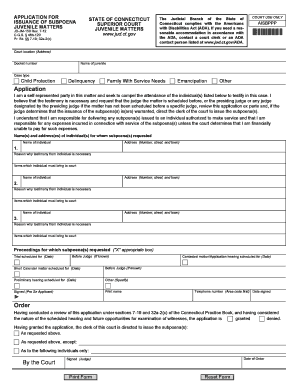
Pr. Bk. 7-19; 32a-2(c) The Judicial Branch of the State of Connecticut complies with the Americans with Disabilities Act (ADA). If you need a reasonable accommodation in accordance with the ADA, contact a court clerk or an ADA contact person listed at www.jud.ct.gov/ADA. COURT USE ONLY AISBPPP *AISBPPP* Court location (Address) Docket number Name of juvenile Case type Child Protection Delinquency Family With Service Needs Emancipation Other Application I am a self-represented.
Loading
Open form follow the instructions
Easily sign the form with your finger
Send filled & signed form or save
How to fill out the CT JD-JM-150 online
The CT JD-JM-150 form is essential for individuals seeking the issuance of a subpoena in juvenile matters in Connecticut. This guide provides clear and straightforward steps to help you fill out the form online, ensuring that you can effectively obtain the necessary testimony for your case.
Follow the steps to complete the form accurately and efficiently.
- Press the ‘Get Form’ button to access the CT JD-JM-150. This action will open the form for you to edit and complete.
- Enter the court location, docket number, and the name of the juvenile in the designated fields. Ensure that these details are accurate to assist in the processing of your application.
- Indicate the case type by checking the appropriate box. Options include child protection, delinquency, family with service needs, emancipation, or other. This classification is crucial for the nature of your application.
- List the names and addresses of the individual(s) for whom the subpoena(s) are requested. Include detailed address information, such as the number, street, and town.
- For each individual listed, provide a reason why their testimony is necessary and specify any items they must bring to court.
- Indicate the proceedings for which the subpoena(s) are requested by checking the appropriate box. Fill in relevant dates and the name of the judge if known.
- As the pro se applicant, sign and print your name in the designated space. Additionally, provide your contact telephone number and the date of signing.
- After completing the form, review all entries for accuracy. Once confirmed, you can save changes, download, print, or share the filled form as needed.
Complete your documents online today for efficient and streamlined processing.
Experience a faster way to fill out and sign forms on the web. Access the most extensive library of templates available.
Related content
JD-JM-150 Rev. 9-20. C.G.S. § 46b-120;. P.B. §§ 7-19; 32a-2(c). I am a self-represented...
by KH Kernstine · 1999 · Cited by 178 — This study compares PET, CT, and MRI-C for...
SSOA VGE = 15V, TVJ = 125°C, RG = 5Ω ICM = 120 A. (RBSOA) Clamped inductive load @ ≤...
Get answers to your most pressing questions about US Legal Forms API.
How to serve a subpoena in CT?
Serving a subpoena in Connecticut can be done by delivering it personally or using a professional service. Ensure you provide the subpoena at least 10 days before the court date to adhere to CT JD-JM-150 guidelines. If you’re feeling uncertain about the process, USLegalForms offers resources and templates to help simplify serving legal documents effectively.
How far in advance must a subpoena be served in Connecticut?
In Connecticut, a subpoena must be served to the recipient at least 10 days before the scheduled court date. This timeline helps ensure that the recipient has adequate notice to prepare. When working with legal documents like the CT JD-JM-150, proper timing is essential for a smooth legal process. USLegalForms can assist you in understanding these timelines and ensuring compliance.
What is the fine for not going to jury duty in CT?
In Connecticut, failing to appear for jury duty can result in a fine. The amount can vary depending on the situation, but typically it ranges from $50 to $500. Understanding the importance of your civic duty can help prevent such penalties, especially related to the CT JD-JM-150. To avoid issues, always respond promptly to your jury summons.
How to serve subpoena in Connecticut?
In Connecticut, serving a subpoena involves providing a complete copy to the person being summoned. You can either deliver it personally or have it served by a third party, such as a professional process server. Make sure to comply with all local regulations and timelines when handling the CT JD-JM-150. For a smooth process, using a resource like USLegalForms can guide you through the necessary steps.
How do you personally serve a subpoena?
To personally serve a subpoena, you need to deliver a copy directly to the individual named in the subpoena. You can do this in person, ensuring that they receive it and understand its importance. It is essential to follow the rules set forth in Connecticut law for serving legal documents, especially when dealing with the CT JD-JM-150. If you're uncertain about the process, consider using a service like USLegalForms to help you navigate this requirement efficiently.
Who can serve a subpoena in CT?
In Connecticut, various individuals can serve a subpoena, including law enforcement officers, attorneys, and other authorized personnel. The rules surrounding who can serve legal documents are outlined in state laws to ensure the proper execution of the process. If you need guidance on serving subpoenas effectively, CT JD-JM-150 from USLegalForms can provide valuable insights.
Are juvenile records sealed in CT?
In Connecticut, juvenile records can be sealed, meaning they will not be accessible to the public. This process helps protect the future of young individuals and allows them a fresh start after completing their rehabilitation. It's important to understand the steps involved in sealing records, as outlined in CT JD-JM-150, provided on USLegalForms.
Do colleges care about juvenile records?
Colleges often examine an applicant's overall background, which may include juvenile records. However, many institutions understand that juvenile offenses do not define a person's future potential. It’s beneficial to be proactive in addressing any concerns during the application process, which is where CT JD-JM-150 can assist you.
What is the juvenile law in Connecticut?
Juvenile law in Connecticut focuses on the rehabilitation of young offenders rather than punishment. The laws aim to address the reasons behind the behavior and provide appropriate avenues for development. CT JD-JM-150 outlines various aspects of this legal framework, guiding those involved in juvenile justice.
Are Connecticut criminal records public?
Yes, Connecticut criminal records are public. Anyone can access these records, which include arrests, charges, and convictions. However, there may be some restrictions regarding juvenile offenders. If you need assistance navigating these records, consider using the CT JD-JM-150 service available on USLegalForms.
Use professional pre-built templates to fill in and sign documents online faster. Get access to thousands of forms.
If you believe that this page should be taken down, please follow our DMCA take down process here.
This form is available in several versions. Select the version you need from the drop-down list below.