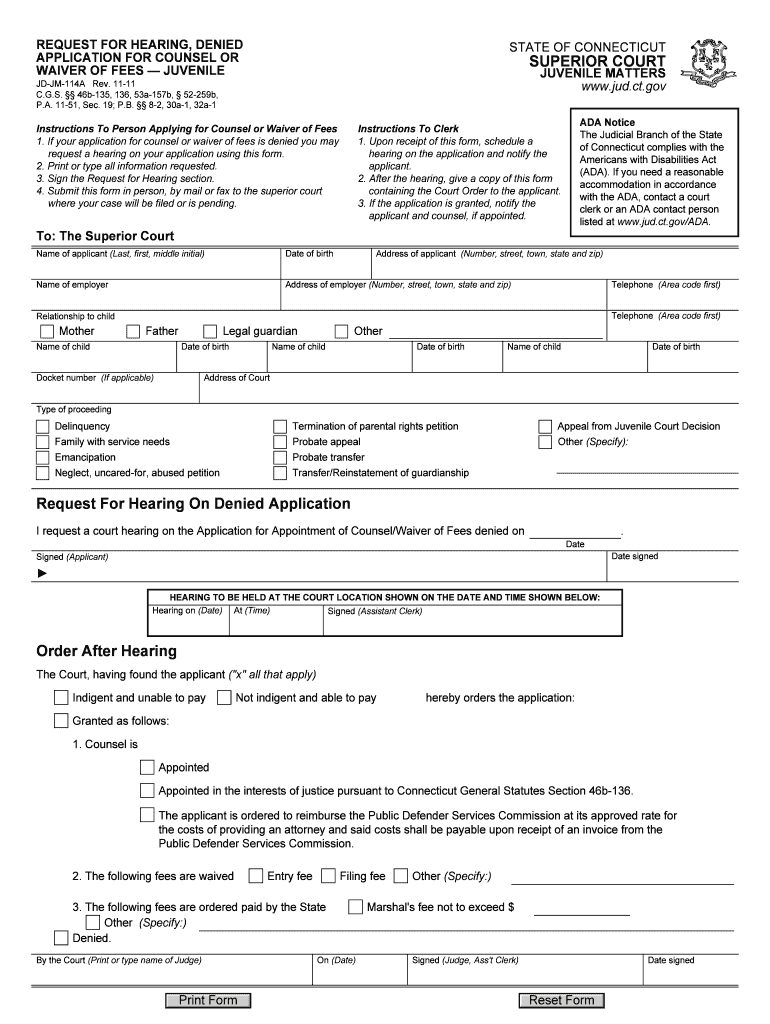
, 136, 53a-157b, 52-259b, P.A. 11-51, Sec. 19; P.B. 8-2, 30a-1, 32a-1 Instructions To Person Applying for Counsel or Waiver of Fees 1. If your application for counsel or waiver of fees is denied you may request a hearing on your application using this form. 2. Print or type all information requested. 3. Sign the Request for Hearing section. 4. Submit this form in person, by mail or fax to the superior court where your case will be filed or is pending. ADA Notice The Judicial Branch of.
Loading

Open form follow the instructions

Easily sign the form with your finger

Send filled & signed form or save
How to fill out the CT JD-JM-114A online
Filling out the CT JD-JM-114A form is a crucial step if your application for counsel or waiver of fees is denied. This guide provides clear, step-by-step instructions to help you complete the form confidently and accurately.
Follow the steps to effectively complete the CT JD-JM-114A form.
- Press the ‘Get Form’ button to acquire the document and open it for editing.
- Fill in your personal information at the top of the form. Provide your name (last, first, middle initial), date of birth, and telephone number. Ensure the information is accurate.
- Next, enter your employer's name and address. Include the number, street, town, state, and zip code.
- Complete the section regarding your relationship to the child. You can select from options such as mother, father, legal guardian, or other. Clearly indicate the name and date of birth for each child involved.
- Include the court's address and your docket number if applicable. Specify the type of legal proceeding related to your case.
- In the 'Request for Hearing on Denied Application' section, indicate the date when your application for counsel or waiver of fees was denied.
- Sign and date the application in the designated areas. Ensure your signature matches the name provided above.
- Review the completed form for accuracy and clarity. After ensuring all information is correct, you can save the changes, download, print, or share the form as necessary.
Complete your documents online today to ensure timely processing.
Experience a faster way to fill out and sign forms on the web. Access the most extensive library of templates available.
Related content
If your application for counsel or waiver of fees is denied, you can request a hearing...
by MIS Gonzaga · Cited by 46 — Abstract Plant age affects its elemental uptake and...
We are delighted to present the 2019 edition of the European Association of Urology (EAU)...
Get answers to your most pressing questions about US Legal Forms API.
How much can you sue for in small claims court in CT?
In Connecticut, the maximum amount you can sue for in small claims court is $5,000. This limit applies to most claims, making it an accessible option for individuals seeking to resolve disputes without extensive legal expenses. By using the CT JD-JM-114A form and the resources at uslegalforms, you can appropriately file your claim and potentially recover your owed amount.
What is the statute of limitations in CT for small claims court?
The statute of limitations for small claims court in Connecticut is generally six years. This applies to most types of claims, allowing you ample time to prepare your case. By completing the CT JD-JM-114A form with all necessary details, you can ensure your claim is valid. Our platform, uslegalforms, can provide valuable support in this process.
How long do you have to sue someone in CT?
The time limit to sue someone in Connecticut depends on the nature of your claim. Typically, personal injury claims must be filed within two years, while contract claims have a six-year window. To navigate the legal process effectively, consider utilizing the CT JD-JM-114A form along with uslegalforms for guidance and precise documentation.
How long do you have to file small claims in CT?
In Connecticut, you generally have six years to file a small claims case. This time frame begins from the date of the incident that caused your claim. The CT JD-JM-114A form helps streamline the filing process. By using resources like uslegalforms, you can easily access the necessary documents and ensure timely submission.
What is the Connecticut Attorney Client Security Fund?
The Connecticut Attorney Client Security Fund provides financial protection to clients who suffer losses due to the dishonest conduct of their attorneys. It aims to promote trust in the legal profession and ensure clients are compensated. For those seeking additional information on legal matters, using resources like CT JD-JM-114A on the US Legal Forms platform can be helpful.
What does the CT judicial branch do?
The Connecticut judicial branch administers justice and maintains public trust in the legal system. It handles a variety of cases, including civil, criminal, and family matters. Understanding its functions can help you navigate legal processes, especially when dealing with documents like CT JD-JM-114A found on US Legal Forms.
What is the main role of the judicial branch?
The main role of the judicial branch is to interpret and apply the law. It ensures justice by resolving disputes and protecting individual rights. In Connecticut, the judicial branch plays a crucial part in overseeing legal matters like those addressed through forms such as CT JD-JM-114A.
What is a CT tax power of attorney?
A CT tax power of attorney allows you to designate another person to handle your tax matters in Connecticut. This document provides them the authority to represent you before the Connecticut Department of Revenue Services. For your convenience, you can find form CT JD-JM-114A on the US Legal Forms platform, which simplifies the process of granting this power of attorney.
How to fill out a divorce financial affidavit?
Filling out a divorce financial affidavit involves carefully detailing your financial status. Start by including your income from all sources, alongside a clear enumeration of your monthly expenses. This document should reflect all assets and liabilities to present a genuine picture of your financial health. Tools like CT JD-JM-114A can provide structured guidance and help ease the filling process, ensuring you cover all necessary elements.
What is a CT tax power of attorney form?
A CT tax power of attorney form allows you to designate someone to act on your behalf regarding your tax matters. This empowers your chosen representative to handle matters with the Connecticut Department of Revenue Services. Additionally, it helps ensure that your tax returns and any related documents are processed smoothly. You can find the necessary templates like CT JD-JM-114A to assist in drafting this important legal document.
Use professional pre-built templates to fill in and sign documents online faster. Get access to thousands of forms.
If you believe that this page should be taken down, please follow our DMCA take down process here.