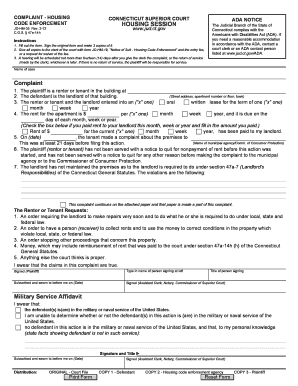
M and make 3 copies of it. 2. Give all copies to the clerk of the court with form JD-HM-19, "Notice of Suit - Housing Code Enforcement" and the entry fee, or a request for waiver of the fee. 3. A hearing will be scheduled not more than fourteen (14) days after you give the clerk the complaint, or the return of service (made by the clerk), whichever is later. If there is no return of service, the plaintiff will be responsible for service. ADA NOTICE The Judicial Branch of the State of C.
Open form follow the instructions
Easily sign the form with your finger
Send filled & signed form or save
How to fill out the CT JD-HM-35 online
The CT JD-HM-35 form is a complaint used in the Connecticut Superior Court's Housing Session for addressing issues related to housing code enforcement. This guide provides clear, step-by-step instructions on how to successfully fill out this form online, ensuring you can navigate it with ease.
Follow the steps to complete the CT JD-HM-35 form online.
- Click ‘Get Form’ button to access the online version of the CT JD-HM-35 and open it in your browser.
- Begin by filling out the 'Name of case' section. Clearly state your full name as the plaintiff and the name of the landlord as the defendant.
- In the next section, mark ‘x’ to indicate your status as a renter or tenant, including the address of the property, such as street address, apartment number, and town.
- Select the type of lease you have by marking ‘x’ next to one of the options: written lease for the term of one month, week, or year.
- Input the amount of rent for the apartment, selecting the appropriate frequency (month, week, year), and indicate the due date.
- If applicable, check the box confirming that you paid the rent for the current month, week, or year, and fill in the amount you paid.
- Enter the date when you last made a complaint about the premises and the name of the municipal agency or the Commissioner of Consumer Protection.
- Indicate that you have not received a notice to quit for nonpayment of rent or for any other reason before filing this action.
- Detail the violations of the landlord’s responsibilities regarding the maintenance of the premises, as per section 47a-7.
- In the requests section, specify what you are asking the court to order, such as repairs or reimbursement of rent.
- Sign the form by typing your name and title. Ensure your signature is clear and matches your printed name.
- Have the form subscribed and sworn to before the appropriate authority, such as an Assistant Clerk or Notary.
- Once completed, you can save the form, download it, print it, or share it according to your needs.
Complete your CT JD-HM-35 form online today and take proactive steps towards resolving your housing issues.
Experience a faster way to fill out and sign forms on the web. Access the most extensive library of templates available.
Related content
File all copies with the clerk of the court accompanied by form JD-HM-19, "Notice of Suit...
This document is the manual of operation for the CT exanl ofthe Franlingham Heart Study...
Imaging work-up should include computed tomography of the chest, abdomen and pelvis for...
Get answers to your most pressing questions about US Legal Forms API.
Where do I file a complaint against a landlord in CT?
Complaints against landlords in Connecticut can be filed at various locations, such as the local housing authority or the Connecticut Department of Consumer Protection. Using the CT JD-HM-35 form can make this process easier, ensuring that you include necessary details. Always keep records of your complaints and any responses you receive to support your case.
What are the renters rights in Connecticut?
In Connecticut, renters have several rights, including the right to a habitable living space and protection against unjust eviction. You also have the right to privacy, meaning landlords must provide notice before entering your unit. Understanding these rights helps protect you from potential violations, and using forms like the CT JD-HM-35 can assist if you need to take legal action.
How to deal with a nasty landlord?
Dealing with a difficult landlord can be challenging, but first, document every interaction and issue. Communication is key, so try discussing your concerns directly with them. If this approach fails, consider utilizing the CT JD-HM-35 form to file a formal complaint. Remember, you have rights as a renter in Connecticut, and there are resources available to help you.
Where can I file a complaint against my landlord in Connecticut?
In Connecticut, complaints against landlords can be filed with the Department of Consumer Protection or through local housing authorities. Additionally, using the CT JD-HM-35 form simplifies this process by guiding you through the required steps and documentation. Always keep a copy of your complaint for future reference and follow up as needed.
How do I file a fair housing complaint in CT?
Filing a fair housing complaint in Connecticut involves submitting it to the Connecticut Commission on Human Rights and Opportunities. You will need to outline the basis of your complaint clearly. Utilizing the CT JD-HM-35 can streamline your filing process and ensure you include all necessary information. Make sure to act quickly, as there are deadlines for submitting your complaint.
How to file legal action against a landlord?
To file legal action against a landlord in Connecticut, start by documenting your concerns with clear evidence. This includes gathering communication records, lease agreements, and photographs of any issues. Next, consider using the CT JD-HM-35 form to ensure you are following the correct procedures. Consulting with a legal expert can also provide valuable guidance through this process.
How do I file a complaint against a landlord in CT?
To file a complaint against a landlord in Connecticut, you can submit a complaint form to the appropriate local housing authority or commission. Include specific details about the issue at hand, supported by any documentation, such as the lease agreement or correspondence with the landlord. Utilizing the CT JD-HM-35 can provide essential guidance throughout this process. It’s critical to take timely action to protect your rights as a tenant.
What is the most common fair housing complaint?
One of the most common fair housing complaints in Connecticut involves discrimination based on disability. Landlords may fail to provide reasonable accommodations, such as allowing service animals or making necessary modifications to premises. Stay informed about your rights under the CT JD-HM-35, as it can help you advocate for fair treatment in housing situations. Being aware of these issues can empower you to take action if you face discrimination.
Which of the following is considered illegal under the Fair Housing Act?
The Fair Housing Act identifies several illegal practices, including refusing to rent to someone based on race or not making accommodations for individuals with disabilities. Additionally, any form of steering, which is directing individuals to or away from certain neighborhoods based on discriminatory criteria, is prohibited. Understanding these illegal actions is crucial, and using resources like CT JD-HM-35 can help navigate housing rights effectively.
How long does a landlord have to fix something in Connecticut?
In Connecticut, landlords are required to make necessary repairs within a reasonable time after being notified. While there is no strict timeline defined, typically a reasonable period might be anywhere from a few days to a couple of weeks, depending on the issue's severity. It is essential for tenants to document their communications with landlords regarding repairs. To ensure compliance, you can refer to the CT JD-HM-35 guidelines for clarity.
Use professional pre-built templates to fill in and sign documents online faster. Get access to thousands of forms.
If you believe that this page should be taken down, please follow our DMCA take down process here.