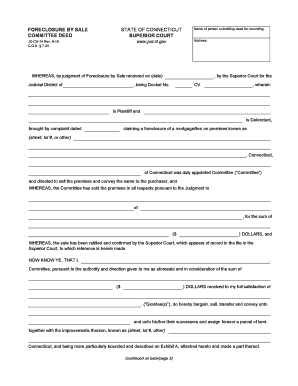
Dgment of Foreclosure by Sale rendered on (date) , by the Superior Court for the , being Docket No. Judicial District of CV , wherein is Plaintiff and is Defendant, claiming a foreclosure of a mortgage/lien on premises known as brought by complaint dated (street, lot #, or other) , Connecticut, of Connecticut was duly appointed Committee ("Committee") and directed to sell the premises and convey the same to the purchaser, and WHEREAS, the Committee has sold the premises in all respects.

How it works
  • Open form

    Open form follow the instructions

  • Easily sign form

    Easily sign the form with your finger

  • Share form

    Send filled & signed form or save

How to fill out the CT JD-CV-74 online

The CT JD-CV-74 is a committee deed used in Connecticut for properties sold under foreclosure by sale. This guide provides step-by-step instructions for filling out the form online, ensuring that you complete it accurately and efficiently.

Follow the steps to complete the CT JD-CV-74 online

  1. Click the ‘Get Form’ button to obtain the CT JD-CV-74 and open it in the online editor.
  2. Begin by entering the name of the person submitting the deed for recording in the designated field.
  3. In the section labeled 'WHEREAS', input the date of the judgment of foreclosure by sale. Also, specify the judicial district and docket number associated with the case.
  4. Provide the names of the plaintiff and defendant, indicating the parties involved in the foreclosure.
  5. Describe the premises being sold, including the street address, lot number, or other identifiers pertinent to the property.
  6. Indicate the name of the purchaser and the total sale amount in the respective fields. Be sure to write out the sum in both numeric and written form.
  7. Under the clause starting with 'AND WHEREAS', confirm that the sale has been ratified and approved by the Superior Court, referencing the court records.
  8. Continue by printing the names of the Committee and the Grantee(s) in the appropriate fields, followed by their signatures where indicated.
  9. Fill in the date of signing and provide the name of the Committee in the 'Committee' section.
  10. In the notary section, fill out the date of acknowledgment and the name of the Commissioner of the Superior Court, Court Clerk, or Notary as applicable.
  11. Finally, review all information for accuracy, save your changes, and choose to download, print, or share the completed form.

Complete your CT JD-CV-74 online today and ensure your document is properly filed.

Get form

Experience a faster way to fill out and sign forms on the web. Access the most extensive library of templates available.

Related content

Foreclosure - Uniform Orders, Procedures and Forms

Application and Execution for Ejectment, Mortgage Foreclosure, Rev. 1/16, JD-CV-30 (PDF) ;...

Learn more
Douglas NeJaime

Feb 26, 2025 — Douglas NeJaime. Anne Urowsky Professor of Law. Yale Law School. 127 Wall...

Learn more
O Novo Padrão

Design Circumaural Supra-auricular de Costas. Fechadas • Curva de EQ para Música e...

Learn more
Questions & Answers

Get answers to your most pressing questions about US Legal Forms API.

Contact support

What is a strict foreclosure in Connecticut?

In Connecticut, a strict foreclosure allows the lender to take possession of the property without offering a redemption period if the borrower defaults. This process entitles the lender to receive the property directly after the court's confirmation of the default. Homeowners should review all foreclosure options carefully, including the legalities represented in CT JD-CV-74.

The primary drawback of strict foreclosure is the potential for the homeowner to lose their property without a redemption period. Unlike other foreclosure types, strict foreclosure does not allow the owner to reclaim the property after a sale. This can lead to a rapid loss of homeownership. Thus, understanding the implications involves consulting resources like CT JD-CV-74.

To pursue a strict foreclosure in Connecticut, the lender must file a lawsuit and obtain a court judgment that identifies the mortgage default. The property owner then receives a notice of default. It's important to note that strict foreclosure is only viable if the homeowner has no equity in the property. Familiarizing yourself with CT JD-CV-74 can provide valuable insights.

The foreclosure process in Connecticut typically takes several months to over a year. Factors affecting this timeline include the type of foreclosure and the specific circumstances surrounding the case. Delays may occur due to court schedules and negotiations with lenders. Understanding the process is essential, especially when dealing with forms like CT JD-CV-74.

Foreclosure auctions can offer properties below market value, but they also come with risks. Buyers often cannot inspect the property beforehand, and there may be existing debts or liens attached to the home. While you can find great deals at these auctions, conducting thorough research is essential. The CT JD-CV-74 can be a useful resource for understanding these risks.

In Connecticut, foreclosure auctions occur after the lender has initiated the foreclosure process and the property has been seized. These auctions are usually public, allowing interested buyers to bid on the property. The highest bidder becomes the new owner, but it's important to understand the property's condition and any liens against it prior to bidding. Familiarizing yourself with the CT JD-CV-74 can help clarify this complex process.

The 120-day rule in Connecticut mandates that lenders must wait at least 120 days after your first missed payment before initiating foreclosure proceedings. This waiting period provides you time to work things out, such as securing a repayment plan. Knowing this rule can empower you to take action before foreclosure becomes imminent. You can find more insights with CT JD-CV-74.

Most homeowners in Connecticut can miss about 3 payments before facing foreclosure threats. However, this is not a hard and fast rule, as individual lenders may have different protocols. Staying engaged with your lender can help you navigate this sensitive period. For legal guidance, resources like CT JD-CV-74 are very helpful.

In Connecticut, missing 3 to 4 consecutive mortgage payments often leads lenders to start the foreclosure process. However, the specific threshold may vary by lender. Taking proactive measures and seeking assistance is essential. Consult CT JD-CV-74 for the legal specifics that can aid your situation.

In Connecticut, you generally have six years to file a small claims case for most disputes. This time frame can be critical, especially if you are seeking compensation or resolution. To avoid any unnecessary delays in your case, it’s wise to act as soon as possible. Referencing CT JD-CV-74 may provide further clarity on the process.

Get This Form Now!

Use professional pre-built templates to fill in and sign documents online faster. Get access to thousands of forms.

If you believe that this page should be taken down, please follow our DMCA take down process here.

CT JD-CV-74 Form

This form is available in several versions. Select the version you need from the drop-down list below.

Get CT JD-CV-74