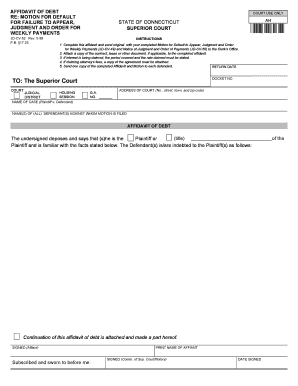
Ffidavit and send original with your completed Motion for Default to Appear, Judgment and Order for Weekly Payments (JD-CV-49) and Notice of Judgment and Order of Payments (JD-CV-50) to the Clerk's Office. 2. Attach a copy of the contract, lease or other document, if applicable, to the completed affidavit. 3. If interest is being claimed, the period covered and the rate claimed must be stated. 4. If claiming attorney's fees, a copy of the agreement must be attached. 5. Send one copy of the compl.

How it works
  • Open form

    Open form follow the instructions

  • Easily sign form

    Easily sign the form with your finger

  • Share form

    Send filled & signed form or save

How to fill out the CT JD-CV-52 online

Filling out the CT JD-CV-52 form can be a straightforward process when done correctly. This guide provides a step-by-step approach to assist you in completing the affidavit of debt efficiently and accurately.

Follow the steps to complete the affidavit of debt form.

  1. Click ‘Get Form’ button to access the form and open it in the editing interface.
  2. Begin by entering the court's information in the designated spaces. Provide the name and address of the Superior Court in Connecticut where your case will be filed.
  3. Fill in the name of the case format. This should include the names of the plaintiff and defendant (e.g., Plaintiff v. Defendant).
  4. In the section below the name of the case, indicate the return date and docket number as required. These details are crucial for the court's record keeping.
  5. Proceed to the affidavit section. State that you, the affiant, are either the plaintiff or a representative, and confirm that you are familiar with the facts outlined in the affidavit.
  6. Clearly outline the amount of debt owed by the defendant(s) in concise terms. If applicable, include the period covered and the interest rate if you are claiming interest.
  7. If you are claiming attorney's fees, make sure to attach a copy of the relevant agreement and state this in the affidavit.
  8. Once all information is filled in correctly and thoroughly, review the form for accuracy.
  9. After finalizing your form, save your changes, download a copy for your records, and choose to print it or share it as needed.

Complete your documents online for a smoother filing experience.

Get form

Experience a faster way to fill out and sign forms on the web. Access the most extensive library of templates available.

Related content

AFFIDAVIT OF DEBT RE - Connecticut Judicial Branch...

This affidavit of debt is filed with a motion for default, stating the defendant's debt to...

Learn more
CERTIFICATE OF JUDGMENT FORECLOSURE BY SALE ...

This is to certify that at a session of the Superior Court, within and for said Judicial...

Learn more
O Novo Padrão

Design Circumaural Supra-auricular de Costas. Fechadas • Curva de EQ para Música e...

Learn more
Questions & Answers

Get answers to your most pressing questions about US Legal Forms API.

Contact support

Is a decree of divorce the final divorce?

Yes, a decree of divorce is the final legal document that officially ends the marriage. It includes terms regarding property division, alimony, and custody, among other aspects. Hence, receiving your decree, often facilitated by tools like the CT JD-CV-52 form, marks the conclusion of your divorce proceedings and establishes the terms for your future.

A motion for order of compliance in Connecticut is a request submitted to the court to enforce compliance with a previous court order. This may involve issues stemming from divorce agreements or custody arrangements. Understanding this motion can be crucial for ensuring adherence to the CT JD-CV-52 directives, and you can seek help through professional legal services if needed.

To obtain a copy of a divorce decree in Connecticut, you can request it from the Clerk’s Office where the divorce was finalized. You will likely need to fill out the CT JD-CV-52 form. If you prefer convenience, consider using online resources that streamline this process and provide clear directions tailored to your needs.

You can get divorce papers without appearing in court by using online services that offer document preparation. Many platforms, including US Legal Forms, provide the necessary forms like the CT JD-CV-52 template to guide you through the process. This approach saves time and simplifies the legal documentation needed for filing.

To obtain a copy of your divorce decree online in the US, visit your state's court website. Most states have a portal where you can request documents using the CT JD-CV-52 form. Additionally, you may need to provide details like your case number or personal information to process your request efficiently.

To file a small claims lawsuit in Connecticut, you start by completing the CT JD-CV-52 form, which is essential for initiating your case. You then submit the form to the appropriate court, paying any required filing fees. Be sure to include all relevant evidence and documentation to support your claim. This process allows you to address disputes efficiently, ensuring your voice is heard in a timely manner.

It is generally a good practice to inform the other party before taking them to small claims court. This can foster communication and possibly lead to a resolution without needing legal action. However, if communication fails, you can proceed using the CT JD-CV-52 form to file your claim. Keeping the process transparent can sometimes encourage a settlement.

In Connecticut, the time limit to file a lawsuit varies based on the type of claim. For most personal injury cases, you generally have two years from the date of the incident to file your lawsuit. With the CT JD-CV-52 form, you can simplify the filing process and adhere to the required deadlines. Ensure you gather all necessary documentation to strengthen your case.

When filing a small claims case in Connecticut, you generally have a two-year period to initiate the process for many types of claims. This timeframe begins from when the incident occurred or when the debt was due. Using the CT JD-CV-52 form can help you effectively file your small claims case promptly. To ensure your claims meet all legal requirements, consider resources like USLegalForms for guidance.

In Connecticut, the statute of limitations determines how long you have to sue someone, which varies based on the type of claim. Generally, for contract disputes, the limit is six years, while for personal injury claims, it is typically two years. Understanding these timeframes is essential, and using the CT JD-CV-52 can help you file your claim within the correct timeframe. Always consult an attorney if you are unsure about your specific case.

Get This Form Now!

Use professional pre-built templates to fill in and sign documents online faster. Get access to thousands of forms.

If you believe that this page should be taken down, please follow our DMCA take down process here.

Get CT JD-CV-52