Hone number Mailing address (Number, street, town, state and zip code) Order Motion For Continuance is: Granted Matter Continued To: Date Signed (Judge) Denied *If necessary, attach additional sheet or sheets with name and address which the copy was mailed or delivered to. Print Form Reset Form.
Loading
Open form follow the instructions
Easily sign the form with your finger
Send filled & signed form or save
How to fill out the CT JD-CV-21 online
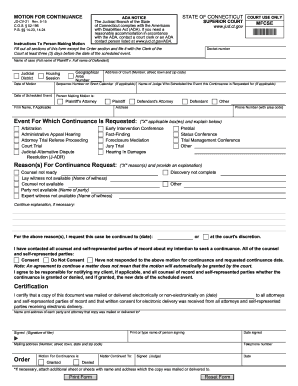
Filling out the CT JD-CV-21 form, also known as the motion for continuance, is a crucial step in seeking a postponement of a scheduled court event. This guide provides clear, step-by-step instructions to help users complete the form accurately and efficiently.
Follow the steps to complete your CT JD-CV-21 form.
- Click ‘Get Form’ button to obtain the form and open it in your browser.
- Begin by entering the docket number in the designated field. This number is unique to your case and is essential for identifying it in court records.
- In the 'Name of case' section, provide the full names of the plaintiff and defendant, formatted as 'Full name of Plaintiff v. Full name of Defendant.' This ensures clarity regarding the parties involved.
- Fill in the 'Judicial District' and 'Geographical Area Number' where your case is being heard. This information directs your motion to the correct court.
- Include the 'Address of Court' by entering the street address, town, and zip code of the court handling your case.
- Provide the 'Date of Motion' to indicate when you are filing this request, and enter the 'Date of Scheduled Event' that you wish to postpone.
- In the 'Event For Which Continuance Is Requested' section, check the applicable box(es) and provide any necessary explanations regarding the event you are seeking to continue.
- State your 'Reason(s) For Continuance Request' by selecting an option and offering a brief explanation, should it be required.
- Indicate the desired new date for the case to be continued to or note 'at the court's discretion' if you are flexible with the date.
- Confirm that you have contacted all parties involved by checking the appropriate box regarding their consent or responses.
- Complete the certification section to confirm you have shared the document with relevant parties, including their names and addresses.
- Finally, sign and date the form in the designated signature area, ensuring that your contact information is also filled out.
- Once all sections are completed, review the form for accuracy. You can then save changes, download, print, or share the document as needed.
Complete your CT JD-CV-21 form online today to ensure your motion for continuance is submitted accurately.
Experience a faster way to fill out and sign forms on the web. Access the most extensive library of templates available.
Related content
JD-CV-21 Rev. 5-15. C.G.S. § 52-196. P.B. §§ 14-23, 14-24. STATE OF CONNECTICUT ... If...
Thus, in Planned Parenthood, the court held the plaintiff could challenge certain federal...
The U.S. Environmental Protection Agency through its Office of Research and Development...
Get answers to your most pressing questions about US Legal Forms API.
Do I need to wear a suit to small claims court?
In small claims court in Connecticut, formal attire is not mandatory, but dressing appropriately is encouraged. Wearing neat and professional clothing can convey respect for the court. While a suit is not required, remember that your demeanor and presentation are important when addressing the judge.
What number do I call to see if I have jury duty in CT?
To check your jury duty status in Connecticut, you can call the Jury Administration at their designated telephone number. This can help you confirm whether you are required to attend jury duty and provide you with any necessary details. Staying informed about your jury obligations ensures you respect the legal procedures as outlined in CT JD-CV-21.
How to serve a small claims writ and notice of suit in CT?
To serve a small claims writ and notice of suit in Connecticut, you must deliver these documents to the defendant. This can be done via a state marshal or another authorized person. Make sure you follow the guidelines set in CT JD-CV-21 to ensure proper service, as this step is essential for the court’s jurisdiction over the defendant.
What is the statute of limitations in CT for small claims court?
The statute of limitations for filing a small claims case in Connecticut varies depending on the type of claim. Generally, you have up to six years to file a breach of contract claim and two years for personal injury cases. It is vital to act promptly and reference CT JD-CV-21 when preparing to file your claim to ensure compliance with all legal requirements.
How do I file a small claims suit in Connecticut?
To file a small claims suit in Connecticut, you will need to complete the necessary forms, including the CT JD-CV-21. You can find these forms at your local courthouse or online through the official Connecticut Judicial Branch website. Ensure that you provide all required information and documentation to support your claim before submitting it to initiate the process.
What are the grounds for a motion to dismiss in CT?
In Connecticut, a motion to dismiss can be filed for several reasons. Common grounds include lack of subject matter jurisdiction, failure to state a claim upon which relief can be granted, and other procedural issues. It is crucial to ensure that your motion adheres to the rules outlined in CT JD-CV-21 to avoid delays in the court process.
How many continuances are allowed in a criminal court case?
While there is no explicit limit on the number of continuances allowed in a criminal court case, the judge's discretion plays a key role. Courts typically restrict excessive delays to maintain the integrity of the legal process. When considering a continuance, familiarize yourself with the CT JD-CV-21 requirements for a smoother process.
How many times can a defendant ask for a continuance?
A defendant can request a continuance multiple times, but each request must be justified and presented to the court. Courts usually evaluate the reasons behind each request and their impact on the case timeline. When pursuing a continuance, it may be helpful to utilize the CT JD-CV-21 for guidance.
When to file certificate of closed pleadings CT?
In Connecticut, a certificate of closed pleadings should be filed after all parties have had the opportunity to present their pleadings and motions have concluded. This document is vital for moving forward in the litigation process, particularly with the CT JD-CV-21 form. Timely filing ensures that your case proceeds without unnecessary delays.
Why would a judge deny a continuance?
A judge may deny a continuance if they believe that the request is unreasonable or if it may cause undue delay in the judicial process. Factors such as previous continuances, the nature of the case, and the impact on justice are considered. Understanding the CT JD-CV-21 can help you make a stronger case for your request.
Use professional pre-built templates to fill in and sign documents online faster. Get access to thousands of forms.
If you believe that this page should be taken down, please follow our DMCA take down process here.