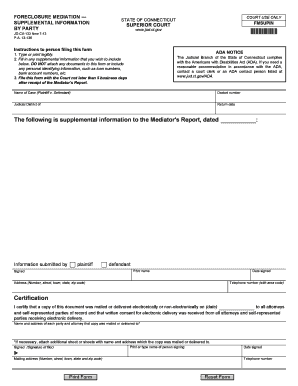
Rson filing this form ADA NOTICE 1. Type or print legibly. 2. Fill in any supplemental information that you wish to include below. DO NOT attach any documents to this form or include any personal identifying information, such as loan numbers, bank account numbers, etc. 3. File this form with the Court not later than 5 business days after receipt of the Mediator's Report. The Judicial Branch of the State of Connecticut complies with the Americans with Disabilities Act (ADA). If you need a reas.
Loading
Open form follow the instructions
Easily sign the form with your finger
Send filled & signed form or save
How to fill out the CT JD-CV-133 online
The CT JD-CV-133 form is essential for individuals involved in foreclosure mediation in Connecticut. This guide provides a step-by-step approach to help users complete the form accurately and efficiently online, ensuring all necessary information is included without any personal identifying information.
Follow the steps to fill out the CT JD-CV-133 online.
- Click ‘Get Form’ button to obtain the form and open it in the editor.
- Begin by entering the name of the case at the top of the form, specifying the Plaintiff versus Defendant.
- Next, include the docket number associated with your case.
- Fill in the Judicial District where your case is being filed.
- Provide the return date as specified in your mediation instructions.
- In the section for supplemental information, indicate who is submitting the information by selecting either 'plaintiff' or 'defendant' and print your name.
- Sign the form in the designated area and include the date you signed it.
- Complete your address, including street, town, state, and zip code.
- Enter your telephone number with the area code.
- In the certification section, ensure to certify that the document was mailed or delivered to the necessary parties and record the date.
- List the name and address of each party and attorney that the document was delivered to, making use of additional sheets if necessary.
- Print or type your name as the person signing the document and sign it.
- Finally, review all entries to ensure accuracy, then save your changes, and proceed with any preferred options to download, print, or share the form.
Complete your CT JD-CV-133 online today for a streamlined submission process.
Experience a faster way to fill out and sign forms on the web. Access the most extensive library of templates available.
Related content
JD-CV-133 Rev. 9-19. C.G.S. § 49-31n. Instructions. 1. Type or print legibly. 2. Fill in...
2008 – Present Shauna C. Larson University Professorship and Professor of Education and...
Design Circumaural Supra-auricular de Costas. Fechadas • Curva de EQ para Música e...
Get answers to your most pressing questions about US Legal Forms API.
What does it mean when pleadings are closed?
When pleadings are closed, it means that all parties have submitted their claims and defenses, and no additional documents can be added at that stage. This closure allows the court to focus on the arguments presented and prepare for a decision. Closing pleadings is a critical milestone in litigation, as it sets the stage for the next steps in the process. You can rely on US Legal Forms to help you navigate the requirements for closing pleadings, including the CT JD-CV-133.
What does a certificate of closed pleadings mean?
A certificate of closed pleadings, such as form CT JD-CV-133, indicates that all parties in a case have completed their submissions and await a decision from the court. This document effectively marks the official closing of arguments in your legal matter. Submitting this certificate is a vital step in moving your case forward into the next phase. If you need assistance with this process, US Legal Forms has the necessary tools and templates at your disposal.
What is Section 10 35 of the CT practice book?
Section 10 35 of the CT practice book addresses the timeline and procedures for filing a certificate of closed pleadings in Connecticut. Essentially, it helps ensure that all parties involved are clear on when they must finalize their pleadings. Understanding this section is important for maintaining compliance in your legal matters. You can find resources related to Section 10 35 and the CT JD-CV-133 on US Legal Forms.
When to file certificate of closed pleadings CT?
You should file the certificate of closed pleadings CT JD-CV-133 once all parties have submitted their final documents and closed their arguments in the case. This filing confirms that no further pleadings will be added to the record. Timely submission is crucial to avoid delays in your legal process. By using US Legal Forms, you can easily access the CT JD-CV-133 to ensure you meet the necessary deadlines.
What are the 6 phases of foreclosure?
The six phases of foreclosure typically include: default, pre-foreclosure, foreclosure filing, foreclosure sale, eviction, and post-foreclosure. Each phase serves distinct procedures, starting from the borrower missing a payment to eventual eviction if the property is not redeemed. Familiarizing yourself with these phases can help you stay informed and better prepared, especially when referencing CT JD-CV-133.
How long does foreclosure take in WV?
In West Virginia, the foreclosure process can vary significantly in duration, often taking anywhere from 6 months to over a year. Factors such as court schedules and the type of foreclosure impact this timeline. Understanding the process through resources like CT JD-CV-133 can help you navigate your options and timelines more effectively.
What is the 120 day rule for foreclosure?
The 120-day rule for foreclosure refers to the timeframe in which a lender must file a foreclosure action after a borrower defaults. According to the CT JD-CV-133 guidelines, lenders must notify borrowers of their default status and allow them 120 days to resolve the situation before initiating foreclosure proceedings. This rule aims to give homeowners a chance to catch up on missed payments or explore alternatives, thus promoting better outcomes for both parties.
Who pays lawyer fees in small claims court?
In small claims court, individuals usually represent themselves without lawyers, thus avoiding legal fees. However, if one party is represented and the other is not, the represented party may incur costs for their lawyer. The CT JD-CV-133 form assists in expediting the process to minimize disputes over fees. Ultimately, it’s important for both parties to understand their responsibilities before entering court.
What is the maximum I can claim in the small claims court?
In Connecticut, small claims courts typically allow claims up to $5,000. If your claim involves a matter like property damage or unpaid bills, using the CT JD-CV-133 form to file your case can streamline the process. This limit indicates that small claims court serves as an accessible way for individuals to resolve disputes quickly. Always ensure your claim falls within this threshold before filing.
How long do you have to take someone to Small Claims Court in CT?
For example, the Connecticut statute of limitations is three years for oral contracts, six years for written contracts, and two years for personal injury and personal property damage cases. If you don't file within the proper period, you lose your right to sue.
Use professional pre-built templates to fill in and sign documents online faster. Get access to thousands of forms.
If you believe that this page should be taken down, please follow our DMCA take down process here.