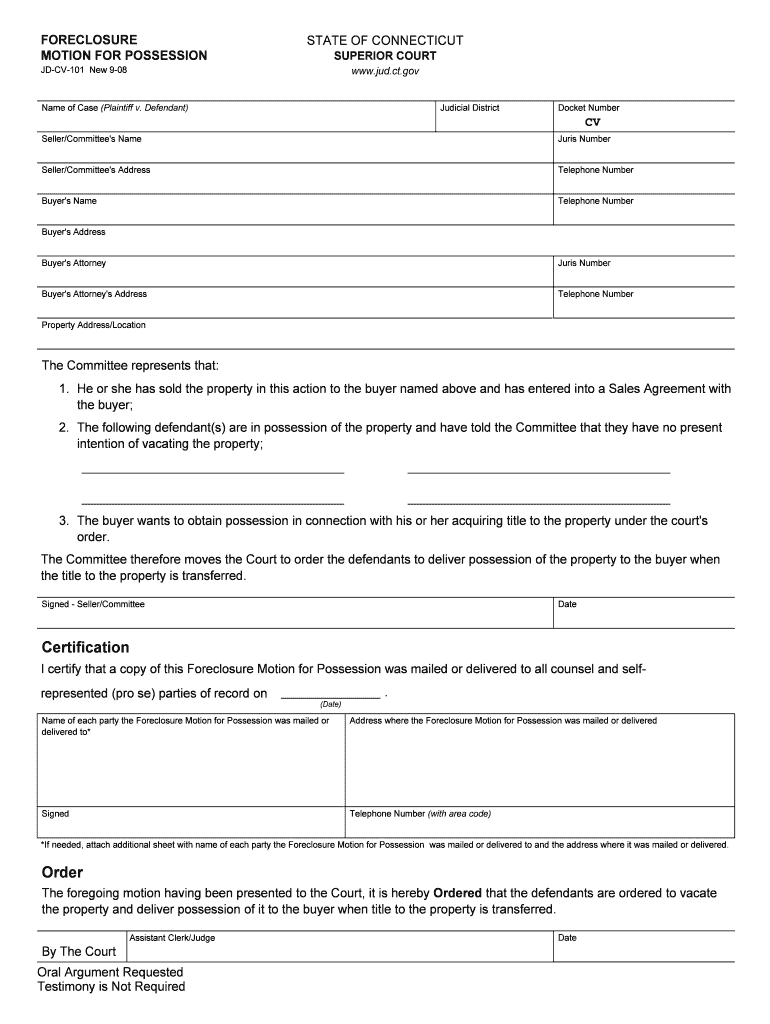
Ttee's Name Juris Number Seller/Committee's Address Telephone Number Buyer's Name Telephone Number Buyer's Address Buyer's Attorney Juris Number Buyer's Attorney's Address Telephone Number Property Address/Location The Committee represents that: 1. He or she has sold the property in this action to the buyer named above and has entered into a Sales Agreement with the buyer; 2. The following defendant(s) are in possession of the property and have told the Committee that they have no pre.
Loading

Open form follow the instructions

Easily sign the form with your finger

Send filled & signed form or save
How to fill out the CT JD-CV-101 online
This guide provides a step-by-step approach to filling out the CT JD-CV-101, a crucial document in Connecticut's foreclosure process. Whether you are a legal professional or a first-time user, this guide will help you navigate the form with ease.
Follow the steps to accurately complete the CT JD-CV-101 form.
- Click ‘Get Form’ button to obtain the form and access it in the online editor.
- In the first section, enter the name of the case, including both the Plaintiff and Defendant, as well as the Judicial District and Docket Number. This information is essential for proper identification in court records.
- Fill in the Seller/Committee's Name, Juris Number, and Address with the relevant contact details, including a telephone number. This section establishes the identity of the party acting on behalf of the seller.
- Input the Buyer's Name, Telephone Number, and Address. If a buyer's attorney is involved, provide their name, Juris Number, Address, and Telephone Number as well.
- Specify the Property Address or Location that is the subject of the motion. Accurate details are necessary for transparency and court records.
- In the representation section, check the boxes affirming that the property has been sold to the buyer and that the defendant(s) are currently in possession, indicating intent to vacate.
- Have the Seller/Committee sign and date the form to certify the accuracy of the information provided.
- Complete the Certification section, ensuring to include the date when the Foreclosure Motion for Possession was mailed or delivered to all counsel and self-represented parties. Include names and addresses as needed, attaching additional sheets if necessary.
- After reviewing all fields for accuracy, save changes and options to download, print, or share the completed form as needed.
Complete your documents online with confidence and ensure legal compliance.
Experience a faster way to fill out and sign forms on the web. Access the most extensive library of templates available.
Related content
JD-CV-101 Rev. 12-22. Signed - Seller/Committee. The committee represents that: Oral...
by EG Martinazzo · 2016 · Cited by 5 — Este trabalho teve como objetivo verificar o...
Design Circumaural Supra-auricular de Costas. Fechadas • Curva de EQ para Música e...
Get answers to your most pressing questions about US Legal Forms API.
How do you record adverse possession?
Recording adverse possession in Connecticut involves preparing a petition that details your claim of ownership, supported by evidence of your possession. This petition must then be filed with the local land records office, where it becomes a part of the public record. The CT JD-CV-101 offers essential guidance and necessary forms to help you effectively record your claim.
When to file certificate of closed pleadings CT?
You should file a certificate of closed pleadings in Connecticut once all parties have submitted their pleadings and you are ready to move forward in the court process. This certificate acts as a formal declaration, indicating that there are no outstanding issues to resolve at that stage. For the correct procedures, refer to CT JD-CV-101 to ensure compliance with local laws.
How do I claim adverse possession in CT?
To claim adverse possession in Connecticut, you need to demonstrate that you have possessed the property for a minimum of 15 years in a manner that is open, notorious, and without the consent of the owner. You must gather adequate evidence, such as witness statements or documentation, to support your claim. CT JD-CV-101 provides specific instructions and forms that make this process more straightforward.
How many missed payments before foreclosure in CT?
In Connecticut, a lender typically initiates foreclosure proceedings after a borrower has missed three consecutive mortgage payments. This can vary based on the lender, but consistent communication with your lender may prevent foreclosure. If facing potential foreclosure, referring to the CT JD-CV-101 is beneficial for understanding your rights and obligations.
How to file adverse possession in CT?
To file for adverse possession in Connecticut, you must first establish ownership through continuous and visible possession for 15 years. Then, you need to prepare the necessary legal documentation, including evidence of possession, and file this information in the local court. Utilizing resources like CT JD-CV-101 can provide the templates and forms needed for this process.
How long is adverse possession in CT?
In Connecticut, the period for claiming adverse possession is 15 years. This means that you must continuously and openly possess the property without the permission of the true owner for a complete 15-year period. If you meet these requirements, you may be able to claim the property. It's advisable to consult legal resources like CT JD-CV-101 for guidance.
How long do you have to move out after foreclosure in CT?
After a foreclosure in Connecticut, the homeowner generally has a period of 30 days to vacate the property following the sale. This timeframe allows individuals to make necessary arrangements for relocation. However, this can vary based on specific circumstances, so it is wise to be aware of your obligations. For comprehensive details related to this process, consult CT JD-CV-101.
How do foreclosures work in Connecticut?
Foreclosures in Connecticut operate through a judicial process, meaning they require court involvement. Initially, the lender must file a complaint in court, and a trial may follow if the borrower contests the foreclosure. If the court rules in favor of the lender, a sale can be scheduled. For an in-depth understanding of this process, including necessary forms like CT JD-CV-101, visit our platform for resources.
Is there a foreclosure redemption period in Connecticut?
Yes, Connecticut law provides a redemption period for homeowners facing foreclosure. This period typically allows the homeowner to reclaim their property after a sale, lasting up to 6 months under certain circumstances. Knowledge of this period can significantly benefit those affected by foreclosure, giving them a chance to negotiate or recover. Be sure to check the details on CT JD-CV-101 for comprehensive guidelines.
How to serve a small claims writ and notice of suit in CT?
Serving a small claims writ and notice of suit in Connecticut requires a specific process to ensure legality. Typically, you will need to have the documents served by a marshal or a person who is not involved in the case. Proper service is critical as it provides the defendant with the opportunity to respond to the claim. For more detailed instructions and templates, you may refer to CT JD-CV-101.
Use professional pre-built templates to fill in and sign documents online faster. Get access to thousands of forms.
If you believe that this page should be taken down, please follow our DMCA take down process here.