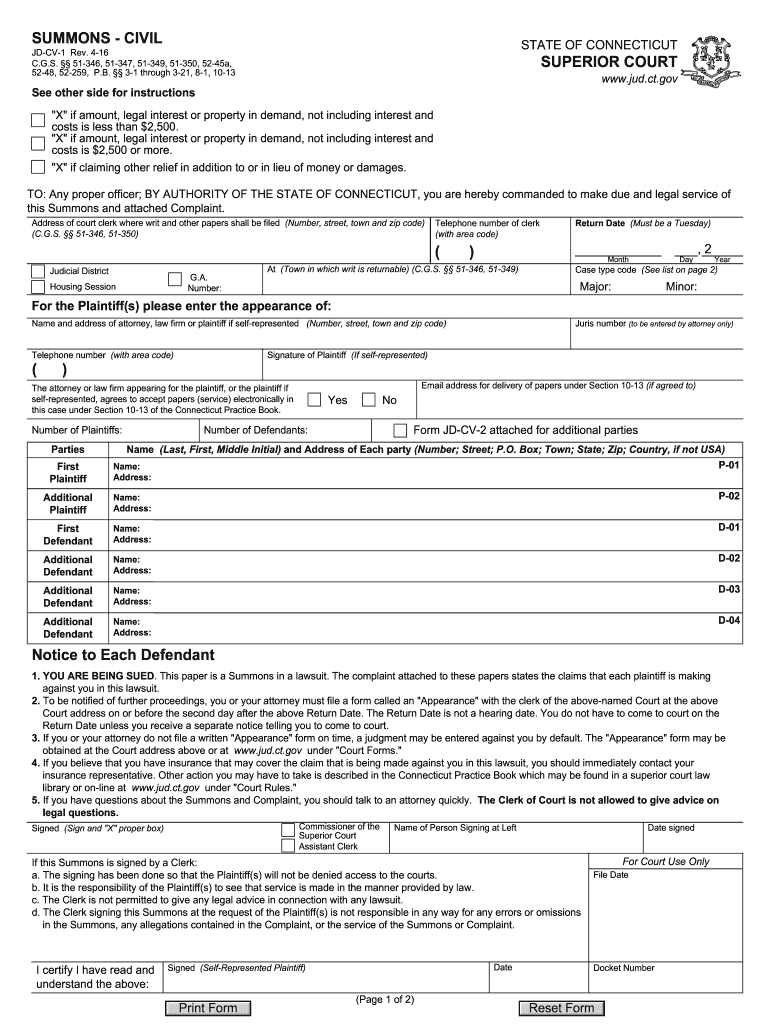
Her side for instructions "X" if amount, legal interest or property in demand, not including interest and costs is less than $2,500. "X" if amount, legal interest or property in demand, not including interest and costs is $2,500 or more. "X" if claiming other relief in addition to or in lieu of money or damages. TO: Any proper officer; BY AUTHORITY OF THE STATE OF CONNECTICUT, you are hereby commanded to make due and legal service of this Summons and attached Compla.
Loading

Open form follow the instructions

Easily sign the form with your finger

Send filled & signed form or save
How to fill out the CT JD-CV-1 online
The CT JD-CV-1 form, also known as the Summons for Civil cases in Connecticut, is a crucial document in initiating legal proceedings. This guide provides clear and supportive instructions to assist users in completing this form online, ensuring a smooth filing process.
Follow the steps to successfully complete the CT JD-CV-1 form online.
- Click the ‘Get Form’ button to obtain the CT JD-CV-1 form and open it in an online editor.
- Begin by entering the address of the court clerk where the writ and other papers will be filed. This information is usually provided on the form.
- Next, specify the return date, which must be a Tuesday. Enter the month, day, and year accurately to avoid errors.
- Indicate the judicial district and case type code by referring to the provided code descriptions, ensuring the correct categorization of your case.
- Fill in the number of plaintiffs and defendants involved in the case. If there are more than two plaintiffs or four defendants, attach the JD-CV-2 form as necessary.
- Provide the names and addresses of each party involved in the case, including all plaintiffs and defendants. Be thorough to ensure accurate service documents.
- Review the notice section to understand the implications for the defendants regarding their legal obligations and rights.
- If you are self-represented, sign the form where indicated. Attorneys need to provide their jurist number and details.
- Finally, after completing the form, you can save any changes made, download a copy, print it out, or share it as necessary for filing.
Begin completing the CT JD-CV-1 form online now to ensure your legal documents are filed correctly.
Experience a faster way to fill out and sign forms on the web. Access the most extensive library of templates available.
Related content
A civil summons is a notice that you are being sued. The complaint attached states the...
DAZA JD, CV 1 JUAN DIEGO DAZA, CURRICULUM VITAE Visiting professor, Sam Houston State...
ATTENTION: This drive contains ESD (Electrostatic Discharge) sensitive parts and...
Get answers to your most pressing questions about US Legal Forms API.
How do I introduce myself to the court?
To introduce yourself to the court, begin by addressing the judge respectfully and clearly stating your name and your role in the case, typically as an attorney representing a client. It’s important to maintain professionalism and confidence during this introduction, as it sets a positive tone for your involvement in the proceedings. Prepare and practice this introduction, particularly when working within frameworks like those provided by the CT JD-CV-1 forms.
How to enter an Appearance in court?
To enter an appearance in court, you must file a formal entry of appearance document with the court that contains the case information and your details as the attorney. This document should clearly state your intention to represent your client in the proceedings. Using the CT JD-CV-1 form can simplify this process and ensure all necessary information is included.
What does it mean when pleadings are closed?
When pleadings are closed, it means that no further pleadings are permitted to be filed in a case, and the scope for presenting new claims is limited. This closure promotes judicial efficiency by ensuring cases move forward without endless amendments or new arguments. Understanding this state is essential for legal practitioners, especially when utilizing forms like CT JD-CV-1 for the next steps in court.
What is the rule of appearance?
The rule of appearance refers to the legal principle that an attorney must formally enter their appearance in court to represent a client. This rule ensures the court and all parties are aware of legal representation and can communicate effectively with the attorney. Familiarity with the rule of appearance is essential, particularly when utilizing forms such as CT JD-CV-1 during legal proceedings.
What does a certificate of closed pleadings mean?
A certificate of closed pleadings signifies that all pleadings and motions in a case have been finalized and no further amendments or additions are allowed. This document is important because it marks a pivotal stage in litigation, indicating that the case is ready to proceed to the next steps. Understanding this process can enhance your legal strategy, especially when implementing tools like the CT JD-CV-1.
When to file certificate of closed pleadings CT?
You should file the certificate of closed pleadings when you have completed the initial pleadings and finalized any necessary motions in a case. This is crucial as it indicates that all parties have had the opportunity to present their respective positions. Filing this certificate timely, often using templates like CT JD-CV-1, helps to prevent delays in court scheduling and facilitates a smoother progression of the case.
How to write an entry of appearance?
To write an entry of appearance, you typically need to include the case caption, the names of the parties involved, and your details as the attorney. It's important to clearly state that you are entering your appearance on behalf of a specific client, along with any applicable case numbers. Ensuring accuracy and clarity in this document is vital for maintaining proper communication in the legal process, especially when using the CT JD-CV-1 form.
What is Section 10 35 of the CT practice book?
Section 10 35 of the CT Practice Book refers to specific rules governing pleadings and motions within judicial proceedings in Connecticut. This section outlines the methods and requirements for filing various documents, ensuring that all parties adhere to legal standards. Familiarity with Section 10 35 can greatly aid in understanding how to effectively navigate court processes, particularly when utilizing CT JD-CV-1 forms.
What is the entry of appearance in court?
An entry of appearance is a formal document filed in court which notifies the court that an attorney represents a party in a particular case. This document is crucial because it establishes the attorney's authority to act on behalf of their client, ensuring that all legal communications and documents are appropriately directed. Properly submitting an entry of appearance, especially using forms like CT JD-CV-1, streamlines the legal process.
Can you say no to a court summons?
While you cannot simply refuse a court summons, you can respond in various ways. You have the option to contest the summons if you believe there are grounds to do so. Filing a formal response using the CT JD-CV-1 can help you articulate your position and subsequently address the issue within the court system.
Use professional pre-built templates to fill in and sign documents online faster. Get access to thousands of forms.
If you believe that this page should be taken down, please follow our DMCA take down process here.
This form is available in several versions. Select the version you need from the drop-down list below.