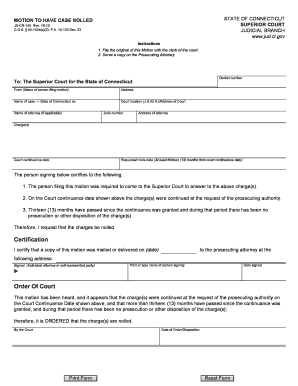
This Motion with the clerk of the court. 2. Serve a copy on the Prosecuting Attorney. Docket number To: The Superior Court for the State of Connecticut From (Name of person filing motion) Address Name of case State of Connecticut vs. Court location (J.D./G.A.)/Address of Court Juris number Name of attorney (If applicable) Address of attorney Charge(s) Court continuance date Requested nolle date (At least thirteen (13) months from court continuance date) The person signing below c.
Open form follow the instructions
Easily sign the form with your finger
Send filled & signed form or save
How to fill out the CT JD-CR-145 online
The CT JD-CR-145 is a motion to have a case nolled in the Superior Court of Connecticut. This guide provides clear and comprehensive instructions for completing the form online to assist in ensuring proper submission.
Follow the steps to successfully fill out the CT JD-CR-145 online.
- Press the ‘Get Form’ button to obtain the CT JD-CR-145 and open it in your online document editor.
- Fill in the docket number associated with your case. This number can typically be found in court documents related to your case.
- Address the form to the Superior Court for the State of Connecticut, ensuring you specify the name of the person filing the motion.
- Enter the address of the person submitting the motion, which may include street address, city, state, and ZIP code.
- Indicate the name of the case by writing 'State of Connecticut vs.' followed by the name of the defendant.
- Specify the court location by indicating whether it is a Judicial District (J.D.) or Geographic Area (G.A.), along with the court's address.
- Provide the Juris number, which is necessary for case identification.
- If applicable, include the name and address of the attorney representing the person filing the motion.
- List the charge or charges against you that are being addressed in this motion.
- Fill in the court continuance date when the charges were moved to a later date at the request of the prosecuting authority.
- Specify the requested nolle date, ensuring it is at least thirteen months from the court continuance date entered previously.
- Read the certification statement and ensure that the conditions described regarding the case status are accurate for your situation.
- Sign the form by either an individual attorney or a self-represented party. Include their printed or typed name and the date signed.
- Prepare to certify that a copy of your motion was mailed or delivered to the Prosecuting Attorney, including the date and address.
- Lastly, ensure to click on options to save changes, download, print, or share the completed form as necessary.
Complete your CT JD-CR-145 motion online today to ensure proper legal procedure.
Experience a faster way to fill out and sign forms on the web. Access the most extensive library of templates available.
Related content
This motion has been heard, and it appears that the charge(s) were continued at the...
The manual covers patient selection, safe injection, reactions, kidney injury, GI...
Figure 145. Report Generator. Figure 146. Attenuation. Coefficients Submenu. 5.5.1.2...
Get answers to your most pressing questions about US Legal Forms API.
How to file workers comp in CT?
Filing workers' compensation in Connecticut requires you to report your injury to your employer swiftly. Following this, you should complete and submit the CT JD-CR-145 along with any other needed forms to your employer's insurance provider. Resources like USLegalForms can assist you in this process, ensuring that you have all necessary documentation. Taking these steps promptly can enhance your chances of receiving benefits.
How do you request leave to amend a complaint in CT?
To request leave to amend a complaint in Connecticut, file a motion with the court that clearly explains the reasons for your amendment. This request should align with the procedures outlined in the CT JD-CR-145. Be sure to include relevant details and any new evidence that supports your case. Consulting with legal experts can provide additional clarity in this legal process.
Is it worth filing a workers' comp claim?
Filing a workers' compensation claim in Connecticut can indeed be worth it, especially if your injury impacts your ability to work. Benefits can cover medical expenses, lost wages, and rehabilitation costs, all of which are crucial under the CT JD-CR-145 regulations. Evaluating your individual circumstances will help you understand the potential advantages of filing. Seeking advice from professionals, like those at USLegalForms, can also clarify your decision.
How to file for workers' comp in CT?
To file for workers' compensation in Connecticut, first notify your employer about your injury. Then, complete the necessary forms, including the CT JD-CR-145 form, and submit it to your employer or their insurance carrier. You also have the option to utilize platforms like USLegalForms for guidance in preparing your claim documents. This step ensures you meet all necessary requirements for a successful filing.
What not to say to a workers' comp doctor?
When visiting a workers' compensation doctor, avoid downplaying your injury or overstating your condition. These statements can have serious implications on your claim process under CT JD-CR-145. Stick to factual descriptions of your symptoms and how they impact your daily activities. Maintain consistency with your medical documentation for better outcomes.
How long do I have to report a work injury in CT?
In Connecticut, you must report your work injury to your employer within thirty days to ensure you are eligible for workers' compensation benefits. This immediate action helps secure your rights under the CT JD-CR-145 guidelines. Prompt reporting also aids in documenting your injury effectively. Always keep a written record to protect your interests.
How to vacate a warrant in CT?
To vacate a warrant in Connecticut, you need to file a motion with the court requesting the warrant's removal. This process often involves presenting evidence or reasons justifying the request. Utilizing the CT JD-CR-145 form can make this process easier and more organized. Consider seeking legal advice to ensure you follow the correct procedures.
What is the best thing to do if you have a warrant?
If you have a warrant, the best course of action is to address it immediately. You can consult with a legal professional to explore your options. Taking proactive steps, like filing the CT JD-CR-145 form, can help to resolve the issue effectively. Ignoring the warrant may result in more severe consequences, so acting promptly is crucial.
What is the process of warrant of removal?
The process of a warrant of removal involves a court order that directs law enforcement to remove a tenant from a property. This usually follows an eviction proceeding where the landlord has obtained a judgment. If you find yourself facing this situation, using the CT JD-CR-145 can provide essential guidance. Understanding your rights and responsibilities is critical, so consulting a legal expert is beneficial.
How long does a warrant stay active in Connecticut?
In Connecticut, a warrant typically remains active until it is executed or lifted by the court. There is no fixed duration, so it is crucial to address any outstanding warrants promptly. Ignoring the issue may lead to more complications down the road. Consider using the CT JD-CR-145 to manage your legal situation effectively.
Use professional pre-built templates to fill in and sign documents online faster. Get access to thousands of forms.
If you believe that this page should be taken down, please follow our DMCA take down process here.