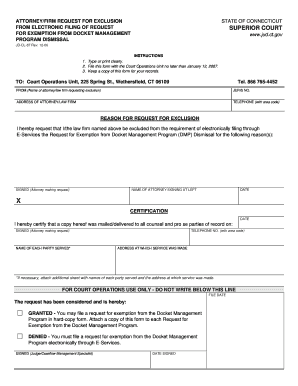
-06 INSTRUCTIONS 1. Type or print clearly. 2. File this form with the Court Operations Unit no later than January 12, 2007. 3. Keep a copy of this form for your records. TO: Court Operations Unit, 225 Spring St., Wethersfield, CT 06109 Tel. 866 765-4452 FROM (Name of attorney/law firm requesting exclusion) JURIS NO. ADDRESS OF ATTORNEY/LAW FIRM TELEPHONE (with area code) REASON FOR REQUEST FOR EXCLUSION I hereby request that I/the law firm named above be excluded from the requirement of.

How it works
  • Open form

    Open form follow the instructions

  • Easily sign form

    Easily sign the form with your finger

  • Share form

    Send filled & signed form or save

How to fill out the CT JD-CL-87 online

Filling out the CT JD-CL-87 form is a necessary step for attorneys or law firms seeking to request exclusion from electronic filing requirements. This guide provides step-by-step instructions to help users navigate the online process with clarity and ease.

Follow the steps to complete the CT JD-CL-87 form online.

  1. Click ‘Get Form’ button to access the CT JD-CL-87 form and open it in the designated editor.
  2. In the 'FROM' section, enter the name of the attorney or law firm requesting the exclusion. Ensure that this information is clear and accurate.
  3. Provide the Juris number in the designated field. This number is crucial for identifying the attorney or law firm within the court system.
  4. Fill in the address of the attorney or law firm. Be precise to ensure that any correspondence is directed correctly.
  5. Enter the telephone number with the area code in the appropriate field. This will enable the court to contact you if necessary.
  6. In the 'REASON FOR REQUEST FOR EXCLUSION' section, clearly state the reason for your request. Provide any necessary details to support your case.
  7. The attorney making the request must sign the form in the designated area. This signature confirms the validity of the request.
  8. Enter the date of signing next to the signature to indicate when the form was completed.
  9. Fill in the certification section, indicating the date a copy of the form was mailed or delivered to all counsel and pro se parties of record.
  10. Sign again in the certification section and list the name, telephone number, and address of each party served. Use an additional sheet if necessary.
  11. Review the form for accuracy and completeness before submitting. Once finalized, save your changes, and you can download, print, or share the form as needed.

Complete your CT JD-CL-87 form online today to ensure a smooth filing process.

Get form

Experience a faster way to fill out and sign forms on the web. Access the most extensive library of templates available.

Related content

Notice to Attorneys re: Docket Management Program...

Sep 1, 2006 — (JD-CL-87). The form to request the exclusion may be obtained by calling...

Learn more
Astrophysics Data System

A powerful, streamlined new Astrophysics Data System.

Learn more
2019 edition - Urology Guidelines

We are delighted to present the 2019 edition of the European Association of Urology (EAU)...

Learn more
Questions & Answers

Get answers to your most pressing questions about US Legal Forms API.

Contact support

What is the statute of limitations in CT for small claims court?

In Connecticut, the statute of limitations for small claims court is generally two years for most civil claims. This time frame is important for individuals seeking to recover debts or damages through small claims. Utilizing CT JD-CL-87 can help you navigate the filing process within this timeframe, ensuring that your claims are considered.

A motion for clarification seeks precise understanding of the legal interpretation of a court order or ruling. It is essential for parties involved in ongoing legal matters to have a clear grasp of their responsibilities and the implications of court decisions. With CT JD-CL-87, you can effectively communicate your need for clarification to the court.

The three primary grounds for a motion for reconsideration in Connecticut include new evidence that was not available during the original ruling, a change in the law, or demonstrating that the previous decision was clearly erroneous. These grounds provide a valuable opportunity to revisit a case when significant factors change. The CT JD-CL-87 form can assist you in properly submitting this motion.

A Motion for Clarification in Connecticut is a request made to the court to explain or clarify ambiguous aspects of an existing order. This motion ensures that all parties comprehend the specific language and implications of a ruling. Utilizing CT JD-CL-87 can streamline this process and reduce future disputes over interpretations.

The grounds for a Motion to Dismiss in Connecticut include insufficient legal claims, lack of personal jurisdiction, and failure to comply with procedural rules. Understanding these grounds can significantly influence the outcome of a case. Using the CT JD-CL-87 form, individuals can properly articulate their reasons for seeking dismissal.

Order clarification refers to a process that helps clarify the terms or conditions of a legal order. In the context of CT JD-CL-87, it enables the parties involved to understand their obligations clearly. By seeking clarification, individuals can avoid misunderstandings that could lead to further legal complications.

To obtain court documents in Connecticut, you can visit the appropriate courthouse or access their online portals. Most documents, including those related to the CT JD-CL-87, can be requested digitally for convenience. Additionally, many forms can be filled out online and submitted for processing. For streamlined access to legal documents, consider using uslegalforms, which provides a user-friendly platform for retrieving necessary court materials.

Court records in Connecticut generally remain accessible online indefinitely. Once a case is filed, the related records are digitized and indexed, allowing public access through various platforms. However, specific limitations may apply depending on the type of case and its resolution. Utilizing resources related to the CT JD-CL-87 can help you navigate these records efficiently.

In Connecticut, summons are typically served by a state marshal. The marshal delivers the summons in person to the defendant, ensuring that they receive the necessary legal notification. Alternatively, if personal service is not possible, the summons may be sent via certified mail. For guidance on the process, you can refer to the CT JD-CL-87 form, which outlines detailed procedures.

In Connecticut, a judgment lien remains in effect for 20 years. This lien can affect your property and may influence your ability to sell or refinance. It’s vital to resolve outstanding judgments promptly to prevent complications. For assistance in dealing with judgment liens, consider using the CT JD-CL-87 to navigate the process.

Get This Form Now!

Use professional pre-built templates to fill in and sign documents online faster. Get access to thousands of forms.

If you believe that this page should be taken down, please follow our DMCA take down process here.

Get CT JD-CL-87