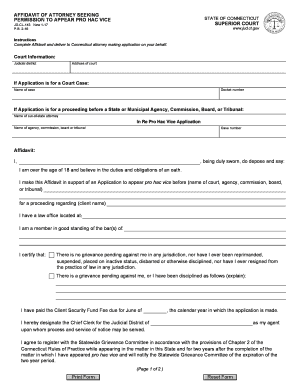
Connecticut attorney making application on your behalf. Court Information: Judicial district Address of court If Application is for a Court Case: Name of case Docket number If Application is for a proceeding before a State or Municipal Agency, Commission, Board, or Tribunal: Name of out-of-state attorney In Re Pro Hac Vice Application Name of agency, commission, board or tribunal Case number Affidavit: I, , being duly sworn, do depose and say: I am over the age of 18 and believe in the.

How it works
  • Open form

    Open form follow the instructions

  • Easily sign form

    Easily sign the form with your finger

  • Share form

    Send filled & signed form or save

How to fill out the CT JD-CL-143 online

Filling out the CT JD-CL-143 form, also known as the Affidavit of Attorney Seeking Permission to Appear Pro Hac Vice, is a crucial step for attorneys wishing to practice in Connecticut for a specific case or proceeding. This guide provides clear, step-by-step instructions to assist users in completing the form accurately and efficiently.

Follow the steps to complete the CT JD-CL-143 online effectively.

  1. Press the ‘Get Form’ button to access the form and open it in your designated editor.
  2. Begin by entering the court information, including the judicial district and the address of the court.
  3. If your application pertains to a case, fill in the name of the case and the docket number.
  4. For applications related to a state or municipal agency, commission, board, or tribunal, provide the name of the out-of-state attorney and specify the agency, commission, board, or tribunal along with the corresponding case number.
  5. Complete the affidavit section by entering your name, affirming your qualifications, and detailing your law office information.
  6. Certify your standing by indicating whether there are any grievances pending against you, and provide an explanation if applicable.
  7. Confirm that you have paid the Client Security Fund Fee for the relevant calendar year.
  8. Designate the Chief Clerk for the Judicial District as your agent for service of process.
  9. Indicate your agreement to register with the Statewide Grievance Committee during and post your pro hac vice appearance.
  10. List the instances you have previously appeared pro hac vice in Connecticut, including case names and docket numbers, along with your Juris Number if assigned.
  11. Acknowledge the requirement for the Connecticut attorney to be present at all proceedings and the signing responsibility.
  12. State the reasons establishing good cause for your representation of the client.
  13. Sign and date the form and ensure a Commissioner of Superior Court or Notary Public witnesses your signature.
  14. Finally, review the filled-out form for accuracy and completeness before you save your changes, download, print, or share the document.

Complete your forms easily online to ensure a smooth application process.

Get form

Experience a faster way to fill out and sign forms on the web. Access the most extensive library of templates available.

Related content

CL143.pdf - Connecticut Judicial Branch - CT.gov

JD-CL-143 Rev. 4-23. P.B. 2-16. Instructions. Complete Affidavit and deliver to...

Learn more
Systolic Blood Pressure Intervention Trial...

A 2-arm, multicenter, randomized clinical trial designed to test whether a treatment...

Learn more
Edible Oil Barriers for Treatment of Chlorinated...

Cl#2.9. The Cl# in the other three injection wells ranged from Cl# 2.14 to 2.84 and the...

Learn more
Questions & Answers

Get answers to your most pressing questions about US Legal Forms API.

Contact support

What is the success rate of representing yourself in court?

The success rate for pro se litigants can be low, especially in complicated cases. Research suggests that individuals with legal representation often fare better than those without. However, by using tools like the CT JD-CL-143 and gathering legal information from platforms like U.S. Legal Forms, you can significantly improve your chances of achieving a favorable outcome.

Yes, there are instances where individuals have successfully represented themselves in court. Success depends on various factors, including the complexity of the case and the individual's understanding of legal procedures. Utilizing resources like the CT JD-CL-143 can enhance your potential for success by ensuring all necessary documents are correctly completed.

Representing yourself in court can be challenging, especially if you are unfamiliar with legal procedures. It requires thorough preparation and a clear understanding of legal documents, like the CT JD-CL-143. Resources, including those from U.S. Legal Forms, can make navigating the process easier and provide you with necessary templates and guidance.

In general, only licensed attorneys can represent individuals in court. However, there are exceptions where non-lawyers can assist in a limited capacity. It is important to review the specific guidelines applicable to your situation, and consulting resources like the CT JD-CL-143 can provide clarity on required representation.

Connecticut's judicial branch interprets laws, ensures justice, and protects the rights of individuals. It operates independently from the legislative and executive branches, providing a crucial balance within the state’s government. The judicial branch also oversees cases involving forms like CT JD-CL-143, ensuring proper legal processes are followed.

Connecticut has several types of courts, including the Supreme Court, Appellate Court, Superior Court, and Geographical Area Courts. Each court serves a specific purpose, handling various cases from civil to criminal matters. Understanding these distinctions is crucial when dealing with your legal needs, especially regarding filings like CT JD-CL-143.

Yes, you can represent yourself in a Connecticut court. This process is known as being a pro se litigant. However, it is essential to familiarize yourself with court procedures and the relevant forms, such as the CT JD-CL-143. Utilizing resources from platforms like U.S. Legal Forms can help guide you through the necessary steps.

To file a workers' compensation claim in Connecticut, notify your employer of your injury or illness as soon as possible, ideally within one day. Following that, you need to complete a Form 30C, which notifies the Workers' Compensation Commission of your claim. If you're seeking assistance, legal platforms such as US Legal Forms can provide you with detailed guidance tailored to CT JD-CL-143, ensuring you understand each necessary step.

You must file a small claims case in Connecticut within six years of the incident that gave rise to your claim. Keeping this timeframe in mind will allow you to pursue the matter effectively. If you are unsure about the filing process or deadlines, resources like US Legal Forms can guide you through completing necessary paperwork related to CT JD-CL-143.

You generally have six years to sue someone in Connecticut for most civil claims. This timeline is important because if you exceed the six-year period, your chance for relief may be lost. If you feel wronged, consult with legal resources regarding CT JD-CL-143, as knowing your rights can empower you to take action within the necessary time frame.

Get This Form Now!

Use professional pre-built templates to fill in and sign documents online faster. Get access to thousands of forms.

If you believe that this page should be taken down, please follow our DMCA take down process here.

Get CT JD-CL-143