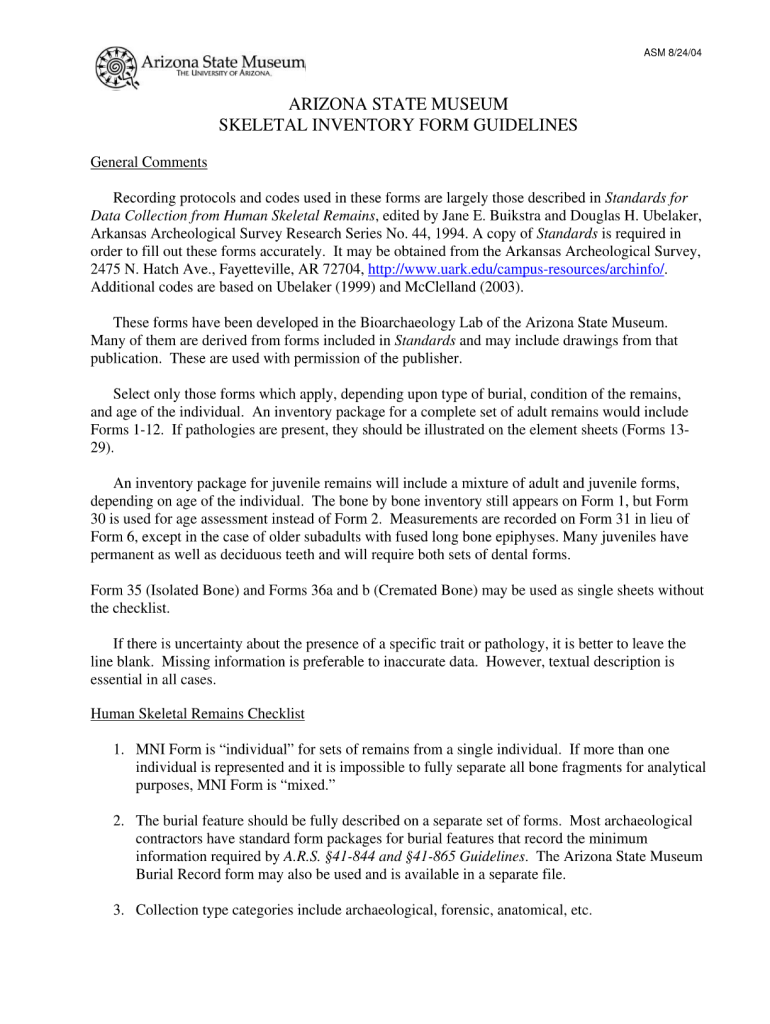
ASM 8/24/04 ARIZONA STATE MUSEUM SKELETAL INVENTORY FORM GUIDELINES General Comments Recording protocols and codes used in these forms are largely those described in Standards for Data Collection.
Loading

Open form follow the instructions

Easily sign the form with your finger

Send filled & signed form or save
How to fill out the AZ State Museum Skeletal Inventory Form Guidelines online
Completing the AZ State Museum Skeletal Inventory Form is essential for accurate inventory management of skeletal remains. This guide provides a clear, step-by-step approach to filling out the form online, ensuring all necessary components are addressed.
Follow the steps to complete the form accurately and efficiently.
- Click ‘Get Form’ button to access the inventory form and open it in your preferred online editor.
- Begin by entering the general information at the top of the form, including the name of the person submitting the inventory, their contact information, and the date of submission.
- In the next section, provide detailed descriptions of the skeletal remains. This includes the species, estimated age at death, and any notable characteristics observed.
- Complete the section regarding the location where the remains were found. Be sure to include specific details such as GPS coordinates or site description.
- Review the field for any legal or ethical considerations associated with the skeletal inventory. Ensure all appropriate permissions or consents are documented in this section.
- After filling out all relevant sections, thoroughly review your entries for accuracy and completeness. Make any necessary edits.
- Finally, save your changes, and choose the option to download, print, or share the completed form as needed.
Start completing your AZ State Museum Skeletal Inventory Form online today!
Experience a faster way to fill out and sign forms on the web. Access the most extensive library of templates available.
Related content
3 days ago — The 88 associated funerary objects consist of plain and decorated sherds...
Additional observations: Fill in skeletal elements present and record notes along side...
by MT Barbour · Cited by 6486 — To issue guidance on cost-effective approaches to...
Get answers to your most pressing questions about US Legal Forms API.
What is skeletal quantity?
Skeletal quantity refers to the total number of skeletal elements within a given collection. Understanding this metric is important for researchers and institutions to analyze the scope and diversity of their collections. Adhering to the AZ State Museum Skeletal Inventory Form Guidelines allows organizations to maintain accurate counts and ensure that all elements are accounted for in their records.
How to do a skeletal inventory?
To conduct a skeletal inventory, you should first gather all relevant skeletal remains and documentation. Next, follow the AZ State Museum Skeletal Inventory Form Guidelines, ensuring that you record each item accurately with its details. This process often involves identifying each skeletal element, tracking their storage locations, and compiling the data into a comprehensive format that allows for easy access and review.
What is skeletal inventory?
A skeletal inventory is a systematic collection of data regarding skeletal remains. It includes details such as the number of remains, their origin, and their condition. According to the AZ State Museum Skeletal Inventory Form Guidelines, having a well-organized skeletal inventory ensures accurate record-keeping and enhances the ability to fulfill academic and cultural responsibilities.
What is skeletal identification?
Skeletal identification refers to the process of determining the origin and characteristics of skeletal remains. This process is vital in forensic science, anthropology, and archaeology. Following the AZ State Museum Skeletal Inventory Form Guidelines, skeletal identification provides essential information to help understand the historical context and significance of the remains.
Why is a skeletal inventory important?
A skeletal inventory is crucial for proper management and documentation of skeletal remains. It helps researchers and institutions meet legal and ethical standards, especially under the AZ State Museum Skeletal Inventory Form Guidelines. By maintaining accurate skeletal inventories, organizations can easily track and manage skeletal collections, promoting transparency and accountability.
How do you date skeletal remains?
Dating skeletal remains involves using methods such as radiocarbon dating or examining specific physical characteristics. These methods provide insights into the age of the bones and can establish when the individual lived. The AZ State Museum Skeletal Inventory Form Guidelines can help you document this data for future reference. Accurate dating is vital for understanding the historical context and significance of the remains.
What is the difference between accession number and catalog number?
The accession number and catalog number serve different purposes within museum management. The accession number tracks an item's entry into the museum’s collection, while the catalog number categorizes items for specific exhibits or collections. Understanding this distinction is key when navigating resources like the AZ State Museum Skeletal Inventory Form Guidelines, as both numbers play a role in effective collection management.
What is the accession number in a museum?
An accession number in a museum serves as a distinctive label for each item that enters the collection. This numbers system is crucial for establishing ownership, tracking provenance, and managing records, particularly in regards to the AZ State Museum Skeletal Inventory Form Guidelines. Each accession number enables staff and researchers to retrieve information about specific items easily.
What is the ASM accession number?
The ASM accession number specifically refers to the unique identification assigned by the Arizona State Museum to each item within its collection. This number is critical for maintaining comprehensive records as guided by the AZ State Museum Skeletal Inventory Form Guidelines. It ensures that each item can be referenced accurately in documentation and future research.
What is the purpose of the accession number?
The accession number serves as a unique identifier for items added to a collection, such as those documented under the AZ State Museum Skeletal Inventory Form Guidelines. It helps museums and institutions track and manage artifacts effectively. This system ensures that every item can be easily located in records and collections, enhancing accountability and organization.
Use professional pre-built templates to fill in and sign documents online faster. Get access to thousands of forms.
If you believe that this page should be taken down, please follow our DMCA take down process here.