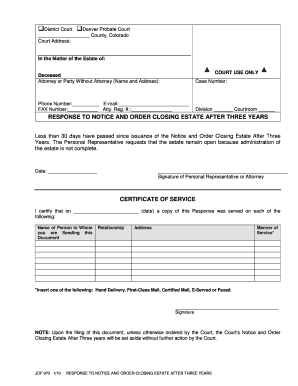
OURT USE ONLY Deceased Attorney or Party Without Attorney (Name and Address): Case Number: Phone Number: E-mail: FAX Number: Atty. Reg. #.: Division Courtroom RESPONSE TO NOTICE AND ORDER CLOSING ESTATE AFTER THREE YEARS Less than 30 days have passed since issuance of the Notice and Order Closing Estate After Three Years. The Personal Representative requests that the estate remain open because administration of the.

How it works
  • Open form

    Open form follow the instructions

  • Easily sign form

    Easily sign the form with your finger

  • Share form

    Send filled & signed form or save

How to fill out the CO JDF 970 online

This guide will provide you with a clear, step-by-step approach to filling out the CO JDF 970 form online. This form is necessary for responding to a notice and order regarding the closing of an estate after three years.

Follow the steps to successfully complete the CO JDF 970 form.

  1. Press the ‘Get Form’ button to obtain the CO JDF 970 document and open it in your preferred online editor.
  2. Fill in the court information by selecting the appropriate court type—either District Court or Denver Probate Court—and enter the court address as needed.
  3. In the section titled 'In the Matter of the Estate of,' input the name of the deceased estate.
  4. Specify the division and courtroom as designated in your original court documentation.
  5. In the body of the form, indicate that less than 30 days have passed since the issuance of the notice and order closing the estate. Clearly state that you, as the personal representative, request the estate remain open, as administration is not complete.
  6. Date your response accurately in the appropriate space provided.
  7. Move to the 'Certificate of Service' section. Enter the date on which you served a copy of this response to each concerned party.
  8. Finally, provide your signature at the bottom of the 'Certificate of Service' confirming the document has been served as stated.
  9. Review all entered information for accuracy. Once complete, you can save your changes, download, print, or share the filled CO JDF 970 form as needed.

Complete your form online to ensure a smooth and efficient process.

Get form

Experience a faster way to fill out and sign forms on the web. Access the most extensive library of templates available.

Related content

JDF 970

I declare under penalty of perjury under the law of Colorado that the foregoing is true...

Learn more
CO-JF-617 Data Calendar for Aug 2025 - IEM

Information Network Table Neighbors Data Calendar. Data Calendar for Arvada 1.1 ENE. The...

Learn more
Operating Instructions

During operation, the engine emits exhaust gas into the environment. The exhaust gas...

Learn more
Questions & Answers

Get answers to your most pressing questions about US Legal Forms API.

Contact support

How long do you have to file probate after death?

You should file for probate after someone's death as soon as possible, preferably within a year. Filing sooner allows the estate to be settled efficiently and can prevent complications that arise from delays. Utilizing resources like the CO JDF 970 form can simplify the paperwork involved in this process. By ensuring timely action, you honor the deceased's wishes and facilitate a smoother transition for loved ones.

An executor in Colorado generally has up to one year to settle an estate, but this can vary based on the complexity of the estate and any potential disputes. Responsibilities include inventorying assets, paying debts, and distributing property to beneficiaries. Proper use of the CO JDF 970 form can assist executors in effectively managing the estate settlement process. Always communicate openly with beneficiaries to keep everyone informed and engaged.

In Colorado, you have to file for probate within a reasonable time frame, typically within one year after the person's death. The sooner you initiate the process, the better it is for managing the estate and addressing obligations such as debts and taxes. Utilizing the CO JDF 970 form can help streamline this process and ensure that all necessary documents are submitted properly. An timely filing can prevent unnecessary delays and complications.

If you do not probate a will in Colorado, the wishes of the deceased may not be carried out as intended. This can lead to complications regarding asset distribution, potentially creating disputes among family members. To avoid such challenges, using the CO JDF 970 form might help clarify your intentions. Engaging the probate process ensures that your loved one's estate is managed according to their wishes.

In Colorado, you are not required to file a will with the court unless you initiate a probate process. However, filing the will can provide clarity and ensure that your wishes are honored according to the terms stated. If you choose to use the CO JDF 970 form, it can simplify this process by providing a structured format for your will. Ultimately, consider consulting with a legal expert to understand the specifics of your situation.

If you fail to file a will within 10 days in Colorado, you may face potential legal complications. The court could impose penalties, and the estate may not be settled according to the deceased's wishes. Timely filing is essential to encourage a smooth probate process. Consulting resources like CO JDF 970 can help you understand the filing requirements and avoid any issues.

To initiate probate proceedings in Colorado, your estate must be valued above $66,000. This figure reflects the total gross value of your assets, minus any debts. If your estate falls below this amount, you may not need to engage in the probate process. CO JDF 970 can provide detailed guidance on managing estates below this threshold efficiently.

Probate is generally triggered in Colorado if the estate's value exceeds $66,000. This amount includes all assets owned by the deceased. Understanding this limit can help you plan accordingly; if your estate is smaller, you may avoid probate altogether. CO JDF 970 can assist you in exploring your options and ensuring you follow the correct procedures.

In Colorado, the minimum estate value that triggers probate is $66,000, as of the latest regulations. This figure pertains to the gross value of the estate, not including debts. If your estate's value is below this threshold, you might consider alternative processes. Resources like CO JDF 970 can offer more information on managing small estates.

Certain assets in Colorado can bypass probate, saving your family time and expenses. For example, life insurance proceeds, assets held in a living trust, and accounts with designated beneficiaries fall outside probate. Understanding these exemptions can simplify the estate settlement process, and CO JDF 970 provides valuable insights into how to manage these assets effectively.

Get This Form Now!

Use professional pre-built templates to fill in and sign documents online faster. Get access to thousands of forms.

If you believe that this page should be taken down, please follow our DMCA take down process here.

Get CO JDF 970