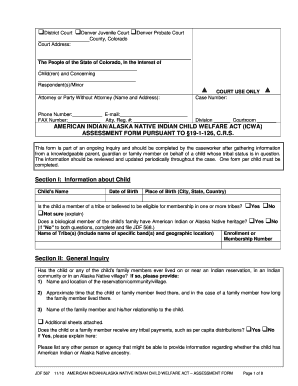
Interest of Child(ren) and Concerning Respondent(s)/Minor Attorney or Party Without Attorney (Name and Address): COURT USE ONLY Case Number: Phone Number: E-mail: FAX Number: Atty. Reg. #: Division Courtroom AMERICAN INDIAN/ALASKA NATIVE INDIAN CHILD WELFARE ACT (ICWA) ASSESSMENT FORM PURSUANT TO 19-1-126, C.R.S. This form is part of an ongo.

How it works
  • Open form

    Open form follow the instructions

  • Easily sign form

    Easily sign the form with your finger

  • Share form

    Send filled & signed form or save

How to fill out the CO JDF 567 online

Filling out the CO JDF 567 form is essential for assessing a child's tribal status under the American Indian/Alaska Native Indian Child Welfare Act. This guide will provide a clear, step-by-step approach to completing the form online, ensuring you have all the necessary information at hand.

Follow the steps to complete the CO JDF 567 form.

  1. Press the 'Get Form' button to access the CO JDF 567 form and open it in your online editor.
  2. Begin by filling out the court information section, selecting the appropriate court type and entering the court address.
  3. Input the names of the children involved and provide relevant details about the respondent(s). Ensure that you list all applicable attorneys or parties without an attorney.
  4. Complete Section I with the child's name, date of birth, place of birth, and tribal status. Answer the questions regarding tribal membership status carefully.
  5. Move on to Section II by detailing any historical ties the child or family members may have to Indian reservations or communities.
  6. In Section III, provide comprehensive information about the child's parents and/or Indian custodian, ensuring accurate names, dates of birth, and tribal affiliations.
  7. Section IV requires you to input detailed ancestry information for the child's maternal and paternal grandparents and great-grandparents. Make sure to document all known tribal affiliations.
  8. Conclude by signing the form to verify that the information is accurate and complete. Include the date the form was completed and the names of those who provided and collected the information.
  9. Once completed, remember to save your changes and consider your options to download, print, or share the form as necessary.

Complete your documents online today to ensure timely processing.

Get form

Experience a faster way to fill out and sign forms on the web. Access the most extensive library of templates available.

Related content

AMERICAN INDIAN/ALASKA NATIVE INDIAN CHILD ...

JDF 567 11/10 AMERICAN INDIAN/ALASKA NATIVE INDIAN CHILD WELFARE ACT – ASSESSMENT FORM...

Learn more
Site Info: CO-WE-567 Evans 2.4 W - IEM

[CO-JF-543] Arvada 0.4 E, [CO-JF-475] Arvada 0.4 ESE [2018-2018], [CO-JF ... [CO-JF-567]...

Learn more
【2012】クソゲーオブザイヤー避難所...

2012年に発売したゲームで一番のクソゲーを決めましょう ルール...

Learn more
Questions & Answers

Get answers to your most pressing questions about US Legal Forms API.

Contact support

Are drugs legal on Indian reservations?

The Menonimee are uniquely placed in the state, as the only American Indian reservation which falls only under federal law, rather than under Wisconsin Public Law 280 like all other reservations in the state, meaning that the state of Wisconsin cannot prevent legal changes within the sovereign reservation.

Tribal state relations: sovereign within a sovereign Article 1, Section 8 of the Constitution states that "Congress shall have the power to regulate Commerce with foreign nations and among the several states, and with the Indian tribes".

There are 573 federally recognized American Indian Tribes in the United States, and the FBI has federal law enforcement responsibility on nearly 200 Indian reservations. This federal jurisdiction is shared concurrently with the Bureau of Indian Affairs, Office of Justice Services (BIA-OJS).

Federal civil jurisdiction is very limited in Indian country. Federal courts have jurisdiction in claims that arise under federal law and in cases of diversity of citizenship.

Overview. There are 573 federally recognized American Indian Tribes in the United States, and the FBI has federal law enforcement responsibility on nearly 200 Indian reservations. This federal jurisdiction is shared concurrently with the Bureau of Indian Affairs, Office of Justice Services (BIA-OJS).

An Indian reservation is a legal designation for an area of land managed by a federally recognized Native American tribe under the U.S. Bureau of Indian Affairs rather than the state governments of the United States in which they are physically located.

Tribal jurisdiction refers to the authority of a tribal governing authority to determine a civil or criminal matter. Tribes have jurisdiction over their members by virtue of their inherent sovereignty.

Tribal police powers Authority to exercise criminal jurisdiction over all tribal members and the authority to arrest and detain non-Indians for delivery to state or federal authorities for prosecution. These tribal police powers are generally limited to tribal lands.

Primarily, Tribal courts oversee cases involving Tribal members. But the jurisdictional scheme for cases in Indian Country is complex. Cases involving conflicts or crimes may be considered in Tribal Courts, Federal Courts possibly even State Courts depending on the circumstances.

ICWA still remains law and still applies to private adoptions and child welfare cases. However, the decision limited ICWA's protections for unwed fathers without custody when their children are voluntarily placed for adoption and changed how ICWA's placement preferences are applied in voluntary adoptions.

Get This Form Now!

Use professional pre-built templates to fill in and sign documents online faster. Get access to thousands of forms.

If you believe that this page should be taken down, please follow our DMCA take down process here.

Get CO JDF 567