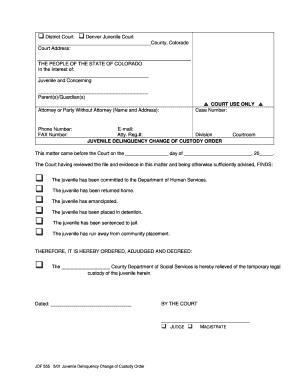
Juvenile and Concerning Parent(s)/Guardian(s) COURT USE ONLY Case Number: Attorney or Party Without Attorney (Name and Address): Phone Number: FAX Number: E-mail: Atty. Reg.#: Division JUVENILE DELINQUENCY CHANGE OF CUSTODY ORDER Courtroom This matter came before the Court on the day of , 20 . The Court having reviewed the file and evidence in this matter and being otherwise suffic.

How it works
  • Open form

    Open form follow the instructions

  • Easily sign form

    Easily sign the form with your finger

  • Share form

    Send filled & signed form or save

How to fill out the CO JDF 555 online

The CO JDF 555 is an important document used in juvenile delinquency cases regarding changes of custody. Filling it out correctly is crucial to ensure legal processes are followed and to provide clear information to the court.

Follow the steps to complete the CO JDF 555 accurately.

  1. Click ‘Get Form’ button to obtain the form and open it in the editor.
  2. Begin by entering the county name at the top of the form where it states 'County, Colorado.' Make sure this reflects the correct jurisdiction for your case.
  3. Next, fill in the court address. This may typically be found on official court documents or the court’s website.
  4. In the section labeled 'In the interest of:', write the name of the juvenile involved in the case. Ensure this is the full legal name.
  5. For the section 'Concerning:', list the names of the parent(s) or guardian(s) of the juvenile using the recommended people-first language.
  6. Proceed to fill in the case number in the 'COURT USE ONLY' section. This number is typically assigned by the court.
  7. In the 'Attorney or Party Without Attorney' section, enter the name and address of the attorney or party representing the juvenile, if applicable.
  8. Provide contact details including a phone number, fax number (if any), and email address in the corresponding fields.
  9. Indicate the attorney registration number, if applicable, and specify which division of the court is handling the case.
  10. In the 'Courtroom' section, specify the courtroom where the hearing will take place, following any guidelines issued by the court.
  11. Complete the section that states the date of the court appearance. This should reflect the actual date the matter is brought before the court.
  12. Next, review and select the findings that apply to the juvenile’s case based on the checkboxes provided.
  13. In the 'THEREFORE, IT IS HEREBY ORDERED,' section, fill in the necessary legal outcomes or orders as determined by the court.
  14. Finally, ensure that the document is signed and dated by the judge or magistrate to make it official.
  15. After completing the form, save your changes, and print or download a copy for your records. You can then share it as needed.

Complete your documents online to ensure they are filed accurately and efficiently.

Get form

Experience a faster way to fill out and sign forms on the web. Access the most extensive library of templates available.

Related content

Juvenile Delinquency Change of Custody Order

Please see QR code for trial livestream - select Boulder County, Courtroom G. Self-Help...

Learn more
Seasonal rhythms of net primary production and...

by MJ Lutz · 2007 · Cited by 539 — We investigate the functioning of the ocean's...

Learn more
MATLAB^SIMULINBC

Sep 1, 2006 — • graycomatix symmetric option that produces graylevel co-occurrence...

Learn more
Questions & Answers

Get answers to your most pressing questions about US Legal Forms API.

Contact support

What is the role of a Juvenile Court judge?

Judges are responsible for hearing court cases and serving the best interests of the offenders, victims and communities. Juvenile courts handle matters involving minors under age 18. Juvenile judges have many of the same responsibilities that adult court judges have; however, there are also some distinct differences.

Basic duties of juvenile judges include interpreting and enforcing juvenile criminal laws set by the local jurisdiction or state government. ... Judges have a great deal of power and responsibility. They can issue juvenile warrants, detain and/or release minors from custody, and dismiss cases.

The juvenile justice system intervenes in delinquent behavior through police, court, and correctional involvement, with the goal of rehabilitation. Youth and their guardians can face a variety of consequences including probation, community service, youth court, youth incarceration and alternative schooling.

The Intake process begins when a citizen makes a complaint to the Juvenile Court involving an alleged delinquent or unruly act by a juvenile. The juvenile is either released to their parents or placed in the detention center pending a hearing.

Once the juvenile is convicted by a judge or jury (or enters an admission), a disposition hearing is scheduled. The judge has many options, including a warning, restitution, fines, community service, probation, foster care, out-of-home placement, or detention.

The juvenile justice system works to treat and rehabilitate juvenile offenders. ... In addition, juvenile courts move more quickly to resolve cases and provide the accused more privacy than adults charged with similar crimes. Investigation and charging. A crime committed by a juvenile is investigated like any other crime.

In a juvenile criminal case, the disposition hearing is basically the sentencing portion of trial. The purpose of a disposition hearing is to determine the most appropriate form of treatment or custody for juvenile offenders. Juvenile proceedings are distinct from regular adult criminal trials.

An adjudicatory hearing is a hearing in which the purpose is making a judicial ruling such as a judgment or decree. It is sometimes used in juvenile criminal cases as another term for a trial. At such an adjudicatory hearing, the judge determines whether the facts as stated in the petition or warrant are true.

A juvenile court judge's determination as to whether or not a youth committed a delinquent offense. A juvenile adjudication is like an adult criminal conviction, but generally does not subject the youth to the same direct and collateral consequences.

Adjudication - Adjudication is the court process that determines (judges) if the juvenile committed the act for which he or she is charged. The term "adjudicated" is analogous to "convicted" and indicates that the court concluded the juvenile committed the act.

Get This Form Now!

Use professional pre-built templates to fill in and sign documents online faster. Get access to thousands of forms.

If you believe that this page should be taken down, please follow our DMCA take down process here.

Get CO JDF 555