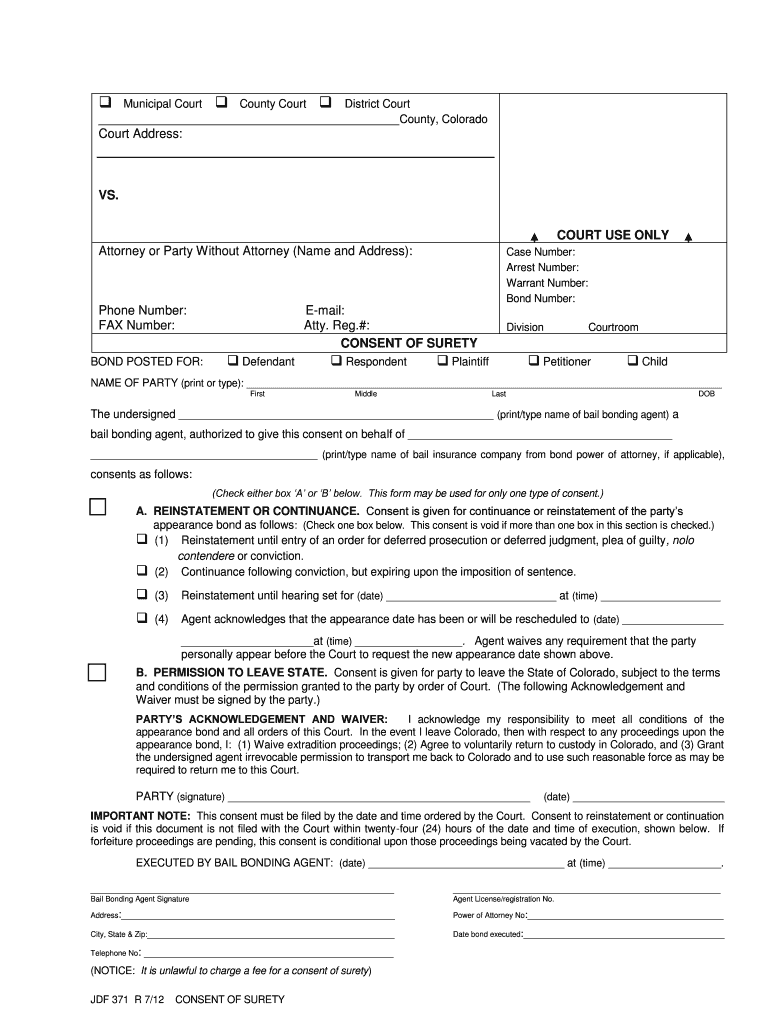
E and Address): Phone Number: FAX Number: BOND POSTED FOR: Case Number: Arrest Number: Warrant Number: Bond Number: E-mail: Atty. Reg.#: CONSENT OF SURETY Defendant Respondent Division Plaintiff Courtroom Petitioner Child NAME OF PARTY (print or type): First Middle Last DOB The undersigned (print/type name of bail bonding agent) a.
Loading

Open form follow the instructions

Easily sign the form with your finger

Send filled & signed form or save
How to fill out the CO JDF 371 online
The CO JDF 371 is a critical document used in the Colorado court system for consenting sureties. This guide will provide clear and supportive instructions on filling out the form online, ensuring that you complete each section accurately and efficiently.
Follow the steps to fill out the CO JDF 371 online.
- Click ‘Get Form’ button to obtain the form and open it in the editor.
- Begin by filling in the court details, including the type of court (Municipal, County, or District), county name, and court address as required at the top of the form.
- Enter the relevant case information, such as the case number, arrest number, warrant number, and bond number in the designated fields.
- Provide your contact information, including your phone number, fax number, and email address, so the court can reach you if necessary.
- Specify whether you are the defendant, respondent, plaintiff, petitioner, or child by checking the appropriate box.
- Print or type the full name of the party involved in the bond, including their first name, middle name, last name, and date of birth.
- Fill in the name of the bail bonding agent and the bail insurance company, ensuring that this information matches that on the bond power of attorney if applicable.
- Choose either option 'A' or 'B' for consent of surety, checking the relevant box and following the instructions that correspond to your choice regarding reinstatement, continuance, or permission to leave the state.
- If you selected option 'B', ensure the party acknowledges and waives their rights as outlined in the section, and have them sign and date the acknowledgment and waiver portion.
- Finally, fill in the date and time the consent was executed by the bail bonding agent, including their signature, license number, address, power of attorney number, city, state, zip code, and the date the bond was executed.
- Review all entries for correctness, save the changes, and once everything is filled out accurately, you can download, print, or share the form as required.
Complete your CO JDF 371 online today to ensure a smooth filing process.
Experience a faster way to fill out and sign forms on the web. Access the most extensive library of templates available.
Related content
JDF 371. Document. JDF 371Consent of Surety R7-12.doc (MS Word, 64 KB). Document. JDF...
by Q Luo · 2022 · Cited by 12 — ALMA Survey of Orion Planck Galactic Cold Clumps...
JPF 2A, 3A, 4A, 41A. 11. Dimensions and Weights. 11. Performance Chart. 11. Performance...
Get answers to your most pressing questions about US Legal Forms API.
What does Bond type C S P mean?
C/P/S refers to the type of bond that is required for release from jail. C = cash; S = surety or bondsman; and P = property. If the person cannot bond out on the bond amount that is set by the court, the person can ask for a lower bond... 0 found this answer helpfulhelpful votes | 2 lawyers agree.
What does PR bond mean?
A PR bond, also known as a Personal Recognizance Bond, is when a Judge allows the defendant to be released without any deposit or collateral. Defendants still have to promise to appear in court even though they had their bond conditions removed.
How does a PR bond work?
PR BONDS. A Personal Recognizance bond, or PR bond, is when the nature of the charge, the criminal history of the arrested person, and the facts of the case warrant releasing a person from jail without them having to put up any money either through the jail or to a bond company. This usually has a trade off.
Do you have to pay for a PR bond?
The benefit of obtaining a PR Bond is that although a bail amount is set by a judge, the bonded party won't have to pay anything and is required to be present for all court appearances.
Can you leave the state of Florida on bond?
when on bond in the state of florida can you leave the sta Depends. If it is just a cash bond, no order from a judge, then you don't have any restrictions on your freedom of movement and can go where you please, as long as you show up for court.
Can you travel when you are on bond?
If travel is possible your bail bond agent will be able to get permission from the court. Usually in state travel is permissible it is out of state travel that can require special permission.
Can you leave the state on a PR bond?
Terms and Conditions Established by the Court That does not mean you cannot obtain permission to leave the state. However, you must seek the court's express permission to leave the state in order to do so lawfully.
How do I release on my own recognizance?
When a criminal suspect is arrested, booked and granted release on their "own recognizance," or "O.R.," no bail money is paid to the court and no bond is posted. The suspect is merely released after promising, in writing, to appear in court for all upcoming proceedings.
What does PR bond stand for?
A PR bond, also known as a Personal Recognizance Bond, is when a Judge allows the defendant to be released without any deposit or collateral. Defendants still have to promise to appear in court even though they had their bond conditions removed.
What does PR mean in court?
A release on your own recognizance (ROR), also known as an own recognizance (OR) or personal recognizance (PR), is a written promise signed by the defendant promising that they will show up for future court appearances and not engage in illegal activity while out on an ROR.
Use professional pre-built templates to fill in and sign documents online faster. Get access to thousands of forms.
If you believe that this page should be taken down, please follow our DMCA take down process here.