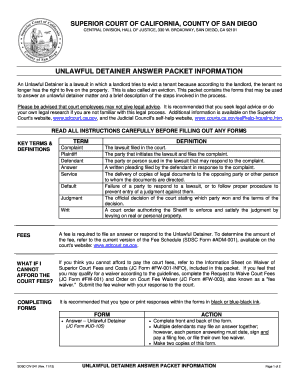
It is recommended that you type or print responses within the forms in black or blue-black ink. FORM Answer Unlawful Detainer (JC Form #UD-105) ACTION SDSC CIV-241 (Rev. 11/12) Complete front and back of the form. Multiple defendants may file an answer together; however, each person answering must date, sign and pay a filing fee, or file their own fee waiver. Make two copies of this form. UNLAWFUL DETAINER ANSWER PACKET INFORMATION Page 1 of 2 COMPLETING FORMS, cont.

How it works
  • Open form

    Open form follow the instructions

  • Easily sign form

    Easily sign the form with your finger

  • Share form

    Send filled & signed form or save

How to fill out the CA PKT-021 online

Filling out the CA PKT-021 form online can be a straightforward process when guided correctly. This user-friendly guide provides step-by-step instructions to help you complete the Unlawful Detainer Answer Packet effectively.

Follow the steps to complete the CA PKT-021 form online easily.

  1. Press the ‘Get Form’ button to access the CA PKT-021 form and open it in the online editor.
  2. Carefully read the instructions provided with the packet, including the definitions of key terms like complaint, plaintiff, and defendant, to understand your rights and obligations.
  3. Begin filling out the ‘Answer – Unlawful Detainer’ form (Judicial Council Form #UD-105) by identifying yourself as the defendant at the top of the form.
  4. In Section 2 of the form, select the appropriate box indicating whether you generally deny the statements in the complaint or admit certain statements, while specifying which ones you dispute.
  5. Proceed to outline any affirmative defenses in Section 3, ensuring you provide brief facts for each selected defense.
  6. Fill out Section 4 with any other statements or information relevant to your case, ensuring to keep detailed records.
  7. If applicable, complete the ‘Proof of Service by First-Class Mail’ form (Judicial Council Form #POS-030) to confirm that you have served the other party with the necessary documents.
  8. Once all sections are filled, review the entire packet for accuracy and clarity.
  9. Save changes to the form in the online editor, and prepare to download and print your completed document.
  10. Finally, submit your original forms along with the required filing fee, or a fee waiver, to the appropriate court as indicated in your instructions.

Start completing your CA PKT-021 form online today!

Get form

Experience a faster way to fill out and sign forms on the web. Access the most extensive library of templates available.

Related content

Unlawful Detainer Answer Packet - San Diego...

PKT-021 (Rev.1/25). SUPERIOR COURT OF CALIFORNIA. COUNTY OF SAN DIEGO. UNLAWFUL DETAINER...

Learn more
Reference Manual

Documentation: Tim Ahern, Incorporated Research Institutions for Seismology. Ray Styles...

Learn more
Questions & Answers

Get answers to your most pressing questions about US Legal Forms API.

Contact support

What is the new law for eviction in California?

California has enacted new laws to enhance tenant protections against eviction. These changes include stricter regulations on notice periods and additional requirements for evictions. Understanding these updates is essential for both landlords and tenants. Detailed information in CA PKT-021 helps users stay informed about their rights and obligations under these new laws.

The eviction process in California can take between three weeks and several months, depending on the circumstances and court schedule. Timeframes vary significantly based on whether the eviction is contested or uncontested. Tenants should be aware of their rights and the legal steps involved. Insights from CA PKT-021 can help clarify potential delays and necessary actions.

In California, tenants have five days to appeal an unlawful detainer judgment after a ruling. This tight timeline emphasizes the need for quick action and thorough preparation for the appeal process. Tenants should gather supporting documents to substantiate their appeal. Knowledge of procedures outlined in CA PKT-021 can streamline this process efficiently.

In California, the landlord typically holds the burden of proof in unlawful detainer cases. This means they must demonstrate valid grounds for eviction, such as non-payment of rent or lease violations. Tenants can challenge this evidence by presenting their own documentation. Using CA PKT-021 can clarify tenant rights and the evidentiary requirements in these situations.

Filing a corporate disclosure statement in California can be done easily online through the state's official website. It involves filling out necessary forms and providing essential corporate information. Ensuring accuracy is crucial to avoid delays in processing. The platform at US Legal Forms can facilitate this process and ensure all requirements are met as stipulated in CA PKT-021.

Beating an unlawful detainer in California requires understanding your legal rights and potential defenses. Tenants can contest the eviction by proving a lack of legal grounds or improper procedure by the landlord. Gathering necessary evidence, such as correspondence or payments, is crucial. Resources like CA PKT-021 offer detailed guidance on accepting a solid defense strategy.

The timeline for an unlawful detainer in California varies but typically takes around 30 to 60 days from the start of the process. After serving the notice, landlords usually file the case, followed by a court hearing. The speed of resolution can depend on the local court's schedule and other factors. Knowledge of CA PKT-021 can help users navigate and expedite the process.

A motion to quash unlawful detainer is a legal request to dismiss the eviction process in California. This motion argues that the court lacks jurisdiction or the notice was improperly served. It can be an effective strategy for tenants to halt eviction proceedings. Referencing CA PKT-021 can guide users on how to properly file such motions.

Yes, a tenant can win an unlawful detainer case in California. Tenants should ensure they present valid defenses and documentation in their favor. Evidence like rental agreements or proof of rent payments can support their case. Using resources such as CA PKT-021 can clarify the legal process involved.

After the eviction court date in California, the judge will issue a ruling based on the evidence presented. If the judgment favors the landlord, they can initiate the eviction process. It is important to understand your next steps and any options available to you, such as appealing the decision. Tools like CA PKT-021 can provide necessary insights to navigate this process effectively.

Get This Form Now!

Use professional pre-built templates to fill in and sign documents online faster. Get access to thousands of forms.

If you believe that this page should be taken down, please follow our DMCA take down process here.

CA PKT-021 Form

This form is available in several versions. Select the version you need from the drop-down list below.

Get CA PKT-021