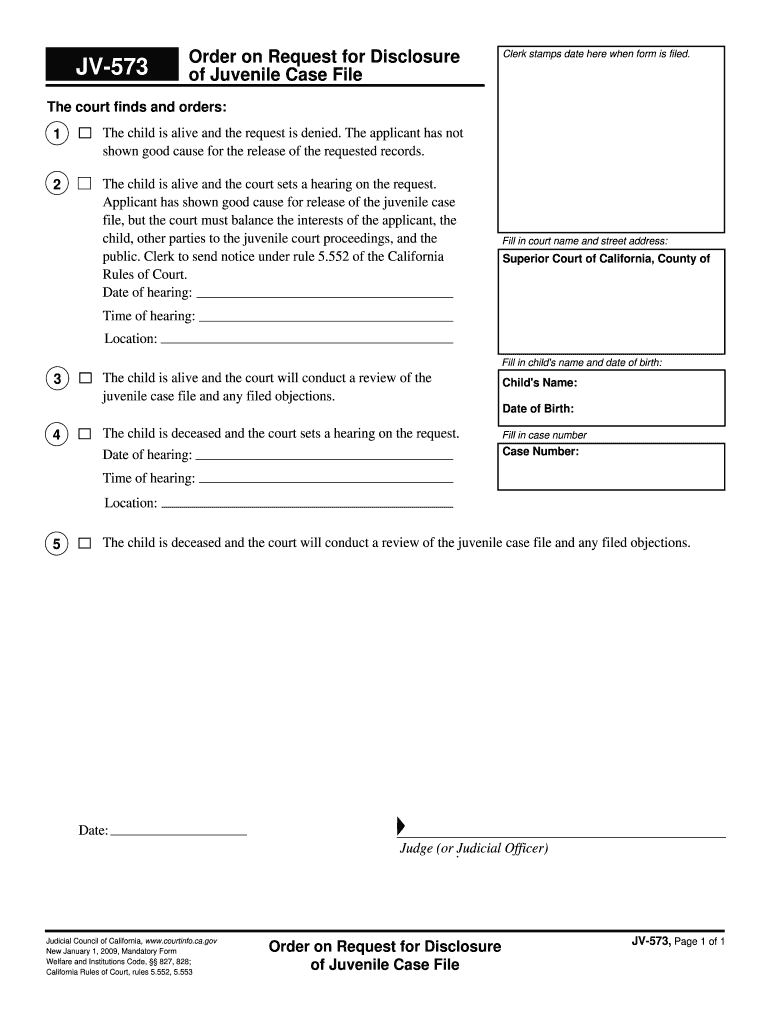
JV-573 Order on Request for Disclosure of Juvenile Case File Clerk stamps date here when form is filed. The court finds and orders The child is alive and the request is denied. The applicant has not shown good cause for the release of the requested records. Applicant has shown good cause for release of the juvenile case file but the court must balance the interests of the applicant the child other parties to the juvenile court proceedings and the public* Clerk to send notice under rule 5. 552 of.
Loading

Open form follow the instructions

Easily sign the form with your finger

Send filled & signed form or save
How to fill out the CA JV-573 online
The CA JV-573 form, known as the Order on Request for Disclosure of Juvenile Case File, is crucial for individuals seeking access to juvenile case records. This guide provides a clear, step-by-step approach to completing the form online, ensuring all users, regardless of legal experience, can navigate the process effectively.
Follow the steps to complete the CA JV-573 form online
- Press the ‘Get Form’ button to access the CA JV-573 document and open it in your preferred editor.
- In the top section of the form, you will find a designated area for the court's name and street address. Fill in the appropriate Superior Court of California, County of information.
- Next, indicate the date and time of the hearing. Clearly fill in the date of the hearing and the corresponding time slot beside it.
- In this section, enter the child's name and date of birth. Ensure this information is accurate as it pertains to the juvenile case.
- If applicable, fill in the case number in the designated area. This is important for identifying the specific juvenile case related to your request.
- Finally, review all the details you have entered for accuracy. After confirming that all information is correct, you can save your changes, download the form, or share it as needed.
Complete your documents online today for a hassle-free filing experience.
Experience a faster way to fill out and sign forms on the web. Access the most extensive library of templates available.
Related content
The child is alive and the court sets a hearing on the request. Applicant has shown good...
Jun 13, 2023 — A permanência de uma imagem estática de alto contraste no ecrã do...
Get answers to your most pressing questions about US Legal Forms API.
What are the three types of cases handled in juvenile court?
Juvenile court primarily handles three types of cases: delinquency, dependency, and status offenses. Each of these cases addresses different aspects of minors’ legal issues, ensuring their protection and rehabilitation. Understanding these distinctions is important, especially when dealing with forms like the CA JV-573 that might apply to various cases. UsLegalForms is here to help you understand and navigate the complexities of juvenile court cases.
How do I file a JV 575?
Filing a JV 575 requires completing the form accurately and submitting it through the appropriate juvenile court. It's essential to ensure that all details are correct, as they directly affect custody or visitation decisions. Working with resources like UsLegalForms can provide guidance and assistance during the filing process, especially when using related documents such as the CA JV-573.
What does JV mean in court?
In court settings, 'JV' refers to juvenile, indicating matters related to minors and their respective cases. The use of JV forms, including the CA JV-573, is integral for processes within the juvenile justice system. Understanding this terminology helps ensure that everyone involved is on the same page when navigating legal situations. UsLegalForms is an excellent resource for anyone dealing with juvenile court terminology and documentation.
What is a JV 820?
The JV 820 form is utilized in juvenile delinquency cases to report a minor’s arrest or detention status. This form helps the court maintain accurate records and ensures proper follow-up regarding the minor's case. Similar to the CA JV-573, it’s vital for individuals involved in juvenile justice to be well-informed about such forms. UsLegalForms can provide easy access to the JV 820 and guidance on its use.
What is a JV 100?
The JV 100 form serves as an application for the court to appoint an attorney for a minor in juvenile dependency cases. This form ensures that minors have adequate legal representation during important hearings. It is closely related to the CA JV-573, as both are essential components of juvenile court procedures. UsLegalForms offers resources to help you understand and complete the JV 100 without hassle.
What is a JV 575 form?
The JV 575 form is often used to request a change in custody or visitation within juvenile court. This form plays a significant role in addressing the specific needs and welfare of minors. To navigate the complexities of juvenile court effectively, it's essential to understand forms like the JV 575 alongside the CA JV-573. UsLegalForms can help simplify the process of obtaining and completing this form.
What is a JV 570?
The JV 570 is a legal form used in juvenile court proceedings. It typically relates to various petitions or reports that affect minors. Understanding this form can be crucial for anyone involved in juvenile cases, particularly when managing cases that also involve the CA JV-573. By utilizing platforms like UsLegalForms, users can easily access the JV 570 and related legal documents.
How are juvenile cases handled in California?
In California, juvenile cases are handled with a focus on rehabilitation and community support. The juvenile court system aims to address behaviors with educational and therapeutic programs rather than punitive measures. This approach seeks to reduce recidivism and promote positive development for young individuals. Using resources like CA JV-573 can provide essential guidance on the specifics of juvenile legal processes.
How do you designate a case as complex in California?
In California, to designate a case as complex, a party must file a motion stating the reasons for such a designation. Factors may include the case's volume of evidence, the number of parties involved, or significant legal issues. The court will then review the motion to determine if the case merits a complex designation. Familiarizing yourself with forms like CA JV-573 can assist you throughout this process.
What are the 4 steps in the juvenile justice process?
The juvenile justice process generally follows four key steps: intake, adjudication, disposition, and post-disposition. During intake, officials assess whether the case should proceed to court. Adjudication involves hearing the case, followed by disposition where penalties or rehabilitation plans are set. Finally, post-disposition ensures that the juvenile receives the necessary follow-up support, often referencing forms like CA JV-573 for guidance.
Use professional pre-built templates to fill in and sign documents online faster. Get access to thousands of forms.
If you believe that this page should be taken down, please follow our DMCA take down process here.
This form is available in several versions. Select the version you need from the drop-down list below.