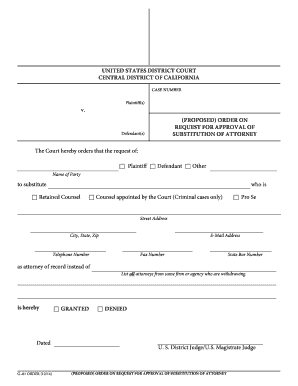
Ttorneys from same firm or agency who are withdrawing. DENIED U. S. District Judge/U.S. Magistrate Judge (PROPOSED) ORDER ON REQUEST FOR APPROVAL OF SUBSTITUTION OF ATTORNEY.

How it works
  • Open form

    Open form follow the instructions

  • Easily sign form

    Easily sign the form with your finger

  • Share form

    Send filled & signed form or save

How to fill out the CA G-01 Order online

Filling out the CA G-01 Order is an essential step for anyone seeking to substitute their attorney in a case. This guide will provide you with step-by-step instructions to complete the form online with ease.

Follow the steps to accurately complete the CA G-01 Order online.

  1. Click 'Get Form' button to access the CA G-01 Order and open it in your preferred online editor.
  2. Begin by entering the case number at the top of the form. This number is crucial for identifying your case within the court system.
  3. Under the 'Plaintiff(s)' section, indicate who is requesting the substitution by checking the appropriate box next to 'Plaintiff,' 'Defendant,' or 'Other.'
  4. Fill in the 'Name of Party' field with the full name of the individual requesting the attorney substitution. This is important for correspondence and identification.
  5. In the 'to substitute' section, specify the name of the new attorney or representative. Select from 'Retained Counsel,' 'Counsel appointed by the Court (Criminal cases only),' or 'Pro Se' to describe their status.
  6. Complete the contact information fields including 'Street Address,' 'City, State, Zip,' 'E-Mail Address,' and 'Telephone Number,' ensuring accurate details for communication.
  7. If applicable, provide the 'Fax Number' and 'State Bar Number' for the new attorney to facilitate further legal processes.
  8. List all attorneys from the same firm or agency who are withdrawing in the specified area, ensuring that the court is informed of any changes.
  9. At the bottom of the form, indicate the request's outcome by marking either 'GRANTED' or 'DENIED' based on the court's decision.
  10. Finally, date the form as required, and review all entries for accuracy before finalizing.

Start filling out your CA G-01 Order online today for efficient processing of your legal needs.

Get form

Experience a faster way to fill out and sign forms on the web. Access the most extensive library of templates available.

Related content

G-001 ORDER.pdf

G–01 ORDER (02/24). (PROPOSED) ORDER ON REQUEST FOR APPROVAL OF SUBSTITUTION OR...

Learn more
Investigative Audits & Reports: Access...

Feb 11, 2015 — G-01. Government Code - GOV. TITLE 2. GOVERNMENT OF THE STATE OF...

Learn more
MICRO COMPONENT SYSTEM

You can arrange the order in which tracks play before you start playing. You can program...

Learn more
Questions & Answers

Get answers to your most pressing questions about US Legal Forms API.

Contact support

How do I remove a case to federal court in California?

To remove a case to federal court in California, you must file a notice of removal in the appropriate federal court before the case proceeds further in state court. This filing must comply with specific legal guidelines, ensuring that jurisdiction is correctly established. The CA G-01 Order may serve as a useful reference for understanding relevant legal considerations during this process.

The federal rule for withdrawal of counsel outlines the specific circumstances under which an attorney can withdraw from a case, similar to state laws but with its own nuances. Attorneys must adhere to ethical standards and provide a valid reason for withdrawal. Understanding these federal guidelines alongside the CA G-01 Order can clarify the withdrawal process.

A motion to be relieved as counsel is a formal request for the court to dismiss an attorney from their role in a case. This motion outlines the reasons for the request and is typically accompanied by a CA G-01 Order to ensure compliance with legal obligations. This process is important for maintaining proper legal representation.

Yes, you can oppose a motion to withdraw as counsel if you believe that the attorney should continue representation. If you feel that the withdrawal could negatively impact your case, it's crucial to voice these concerns promptly. Understanding how to respond in line with the CA G-01 Order is vital for protecting your rights.

Several ethical reasons may prompt an attorney to withdraw from representation, including a breakdown in communication or a conflict of interest. Attorneys must act in the best interests of their clients, and if they feel unable to do so, withdrawal could be necessary. Referencing the CA G-01 Order can help ensure that the withdrawal process aligns with legal standards.

An unopposed motion to withdraw occurs when the client has agreed to the attorney’s request to stop representing them, and no objections are raised. This type of motion is generally easier and can be processed more quickly in court. Knowing how this relates to the CA G-01 Order helps clarify the procedures for withdrawing counsel.

The attorney of record in California is the lawyer who has filed documents and is officially recognized by the court for a case. They hold the responsibility for representing the client and managing all legal matters related to the case. Understanding the role of the attorney of record is essential, especially when addressing motions like the CA G-01 Order.

When an attorney files a motion to withdraw an appearance, they are formally requesting permission from the court to stop representing a client. This motion must often outline the reasons for withdrawal, ensuring they comply with ethical guidelines. The CA G-01 Order can provide clarification on the legal process involved in this action, helping you understand its implications.

Filling out a general resale certificate in California involves providing information about your business, including the seller's name and address. You must also declare that the purchases made are intended for resale. For a led approach to completing this process and ensuring alignment with the CA G-01 Order, consider tools like uslegalforms to simplify paperwork.

To withdraw from a case in California, an attorney usually files a motion with the court and notifies the client. The withdrawal requires the attorney to demonstrate sufficient grounds, such as conflict of interest or client misconduct. For those unsure about the withdrawal process, referencing the CA G-01 Order can provide essential guidance.

Get This Form Now!

Use professional pre-built templates to fill in and sign documents online faster. Get access to thousands of forms.

If you believe that this page should be taken down, please follow our DMCA take down process here.

Get CA G-01 Order