Loading
Form preview
  • US Legal Forms
  • Other Templates
  • Legal Forms
  • California Legal Forms
  • Ca Dv-730 2012

Get Ca Dv-730 2012-2026

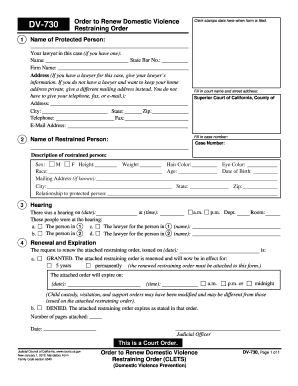
S case, give your lawyer s information. If you do not have a lawyer and want to keep your home address private, give a different mailing address instead. You do not have to give your telephone, fax, or e-mail.): Address: Zip: City: State: Telephone: Fax: E-Mail Address: 2 Clerk stamps date here when form is filed. Fill in court name and street address: Superior Court of California, County of Fill in case number: Name of Restrained Person: Case Number: Description of restrained person:.

How it works

  1. Open form

    Open form follow the instructions

  2. Easily sign form

    Easily sign the form with your finger

  3. Share form

    Send filled & signed form or save

How to fill out the CA DV-730 online

The CA DV-730 form is essential for individuals seeking to renew a domestic violence restraining order. This guide will provide you with clear, step-by-step instructions to help you fill out this form online efficiently and accurately.

Follow the steps to complete your CA DV-730 form online.

  1. Click ‘Get Form’ button to obtain the form and open it in the editor.
  2. Begin by entering the name of the protected person at the top of the form. If you have legal representation, include your lawyer's name, firm name, and their State Bar number.
  3. Provide your address. If you wish to keep your home address private due to safety concerns, you may enter a different mailing address instead. You do not have to disclose your telephone, fax, or email information.
  4. Next, fill in the court name and address. This should be the Superior Court of California in the relevant county.
  5. Enter the case number associated with your restraining order. Then, provide details about the restrained person, including their name, sex, age, height, weight, race, and hair color.
  6. If known, include the mailing address of the restrained person, as well as their relationship to the protected person.
  7. Indicate the date and time of the previous hearing regarding this case, along with the names of those present at the hearing.
  8. In the section for renewal and expiration, check the appropriate box indicating whether your request to renew the restraining order is granted or denied.
  9. If granted, state the duration of the renewed order as either 5 years or permanently, and provide the expiration date of the attached order.
  10. Finally, indicate the number of pages attached to your application and provide the date and signature of the judicial officer.
  11. Once all fields are filled, review your entries for accuracy. You can save your changes, download the completed form, print it, or share it as needed.

Complete your CA DV-730 form online today for a smoother application process.

Get form

Experience a faster way to fill out and sign forms on the web. Access the most extensive library of templates available.
Get form

Related content

DV-730 Order to Renew Domestic Violence...
Jan 1, 2024 — Form DV-730 is used to request renewal of a domestic violence restraining...
Learn more
Post-bloom and preharvest treatment of 'Braeburn'...
Nov 12, 2019 — This study was carried out to assess the effects of treatments of...
Learn more
GZ-MG50U GZ-MG40U GZ-MG30U GZ-MG20U
Utilize bateria JVC BN-VF707U e, para recarregá-la, ou para fornecer energia à câmera a...
Learn more

Related links form

Canada WorkSafeNB Asbestos Management Program Template 2023 Canada Quikcard Adult Dependent Declaration 2019 Canada OPSEU Professional Liability Program Application 2013 Canada Form F4 2021

Questions & Answers

Get answers to your most pressing questions about US Legal Forms API.

Contact support

To obtain a civil harassment restraining order in California, you must present clear evidence of harassment, including documentation of threats or unwanted contact. This can include text messages, emails, or witness statements. If you are dealing with a CA DV-730 situation, leveraging tools available through uslegalforms can provide the necessary guidance to strengthen your case.

A domestic violence misdemeanor can remain on your record indefinitely unless you seek expungement. This can impact various areas of your life, such as employment and housing. Utilizing resources related to CA DV-730 can guide you in managing these challenges effectively.

Evidence Code 730 in California pertains to the provisions for appointing a neutral expert in legal disputes. This expert assists the court by providing unbiased information regarding issues that require specialized knowledge. Familiarity with CA DV-730 can often clarify how such evidence may influence domestic violence cases.

If a victim violates a no contact order, it may lead to legal complications, including potential charges for the violation. It is important for victims to understand the seriousness of the order and its restrictions. If you require assistance concerning your CA DV-730, consider seeking legal help to address any questions.

In California, misdemeanors do not automatically disappear after seven years. Instead, you may need to petition for expungement to remove them from your record. Understanding the implications of your CA DV-730 can help you navigate this process more effectively.

In California, a temporary restraining order may show up on your record for the duration of the order, usually about 21 days. However, if the order is made permanent, it could stay on your record indefinitely. If you encounter issues with a CA DV-730, you can consult legal resources to understand how it may affect your future.

Clear and convincing evidence for a restraining order in California means the evidence must be strong enough to convince the judge of its truth. It is a higher standard than 'preponderance of the evidence' but lower than 'beyond a reasonable doubt.' Understanding this distinction can help in how you prepare your case under the CA DV-730 framework.

The standard of proof for a restraining order in California, especially under CA DV-730, relies on 'preponderance of evidence.' This means that the evidence must show that it is more likely than not that the abuse occurred. This standard allows the court to grant a restraining order based on a reasonable belief in the presented claims.

To fight a restraining order in California, start by filing a response to the order, explaining your side of the situation. It is vital to gather all relevant evidence, and you might consider utilizing resources like US Legal Forms to assist with documentation. Preparing compelling arguments and possibly getting legal counsel can significantly improve your chances of success.

Defending against a restraining order requires careful preparation and a solid understanding of the CA DV-730 process. You should gather evidence that counters the claims made against you, such as witness statements or alibis. Consulting with a legal expert could also provide crucial guidance on how to effectively present your case in court.

Get This Form Now!

Use professional pre-built templates to fill in and sign documents online faster. Get access to thousands of forms.
Get form
If you believe that this page should be taken down, please follow our DMCA take down processhere.
Get CA DV-730
Get form
  • Adoption
  • Bankruptcy
  • Contractors
  • Divorce
  • Home Sales
  • Employment
  • Identity Theft
  • Incorporation
  • Landlord Tenant
  • Living Trust
  • Name Change
  • Personal Planning
  • Small Business
  • Wills & Estates
  • Packages A-Z
  • Affidavits
  • Bankruptcy
  • Bill of Sale
  • Corporate - LLC
  • Divorce
  • Employment
  • Identity Theft
  • Internet Technology
  • Landlord Tenant
  • Living Wills
  • Name Change
  • Power of Attorney
  • Real Estate
  • Small Estates
  • Wills
  • All Forms
  • Forms A-Z
  • Other Templates
  • Legal Hub
  • About Us
  • Help Portal
  • Legal Resources
  • Blog
  • Affiliates
  • Contact Us
  • Delete My Account
  • Site Map
  • Industries
  • Forms in Spanish
  • Localized Forms
  • State-specific Forms
  • Forms Kit
  • Real Estate Handbook
  • All Guides
  • Notarize
  • Incorporation services
  • For Consumers
  • For Small Business
  • For Attorneys
  • USLegal
  • FormsPass
  • pdfFiller
  • signNow
  • altaFlow
  • DocHub
  • Instapage
Form Packages
  • Adoption
  • Bankruptcy
  • Contractors
  • Divorce
  • Home Sales
  • Employment
  • Identity Theft
  • Incorporation
  • Landlord Tenant
  • Living Trust
  • Name Change
  • Personal Planning
  • Small Business
  • Wills & Estates
  • Packages A-Z
Form Categories
  • Affidavits
  • Bankruptcy
  • Bill of Sale
  • Corporate - LLC
  • Divorce
  • Employment
  • Identity Theft
  • Internet Technology
  • Landlord Tenant
  • Living Wills
  • Name Change
  • Power of Attorney
  • Real Estate
  • Small Estates
  • Wills
  • All Forms
  • Forms A-Z
  • Other Templates
Customer Service
  • Legal Hub
  • About Us
  • Help Portal
  • Legal Resources
  • Blog
  • Affiliates
  • Contact Us
  • Delete My Account
  • Site Map
  • Industries
  • Forms in Spanish
  • Localized Forms
  • State-specific Forms
  • Forms Kit
Legal Guides
  • Real Estate Handbook
  • All Guides
Prepared for you
  • Notarize
  • Incorporation services
Our Customers
  • For Consumers
  • For Small Business
  • For Attorneys
Our Sites
  • USLegal
  • FormsPass
  • pdfFiller
  • signNow
  • altaFlow
  • DocHub
  • Instapage
Social Media
Call us now toll free:
+1 833 426 79 33
As seen in:
© Copyright 1999-2026 airSlate Legal Forms, Inc. 17 Station Street, Suite 303, Brookline, MA 02445
  • Your Privacy Choices
  • Terms of Service
  • Privacy Notice
  • Content Takedown Policy
  • Bug Bounty Program