Loading
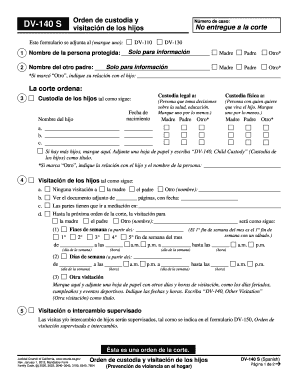
Get Ca Dv-140 S 2012-2026
How it works
-

Open form follow the instructions
-

Easily sign the form with your finger
-

Send filled & signed form or save
How to fill out the CA DV-140 S online
The CA DV-140 S form, also known as the custody and visitation order for children, is an important document for establishing custody arrangements. This guide provides clear, step-by-step instructions to assist users in completing this form online with ease.
Follow the steps to fill out the CA DV-140 S online.
- Click ‘Get Form’ button to obtain the form and open it in the editor.
- Begin by filling out the name of the protected person in the designated field.
- Enter the name of the other parent in the next field, along with the case number.
- Indicate your relationship to the child by marking the appropriate option (mother, father, or other). If 'other' is selected, specify the relationship.
- Detail the custody arrangement for each child by entering their name and date of birth, and specify who has legal and physical custody.
- Outline the visitation schedule, including no visitation, attached documents for more detailed arrangements, and any required mediation.
- Provide specifics for weekend and weekday visitation, including times and days of the week.
- Indicate if there are any supervised visitation requirements, and outline arrangements as needed.
- Fill in the section about transportation responsibilities for visitation.
- Specify any travel restrictions regarding the children, including permissions or court orders.
- If applicable, mark and attach other orders related to custody or visitation by labeling appropriately.
- Review all sections for accuracy, save your work, and consider downloading or printing the completed form for your records.
Complete your documents online today!
In California, a mother cannot unilaterally stop a father from seeing their child unless there are valid reasons, such as concerns about safety. Any decisions regarding custody and visitation must be handled through the court system, often requiring the CA DV-140 S to outline the child's best interests. If there's a dispute, seeking legal advice can help clarify your options and rights.