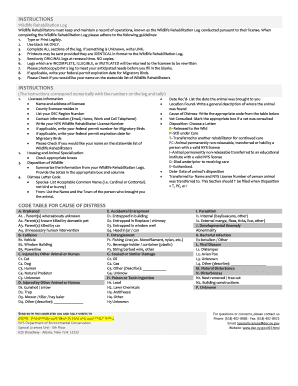
Ng the Wildlife Rehabilitation Log please adhere to the following guidelines: 1. Type or Print Legibly. 2. Use black ink ONLY. 3. Complete ALL sections of the log. If something is Unknown, write UNK. 4. Printouts may be sent provided they are IDENTICAL in format to the Wildlife Rehabilitation Log. 5. Send only ORIGINAL logs at renewal time. NO copies. 6. Logs which are INCOMPLETE, ILLEGIBLE, or MUTILATED will be returned to the licensee to be rewritten 7. Please photocopy/print a log to meet you.

How it works
  • Open form

    Open form follow the instructions

  • Easily sign form

    Easily sign the form with your finger

  • Share form

    Send filled & signed form or save

How to fill out the NY Instructions Wildlife Rehabilitation Log online

Completing the NY Instructions Wildlife Rehabilitation Log is essential for wildlife rehabilitators to maintain accurate records of their operations. This guide will walk you through each section of the log to ensure you fill it out correctly and completely.

Follow the steps to successfully complete your wildlife rehabilitation log.

  1. Press the 'Get Form' button to obtain the form and open it for editing.
  2. In the licensee information section, enter your name and address clearly. Include the county in which you reside and your DEC region number.
  3. Write your NYS Wildlife Rehabilitator License Number.
  4. Indicate whether you would like your name included on the statewide list of Wildlife Rehabilitators by marking the appropriate box.
  5. In the housing and animal specialization section, check the appropriate boxes that represent your specialties.
  6. For the disposition of wildlife, summarize the relevant information from your logs and provide the totals in the specified boxes and columns.
  7. In the distress letter code section, list the common names of the species of animals you have rehabilitated. Be specific (e.g., Cardinal, Cottontail).
  8. Detail the name and town of the person who brought you the animal, along with the date received and the location where the animal was found.
  9. Indicate whether a vet was consulted by marking the corresponding box.
  10. Select the appropriate disposition letter that describes the status of the animal, under the disposition section.
  11. Provide the date of disposition for the animal and, if transferred, include the name and NYS License Number of the individual the animal was transferred to.
  12. Once all sections are completed, review your log for legibility and completeness. You can then save your changes, download, print, or share the form as necessary.

Ensure accurate record-keeping by completing your wildlife rehabilitation logs online today.

Get form

Experience a faster way to fill out and sign forms on the web. Access the most extensive library of templates available.

Related content

NYSDEC Wildlife Rehabilitation Log and Tally...

Summarize the information from your Wildlife Rehabilitation Logs. Provide the totals in...

Learn more
AVMA Guidelines for the Euthanasia of Animals:...

*The AVMA Panel on Euthanasia develops the content of the guidelines, with support from...

Learn more
New York State Flood Risk Management Guidance for...

In 2014, Governor Andrew Cuomo signed the. Community Risk and Resiliency Act (CRRA) to...

Learn more
Questions & Answers

Get answers to your most pressing questions about US Legal Forms API.

Contact support

How to find a wildlife rehabilitator near you?

If your state wildlife agency doesn't list wildlife rehabilitators in your area, you can check for the nearest wildlife rehabilitators by going to the AnimalHelpNow website. You can also locate wildlife rehabilitators by visiting the National Wildlife Rehabilitators Association's (NWRA) “Finding a Rehabilitator” page.

Either: 1. Work under the consultation and support of a licensed veterinarian and shall have satisfactorily completed 200 hours over a 2-year period as a Class I apprentice wildlife rehabilitation permittee; 2. Be a licensed veterinarian; or 3. Hold a valid wildlife rehabilitator license from another state.

Call your Local Wildlife Rehabilitation Organization If you find an injured or orphaned wild animal the best thing you can do is call your local organization and get information on what to do next.

Finding help for an orphaned or injured animal Once you're sure the animal needs your help, call a wildlife rehabilitator for assistance. If you're unable to locate a rehabilitator, try contacting an animal shelter, humane society, animal control agency, nature center, state wildlife agency or veterinarian.

For an injured, distressed or deceased wild animal or other wildlife concerns, contact LA Animal Services at 888-452-7381. You can also contact your local City shelter directly. PLEASE NOTE: Most rehabilitators do not provide services to pick up wildlife. They rely on you to get these animals to them.

In New Jersey, you can try contacting Raptor Trust (https://theraptortrust.org/) which is located in Basking Ridge and handles all kinds of birds. Franklin Lakes Animal Hospital (https://.franklinlakesanimalhospital.com/services/wildlife/) works with injured or orphaned wild animals.

Call the local animal control office or police department for assistance if the animal poses a threat to public health or safety. You should not try to care for wildlife yourself. Many people are not aware that it is illegal to keep wildlife in captivity or as pets in Illinois.

For an injured, distressed or deceased wild animal or other wildlife concerns, contact LA Animal Services at 888-452-7381. You can also contact your local City shelter directly. Encounters with wildlife information curated with the same love and care we should all take with our somewhat wild neighbors.

Get This Form Now!

Use professional pre-built templates to fill in and sign documents online faster. Get access to thousands of forms.

If you believe that this page should be taken down, please follow our DMCA take down process here.

Get NY Instructions Wildlife Rehabilitation Log