With Form DV-110, Temporary Restraining Order, you must turn in any guns or firearms in your immediate possession or control. You must file a receipt with the court from a law enforcement agency or a licensed gun dealer within 48 hours after you received Form DV-110. I do not own or have any guns or firearms. a. I ask for an exemption from the firearms prohibition under Family Code section 6389(h) because b. (specify): c. I have turned in my guns and firearms to law enforcement or sold them to,.

How it works
  • Open form

    Open form follow the instructions

  • Easily sign form

    Easily sign the form with your finger

  • Share form

    Send filled & signed form or save

How to fill out the CA DV-120 online

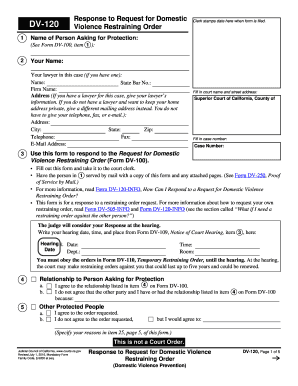
The CA DV-120 form is a Response to Request for Domestic Violence Restraining Order. This guide offers a clear and supportive approach to help users complete the form effectively, ensuring their rights and concerns are communicated appropriately.

Follow the steps to complete the CA DV-120 form online

  1. Press the ‘Get Form’ button to access the DV-120 online form and open it in a document management system.
  2. Begin by entering the name of the person asking for protection in the designated field. This should correlate with the information from Form DV-100, item 1.
  3. Fill in your personal details, including your name, lawyer's information (if applicable), and a mailing address. If you are not represented by a lawyer and wish to keep your home address confidential, provide an alternative mailing address.
  4. Complete the court name and street address fields. Specify the relevant Superior Court of California and the county.
  5. Enter the case number in the specified area.
  6. Refer to Form DV-109 to record your hearing date, time, and place.
  7. Specify your relationship to the person asking for protection and whether you agree or disagree with that relationship.
  8. Indicate your agreement or disagreement with the orders requested, specifying alternatives if you do not fully agree.
  9. Address any personal conduct, stay-away, or move-out orders in the respective sections, agreeing or disagreeing as appropriate.
  10. Respond to sections covering firearms, communication records, animal care, child custody and visitation, child support, and property-related orders similarly, ensuring to provide reasons where applicable.
  11. In item 25, provide detailed reasons for any disagreement with orders requested, ensuring clarity and specificity.
  12. Finalize your filling by declaring the truthfulness of the information provided, signing and dating the form appropriately.
  13. Once completed, save your changes, download the document, print it, or share it as needed.

Fill out your CA DV-120 form online today to protect your rights effectively.

Get form

Experience a faster way to fill out and sign forms on the web. Access the most extensive library of templates available.

Related content

DV-120 Response to Request for Domestic Violence...

Use this form if someone has asked for a domestic violence restraining order against you...

Learn more
HOW TO OBTAIN A DOMESTIC VIOLENCE RESTRAINING ...

In order for the TRO to become effective, the defendant must be personally served with the...

Learn more
DV-120-INFO How Can I Respond to a Request for...

I was served with form DV-100, DV-109, or. DV-110. What does this mean? Someone has asked...

Learn more
Questions & Answers

Get answers to your most pressing questions about US Legal Forms API.

Contact support

Why would a judge dismiss a protective order?

A judge may dismiss a protective order if they find insufficient evidence to support its continuation, or if the individual requesting the dismissal presents a compelling case indicating that the danger has diminished. Judges consider the well-being of all parties involved and rely heavily on evidence during hearings related to the CA DV-120. Always be prepared to communicate clearly your reasons for the request.

Good reasons to drop a restraining order include a change in circumstances that eliminates the need for protection, improved communication with the other party, or proof that the threatening behavior has ceased. Additionally, expressing your willingness to engage in mediation can be a positive step. Being informed about the CA DV-120 will guide you through this process.

The best evidence for a restraining order includes documented incidents, photographs of injuries, text messages, emails, or any other proof of harassment or threats. Presenting clear, factual evidence is crucial during the hearing. Utilizing resources related to the CA DV-120 can help you gather and organize your evidence effectively.

Filling out a DV 120 form requires specific information about both parties involved, as well as details on the restraining order. Start by ensuring you have all necessary details regarding the case, and follow the provided instructions closely. tools and guidance from platforms like US Legal Forms can simplify the process.

When speaking to a judge to drop a restraining order, express your desire to have the order lifted and provide valid reasons for your request. You might mention changes in circumstances or the resolution of conflicts. Remember, clarity and sincerity in your statements regarding the CA DV-120 hold significant weight.

In a restraining order hearing, present your case clearly and confidently. Start by stating your name, and your relationship to the other party, and then outline the reasons for your request for a CA DV-120. Be prepared to provide any supporting evidence or witness testimonies to strengthen your position.

Dissolving a protective order means that the court has lifted the restrictions that were previously imposed to protect someone from harm. This process generally involves filing specific legal documents and may require a hearing. Understanding the implications of the CA DV-120 can help navigate the dissolution process effectively.

To write a letter to remove a restraining order, begin by addressing the court where the order was issued. Clearly state your request to dissolve the restraining order and include details such as your name, case number, and the reasons for your request. It's important to stay respectful and concise while explaining why the conditions of the CA DV-120 are no longer necessary.

If neither party appears for the hearing regarding the CA DV-120, the court typically dismisses the case. This action is taken to ensure that the legal process is efficient and fair to all parties involved. If you anticipate being unable to attend, consider notifying the court in advance to explore potential options.

In California, approximately 70% of restraining orders, like CA DV-120, are granted at the initial hearing. This high percentage reflects the courts' commitment to protecting individuals from abuse and harassment. It's essential to present clear evidence and reasoning when filing a request for a restraining order to increase your chances of approval.

Get This Form Now!

Use professional pre-built templates to fill in and sign documents online faster. Get access to thousands of forms.

If you believe that this page should be taken down, please follow our DMCA take down process here.

Get CA DV-120