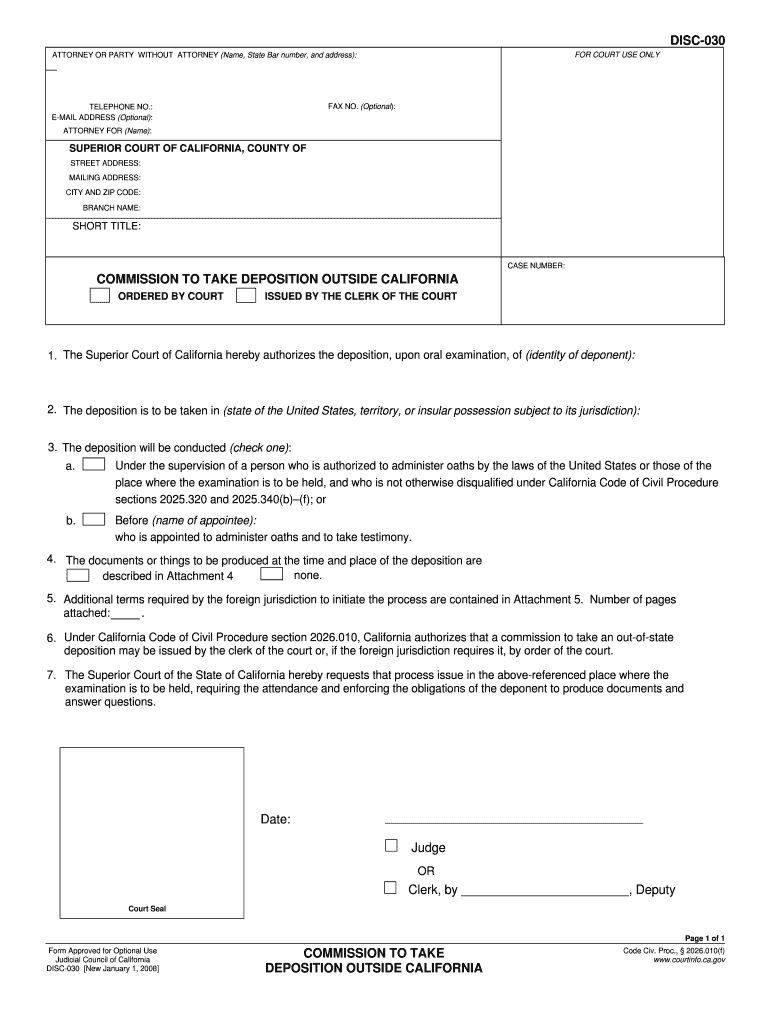
Date Judge OR Clerk by Deputy Court Seal Page 1 of 1 Form Approved for Optional Use Judicial Council of California DISC-030 New January 1 2008 Code Civ. Proc. 2026. DISC-030 FOR COURT USE ONLY ATTORNEY OR PARTY WITHOUT ATTORNEY Name State Bar number and address To keep other people from seeing what you entered on your form please press the Clear This Form button at the end of the form when finished. FAX NO. Optional TELEPHONE NO. E-MAIL ADDRESS Optional ATTORNEY FOR Name SUPERIOR COURT OF CALIFO.
Loading

Open form follow the instructions

Easily sign the form with your finger

Send filled & signed form or save
How to fill out the CA DISC-030 online
The CA DISC-030 form is a commission to take depositions outside California, an important step in the legal process. This guide will provide you with step-by-step instructions on how to accurately complete the form online.
Follow the steps to successfully complete the CA DISC-030 online.
- Click ‘Get Form’ button to obtain the form and open it in the editor.
- Fill in your name, state bar number, and address in the section provided for 'Attorney or party without attorney'. If applicable, you may also include your fax number and email address.
- Enter the appropriate court details by specifying the 'Superior Court of California, county of', followed by the street and mailing addresses, city, and zip code, along with the branch name.
- Provide the 'Short title' of the case which typically summarizes the nature of the case, and enter the case number assigned by the court.
- In section 1, identify the deponent (the individual whose deposition is being taken) clearly.
- Detail the location of the deposition in section 2, specifying the state of the United States, territory, or insular possession.
- In section 3, select whether the deposition will be conducted under the supervision of an authorized person or by an appointed individual. Include the name of the appointee if applicable.
- For section 4, state whether there are documents or items to be produced during the deposition. If there are, specify them in 'Attachment 4'; otherwise indicate 'none'.
- Complete section 5 by listing any additional terms from the foreign jurisdiction if required, noting the number of pages attached.
- Acknowledge section 6 which informs you about the court’s authority to issue the commission.
- In section 7, reaffirm the court's request for the process to issue in the specified location, ensuring all obligations of the deponent are noted.
- Finally, indicate the date, and ensure to sign where requested by the judge or clerk, and include the deputy's name if applicable.
- Once all sections are filled out, you can save your changes, download the form, print it, or share it as needed.
Complete your CA DISC-030 form online now to ensure a smooth legal process.
Experience a faster way to fill out and sign forms on the web. Access the most extensive library of templates available.
Related content
Commission to Take Deposition Outside California (DISC-030). Tell a party or non-party in...
An immersive five-week program, designed for college students to experience how climate...
May 7, 2007 — PRECAUÇÃO—Botão. (prontidão/ligar). Desligue a ficha da tomada da...
Get answers to your most pressing questions about US Legal Forms API.
How to fill out a subpoena form in California?
To fill out a subpoena form in California, carefully follow the instructions provided on the form, ensuring you input the correct names, case details, and specific requests. Make sure you check that all fields are correctly completed to comply with legal standards. Using resources like US Legal Forms can assist you in accurately completing the CA DISC-030.
How to write a subpoena for documents?
Writing a subpoena for documents involves clearly identifying the documents required and providing sufficient detail to avoid confusion. Include the title of the action, court information, and specific deadlines for compliance. Utilizing templates available through US Legal Forms can streamline this process in alignment with the CA DISC-030.
How to issue an out-of-state subpoena in California?
To issue an out-of-state subpoena in California, you must first obtain a court order. After securing the necessary approval, the out-of-state subpoena must adhere to California rules regarding service and compliance. Familiarizing yourself with these regulations under the CA DISC-030 simplifies the process and helps avoid delays.
How to properly serve a subpoena in California?
In California, a subpoena can be served by a process server, a registered process server, or even by mail if the recipient agrees. The individual serving the subpoena should be at least 18 years old and not a party to the case. Following the proper procedures outlined in the CA DISC-030 ensures your subpoena is effective and legally binding.
What must a subpoena contain?
A subpoena must clearly state the name of the court, the title of the action, and the specifics of what is being requested. It should also include the date, time, and location for compliance. Ensuring all necessary details are present in your CA DISC-030 will facilitate its lawful execution and reduce the chance of challenges.
What are valid reasons to get out of a subpoena?
Valid reasons to get out of a subpoena include situations where compliance poses an undue burden or when the subpoena requests privileged information. If the request violates personal rights or lacks relevance to the case, you may also seek to quash it. Understanding these grounds helps protect your rights while complying with the CA DISC-030.
How do I file proof of service in California?
To file proof of service in California, you must complete a proof of service form, documenting how and when you served the subpoena. This document must conform to California's requirements and should be filed with the court. For your convenience, the CA DISC-030 often includes this aspect, making it easier to ensure you follow all legal obligations.
What is the 7 hour rule for depositions?
The 7 hour rule refers to the maximum duration for a single deposition in California. According to this rule, a deposition cannot exceed 7 hours of testimony unless otherwise agreed upon by all parties involved or ordered by the court. Being aware of this guideline helps you plan accordingly and conduct thorough but efficient depositions.
How do I issue a deposition subpoena?
Issuing a deposition subpoena involves several steps. Start by completing the CA DISC-030 form, filling in all pertinent details such as the case number and witness information. After completing the form, serve it to the witness or their attorney, ensuring you follow the proper legal protocol. You may also want to consider using platforms like USLegalForms to streamline the process.
What is the difference between a subpoena and a deposition subpoena?
The primary difference lies in their purpose. A general subpoena compels a person to testify or produce evidence in court, whereas a deposition subpoena, like the CA DISC-030, specifically requires an individual to testify in a pre-trial depositions. Understanding this distinction helps ensure compliance and preparation for legal proceedings.
Use professional pre-built templates to fill in and sign documents online faster. Get access to thousands of forms.
If you believe that this page should be taken down, please follow our DMCA take down process here.