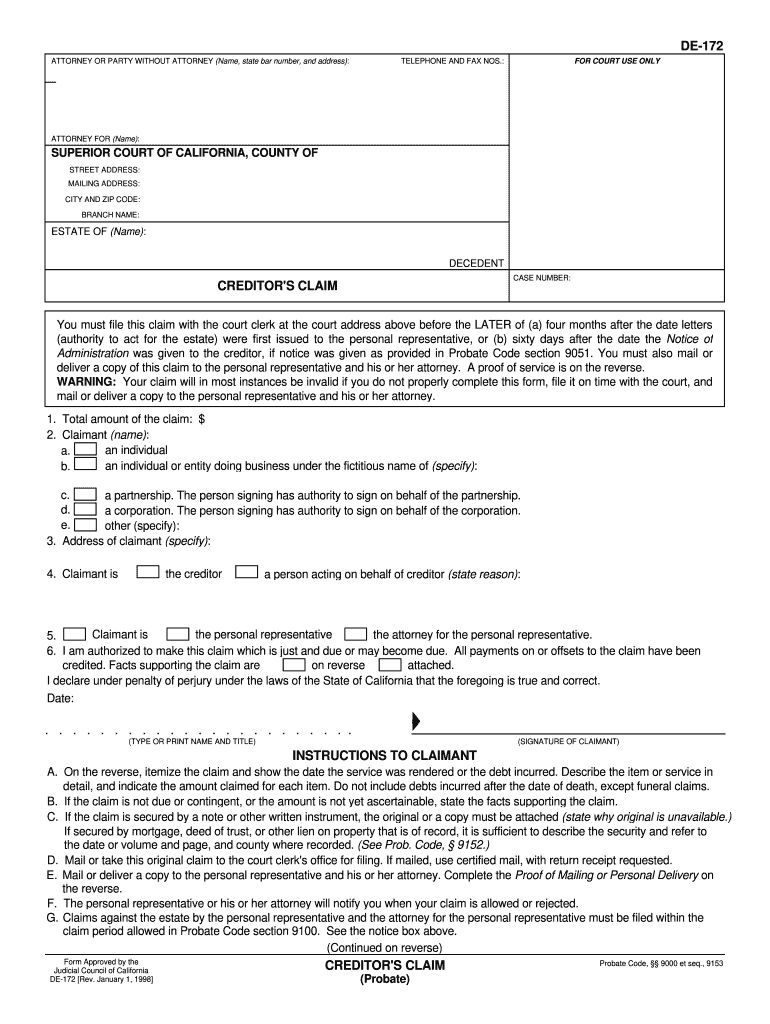
Ed or rejected. G. Claims against the estate by the personal representative and the attorney for the personal representative must be filed within the claim period allowed in Probate Code section 9100. See the notice box above. (Continued on reverse) Form Approved by the Judicial Council of California DE-172 Rev. January 1, 1998 CREDITOR'S CLAIM (Probate) Probate Code, 9000 et seq., 9153 CASE NUMBER: ESTATE OF (Name): DECEDENT FACTS SUPPORTING THE CREDITOR'S CLAIM See attachment (if.
Loading

Open form follow the instructions

Easily sign the form with your finger

Send filled & signed form or save
How to fill out the CA DE-172 online
The CA DE-172 form is a creditor's claim used in the probate process to assert a claim against a decedent's estate. This guide provides clear instructions for completing the form online to ensure that your claim is filed correctly and on time.
Follow the steps to successfully complete your CA DE-172 online.
- Click ‘Get Form’ button to obtain the form and open it in your preferred online editing tool.
- In the first section, provide your name, state bar number, and address if you are an attorney or party without an attorney.
- For court use only, leave the corresponding fields blank as they are reserved for the court clerk.
- State the total amount of your claim in the designated field.
- Complete your address and clarify your role regarding the claim, such as whether you are the creditor, a person acting on behalf of the creditor, or the personal representative.
- In the declaration section, affirm that you are authorized to make the claim and that all payments have been accounted for.
- Lastly, complete the proof of service section on the reverse side by indicating how you will deliver or mail a copy of the claim to the personal representative and their attorney. Make sure to sign and date the form.
- After reviewing all entries for accuracy, you can save your changes, download the completed form, print it, or share it as necessary.
Ensure your claim is filed accurately by completing the CA DE-172 online today.
Experience a faster way to fill out and sign forms on the web. Access the most extensive library of templates available.
Related content
Jan 1, 1998 — I declare under penalty of perjury under the laws of the State of...
You must file this claim with the court clerk at the court address above before the LATER...
O PSR-172/170 possui também a função Portable Grand para apresentação realística de...
Get answers to your most pressing questions about US Legal Forms API.
Who inherits in NJ if there is no will?
If there is no will in New Jersey, the inheritance laws dictate who receives the estate. Typically, the assets go to the spouse and children first, followed by other relatives. Navigating these laws can be overwhelming, but the CA DE-172 can provide a helpful framework to understand the process and rights of heirs involved.
What is the allowance or rejection of a creditor's claim?
The allowance or rejection of a creditor's claim refers to the process in which an executor reviews a creditor's claim against the estate. If the claim is valid, it is allowed, and the creditor receives payment. If rejected, the creditor may contest the decision in court. It's important to understand the implications of this process, and resources like CA DE-172 can assist in properly managing creditor claims.
What happens in TN if someone dies without a will?
In Tennessee, if someone dies without a will, their estate is subject to intestacy laws. This means the state determines how the estate's assets are distributed, typically going to closest relatives first. Understanding these laws can be complex, but using the CA DE-172 template may help provide clarity if you are in a similar situation elsewhere.
Can you petition for probate without a will?
Yes, you can petition for probate without a will in California. This process involves seeking a court's appointment of an administrator to manage the estate based on state intestacy laws. It's crucial to follow the correct procedures to ensure the estate is handled properly. The CA DE-172 will guide you through these steps and ensure your petition is complete.
Does a will always go through probate in California?
In California, a will typically goes through probate, which is a legal process to validate the will and distribute the estate. However, small estates may be exempt from probate if they meet specific criteria. Understanding the probate process is crucial, especially when dealing with the CA DE-172 form. Consider using resources from uslegalforms to navigate this process effectively.
What happens when a creditor files a claim against an estate?
When a creditor files a claim against an estate, it is a formal request for payment from the deceased's estate. The executor must review the claim and determine if it is valid. Valid claims can lead to a reduction in the assets available for distribution to heirs. Handling creditor claims properly is essential, and completing the CA DE-172 can streamline this process.
When to file notice of proposed action?
You should file a notice of proposed action whenever you intend to take significant steps regarding an estate that may affect beneficiaries or other stakeholders. Typically, this notification should occur ahead of the action being taken, allowing ample time for any concerns to be addressed. Utilizing CA DE-172 helps ensure that this essential communication is clear and compliant with legal standards.
How to file to be an administrator of an estate after a death?
To file to become an administrator of an estate after a death, you need to initiate a petition in the appropriate probate court. This involves completing required forms, including the CA DE-172 for notifications, and providing necessary documentation such as the death certificate. Once filed, the court will review your petition and appoint you as the administrator if everything is in order.
What is a Nopa in real estate?
A NOPA, or Notice of Proposed Action, in real estate is a document indicating an intended action affecting the rights or interests of parties involved. It serves to notify affected individuals, giving them a chance to respond. Understanding how to properly utilize CA DE-172 can help streamline any real estate transactions that require transparency and adherence to legal obligations.
What does proposed action mean?
Proposed action refers to the specific steps or decisions a trustee aims to implement regarding the management or distribution of an estate. This term is commonly used in legal contexts where trustees must outline their plans to interested parties. Completing a CA DE-172 form ensures that these proposed actions are formally communicated, thus adhering to fiduciary responsibilities.
Use professional pre-built templates to fill in and sign documents online faster. Get access to thousands of forms.
If you believe that this page should be taken down, please follow our DMCA take down process here.