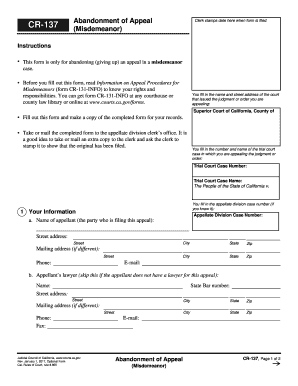
Fill out this form, read Information on Appeal Procedures for Misdemeanors (form CR-131-INFO) to know your rights and responsibilities. You can get form CR-131-INFO at any courthouse or county law library or online at www.courts.ca.gov/forms. You fill in the name and street address of the court that issued the judgment or order you are appealing: Superior Court of California, County of Fill out this form and make a copy of the completed form for your records. Take or mail the complete.
Open form follow the instructions
Easily sign the form with your finger
Send filled & signed form or save
How to fill out the CA CR-137 online
Filling out the CA CR-137 form online is a straightforward process. This guide will provide you with step-by-step instructions to ensure you accurately complete the form for abandoning an appeal in a misdemeanor case.
Follow the steps to successfully complete the CA CR-137 form online.
- Click ‘Get Form’ button to obtain the form and open it in the editor.
- Enter the name and street address of the Superior Court of California where the judgment or order was issued. Ensure all information is accurate.
- Fill in the trial court case number and the case name. This includes writing 'The People of the State of California v.' followed by the case name associated with your appeal.
- If known, enter the appellate division case number in the designated space.
- Provide your information in the designated sections: fill out your name, street address, city, state, zip code, mailing address (if different), email address, and phone number.
- If you have legal representation, complete the lawyer's information section with their name, state bar number, address, and contact details. If not applicable, you may skip this section.
- Specify the date you are filling out the form in the box provided.
- Sign and date the form, indicating that you abandon your appeal or the appeal of your client.
- After completing the form, save your changes and create a copy for your records.
- Submit the completed form by taking or mailing it to the appellate division clerk’s office. It is advisable to also submit an extra copy to request a stamped acknowledgment of the filed original.
Complete your documents online to ensure a smooth filing process.
Experience a faster way to fill out and sign forms on the web. Access the most extensive library of templates available.
Related content
Before you fill out this form, read Information on Appeal Procedures for. Misdemeanors...
The purpose of this Corrective Action Decision Document/Closure Report is to provide...
Quanto é 137 CAD para GBP hoje? Em abril 26, 2025, às 9:32 AM UTC (Tempo Universal...
Get answers to your most pressing questions about US Legal Forms API.
How to get an Abstract of Judgment in California?
Getting an Abstract of Judgment in California involves filing the appropriate form with the court clerk and paying any associated fees. This document is crucial for enforcing the judgment against a debtor’s property. Using resources from uslegalforms can streamline this process, helping you to efficiently manage your CA CR-137 needs.
How do I get an abstract of judgment in California?
To acquire an Abstract of Judgment in California, you must fill out the required form and submit it to the court clerk where the judgment was issued. Keep in mind that this process can involve some fees and specific court procedures. If you need help with forms or proper submission, uslegalforms can guide you through the requirements for CA CR-137.
What is the difference between a judgment and an Abstract of Judgment?
A judgment is the court's official decision on a case, while an Abstract of Judgment is a legal document that summarizes the judgment into a concise form. The Abstract converts the judgment into a record that can be enforced against assets, whereas the original judgment outlines the details of the case. Understanding these distinctions is crucial, especially when dealing with processes like CA CR-137.
Who files a notice of entry of judgment California?
In California, either the prevailing party or their attorney typically files the notice of entry of judgment. This notice serves to inform all parties involved that a judgment has been made by the court. It is important to understand that filing this notice correctly is essential for further legal enforcement, especially when dealing with documents related to CA CR-137.
What is the penal code 137?
The term penal code 137 generally refers to regulations or statutes related to criminal law within a given jurisdiction. While this can differ by state, understanding California's application of this code is vital for legal processes. In California, CA CR-137 relates specifically to specific legal requirements and timelines in probation and parole matters. Legal platforms like uslegalforms can assist in interpreting these codes clearly and efficiently.
What is the penal code 137 in California?
Penal Code 137 in California addresses the legal provisions regarding the waiting period for a person to petition the court. This code is essential in understanding the time frame for legal actions and ensuring you comply with court procedures. It ties into the CA CR-137 process, offering clarity on how legal timelines operate. For accurate guidance, consider using uslegalforms to navigate these legal standards effectively.
What is the app 101 info?
App 101 refers to a document or guideline that offers essential information about legal processes in California. Understanding this information is important, especially when dealing with forms like the CA CR-137. It can help clarify procedures and requirements. Always check official resources for the latest updates and guidelines pertaining to your specific legal matters.
What happens after notice of entry of judgment?
After filing a notice of entry of judgment, the court officially recognizes the judgment made in your case. Parties involved should receive copies of the judgment, which then becomes enforceable. You may also wish to use the CA CR-137 form to initiate any further actions, such as an appeal if applicable. It is essential to understand your rights and obligations following this notice.
Who files the notice of settlement in California?
In California, the party that reaches a settlement typically files the notice of settlement. This can be either the plaintiff or the defendant, depending on the case. Use the CA CR-137 form to ensure that you properly document the settlement in accordance with state regulations. Filing this notice promptly is crucial for keeping the court informed and closing the case efficiently.
How to file California corporate disclosure statement online?
To file a California corporate disclosure statement online, visit the California Secretary of State's website. There, you can access the CA CR-137 form, complete it electronically, and submit it directly. Ensure that you have all necessary information at hand, such as your business's details and any required attachments. Online filing streamlines the process, making it quick and efficient.
Use professional pre-built templates to fill in and sign documents online faster. Get access to thousands of forms.
If you believe that this page should be taken down, please follow our DMCA take down process here.