Loading

Open form follow the instructions

Easily sign the form with your finger

Send filled & signed form or save
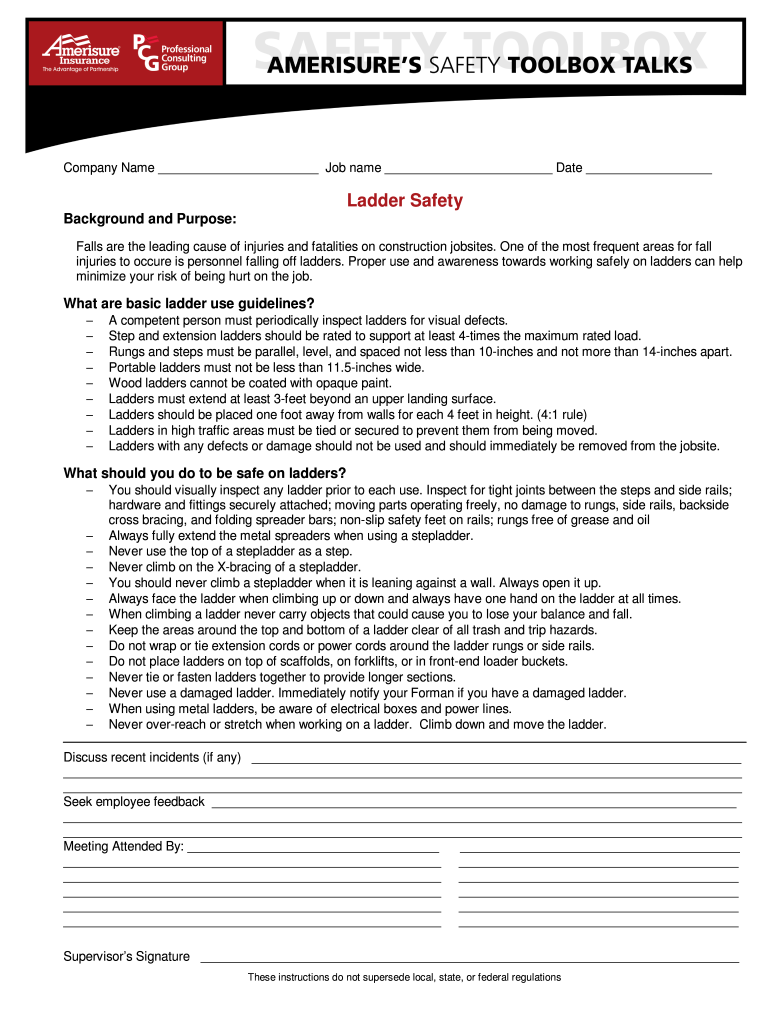
How to fill out the 16-Toolbox Talk - LADDER SAFETY.doc online
Completing the 16-Toolbox Talk - LADDER SAFETY.doc online is an essential step for ensuring ladder safety at your job site. This guide will provide you with clear and concise instructions to effectively fill out the document, enhancing your understanding of ladder safety protocols.
Follow the steps to accurately complete the form.
- Press the ‘Get Form’ button to access the document and open it in your preferred editing tool.
- Enter your company name in the designated field labeled 'Company Name.' This identifies the organization responsible for the safety meeting.
- Fill in the 'Job Name' field concerning the project or site where the ladder safety talk is being conducted.
- Date the document appropriately to reflect when the ladder safety talk occurs.
- Review the 'Background and Purpose' section to understand the importance of ladder safety and ensure it aligns with your team's awareness.
- In the 'Basic Ladder Use Guidelines' section, you can list specific guidelines. Add the guidelines applicable to your worksite to reinforce safety practices.
- Proceed to the 'What Should You Do to Be Safe on Ladders?' section, where you can outline safety practices. Make sure to provide clear instructions for users.
- In the space provided for discussing recent incidents, document any relevant incidents related to ladder safety that may provide context or insights for the team.
- Seek and record employee feedback in the designated section. This encourages engagement from all team members regarding ladder safety.
- At the bottom of the document, list meeting attendees by filling out their names as indicated. Collect signatures from all attendees, including the supervisor’s signature, to validate the meeting.
- Once all sections are completely filled in, review the document for accuracy and completeness before finalizing it.
- Finally, you can save your changes, download the document, print it, or share it as needed to ensure proper distribution among team members.
Complete your documents online to promote safety and responsibility at your job site.
Experience a faster way to fill out and sign forms on the web. Access the most extensive library of templates available.
Related content
This fact sheet examines some of the hazards workers may encounter while working on...
This fact sheet examines some of the hazards workers may encounter while working on...
From the View pull-down menu, choose Toolbox. The Toolbox appears. Configure the Inputs...
Get answers to your most pressing questions about US Legal Forms API.
What is the difference between a safety briefing and a toolbox talk?
A safety briefing typically involves a more formal presentation of safety information, while a toolbox talk encourages open dialogue about safety concerns amongst workers. The 16-Toolbox Talk - LADDER SAFETY.doc is designed to facilitate this more interactive approach. Providing a comfortable space for discussion helps to build a stronger safety culture.
What are the ladder safety topics for toolbox talk?
Common ladder safety topics for toolbox talks include proper ladder selection, inspection procedures, and safe climbing techniques. The 16-Toolbox Talk - LADDER SAFETY.doc provides a structured approach to cover these important topics. Regular discussions help reinforce knowledge and ensure workers can identify and mitigate hazards effectively.
What is the 4 to 1 rule for ladder safety?
The 4 to 1 rule for ladder safety refers to the angle at which a ladder should be placed to ensure stability and safety. For every four feet of height, the base of the ladder should be one foot away from the wall or structure. Using the 16-Toolbox Talk - LADDER SAFETY.doc, employers can effectively teach this rule to their workers during safety discussions.
Is toolbox talk mandatory?
Toolbox talks are not legally required by OSHA, but they are highly recommended as best practice. Implementing a regular routine of toolbox talks, such as using the 16-Toolbox Talk - LADDER SAFETY.doc, can significantly enhance workplace safety. Many companies adopt these talks to foster a safety-first culture and to keep safety at the forefront of daily operations.
What are the OSHA rules for ladder safety?
OSHA outlines several rules regarding ladder safety, including proper selection, use, and maintenance of ladders. Specific guidelines can be found in the 16-Toolbox Talk - LADDER SAFETY.doc, which helps ensure compliance with these standards. Following OSHA's rules not only protects workers but also minimizes liability for employers.
What is the difference between a safety meeting and a toolbox talk?
A safety meeting often covers broader safety topics and involves more detailed training, while a toolbox talk is usually shorter and focuses on specific safety issues, like those outlined in the 16-Toolbox Talk - LADDER SAFETY.doc. Toolbox talks promote participation and practical discussion among workers. Both are essential for reinforcing safety culture, but they serve different purposes.
Does OSHA require safety toolbox talks?
While OSHA does not specifically mandate toolbox talks, it encourages employers to implement them as part of their safety training programs. The 16-Toolbox Talk - LADDER SAFETY.doc can be an excellent resource for these discussions. Engaging your team in consistent safety talks enhances awareness and reduces accidents on the job site.
What are the OSHA requirements?
OSHA requires employers to provide a safe working environment, which includes properly training employees in safety practices. The 16-Toolbox Talk - LADDER SAFETY.doc serves as a key document to educate workers on ladder safety protocols. Employers must also ensure that their workers understand the use of safety equipment and the hazards associated with ladders.
What are the 5 steps to ladder safety?
The five steps to ladder safety include selecting the right ladder for your task, inspecting the ladder before use, using the ladder properly, ensuring it is stable, and maintaining three points of contact. Following these steps can help prevent falls and promote a safer work environment. You can find an in-depth exploration of these steps in the 16-Toolbox Talk - LADDER SAFETY.doc.
What is the safety code for ladders?
The safety code for ladders typically refers to guidelines established by organizations, like ANSI and OSHA. These codes outline specific requirements for ladder design, performance, and safe usage. Adhering to a safety code ensures that ladders are safe to use and reduces the likelihood of accidents. More detailed information is available in the 16-Toolbox Talk - LADDER SAFETY.doc.
Use professional pre-built templates to fill in and sign documents online faster. Get access to thousands of forms.
If you believe that this page should be taken down, please follow our DMCA take down process here.