Loading

Open form follow the instructions

Easily sign the form with your finger

Send filled & signed form or save
How to fill out the Amino Acid Laboratory Sample Submission Form - UC Davis School online
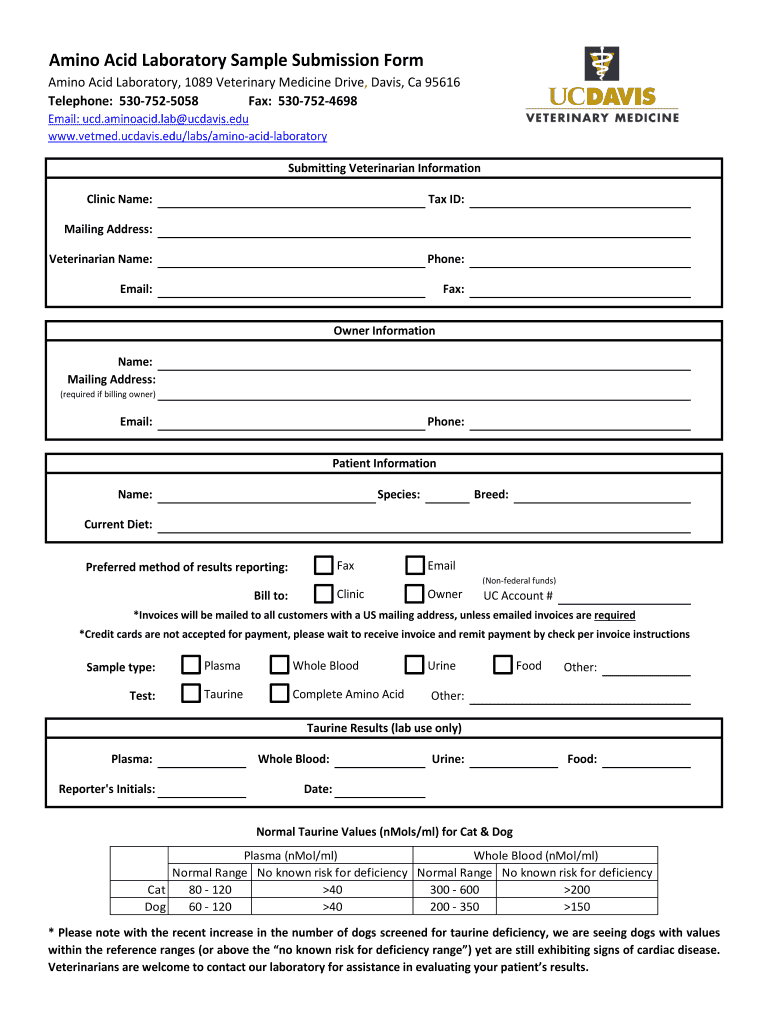
This guide provides clear and comprehensive instructions for users filling out the Amino Acid Laboratory Sample Submission Form from UC Davis School. Whether you are experienced or new to digital document management, this guide will support you in accurately completing the form online.
Follow the steps to successfully fill out the form online.
- Press the ‘Get Form’ button to obtain the form and open it in your editor.
- Begin by filling in the submitting veterinarian information. Enter your clinic name, tax ID, mailing address, veterinarian's name, phone number, email, and fax number.
- Next, provide the owner information. Fill in the owner's name and mailing address (required if billing the owner). Include the owner's email and phone number.
- Proceed to the patient information section. Input the patient's name, species, breed, current diet, and preferred method for results reporting. You can choose to bill to fax, email, clinic, or owner.
- Specify the sample type by selecting from plasma, whole blood, or urine.
- Indicate the test being submitted, choosing from taurine, complete amino acid, or other. If applicable, provide details related to food or other tests you wish to include.
- After completing all sections, ensure that any necessary information regarding taurine results is filled out accurately, including fields assigned for lab use.
- Review all provided information for accuracy. Once confirmed, save changes and select your preferred option to download, print, or share the form.
Complete and submit documents online for efficient processing.
Experience a faster way to fill out and sign forms on the web. Access the most extensive library of templates available.
Related content
100 microliters of each serum sample will be used for determining amino acid...
University of California, Davis, CA 95616. Ph: 530-752-5058 Fax: 530-752-4698. Email:...
The focus of the Laboratory's research program is on methods and their cost-effectiveness...
Get answers to your most pressing questions about US Legal Forms API.
What are the symptoms of low taurine levels?
Low taurine levels can manifest in various symptoms in dogs. Common indications include weakness, frequent coughing, and signs of heart failure. If you notice any of these symptoms, it is important to address them promptly. You can use the Amino Acid Laboratory Sample Submission Form - UC Davis School to request testing and ensure your dog gets the right nutrition.
How to test taurine levels in dogs?
Testing taurine levels in dogs involves a straightforward process. First, consult your veterinarian to collect a blood sample from your dog. You can then use the Amino Acid Laboratory Sample Submission Form - UC Davis School to send the sample to a lab for analysis. This testing will give you valuable insights into your pet's taurine levels.
How do you test for taurine levels in dogs?
To test for taurine levels in dogs, you will need to collect a blood sample from your pet. This sample should be submitted via the Amino Acid Laboratory Sample Submission Form - UC Davis School for analysis. The lab will measure the taurine concentration, providing you with crucial information about your dog's nutritional status. Understanding these levels can help you make informed dietary decisions.
Can you test taurine levels?
Yes, you can test taurine levels in dogs. Testing is essential if you suspect a deficiency or have concerns about your dog's health. The Amino Acid Laboratory Sample Submission Form - UC Davis School provides a reliable way to submit samples for accurate testing. This process helps ensure your pet receives the necessary dietary adjustments if needed.
What are the symptoms of taurine deficiency in dogs?
Taurine deficiency in dogs can lead to several worrying symptoms. Common signs include lethargy, poor coat condition, and heart issues, such as dilated cardiomyopathy. Recognizing these symptoms early is crucial for your dog's health. You can submit a sample for testing using the Amino Acid Laboratory Sample Submission Form - UC Davis School to assess taurine levels.
What are the amino acid sample types?
Some free amino acids that are routinely assayed are glutamine, asparagine, citrulline, B-alanine, taurine, tryptophan and ornithine.
What are the samples amino acids?
The essential amino acids are histidine, isoleucine, leucine, lysine, methionine, phenylalanine, threonine, tryptophan, and valine. The nonessential amino acids are alanine, asparagine, aspartic acid, glutamic acid, and serine.
What is the cost of amino acid profile test?
AMINO ACID PROFILE (35) (Rs. 2000/-)
How do you test for taurine in dogs?
How do we diagnose taurine deficiency and DCM? Taurine deficiency is diagnosed using a blood test. Most dogs who develop taurine-deficiency DCM have low taurine levels on a fasted whole blood sample.
What are the different types of amino acid test?
There are six tests for the detection of functional groups in amino acids and proteins. The six tests are: (1) Ninhydrin Test (2) Biuret Test (3) Xanthoproteic Test (4) Millon's Test (5) Hopkins-Cole Test and (6) Nitroprusside Test.
Use professional pre-built templates to fill in and sign documents online faster. Get access to thousands of forms.
If you believe that this page should be taken down, please follow our DMCA take down process here.