Open form follow the instructions
Easily sign the form with your finger
Send filled & signed form or save
How to fill out the Course 3 Chapter 1 Real Numbers online
This guide provides a clear and systematic approach to filling out the Course 3 Chapter 1 Real Numbers form online. Follow these instructions to ensure accurate completion of each section and field.
Follow the steps to complete the Course 3 Chapter 1 Real Numbers form effectively.
- Press the ‘Get Form’ button to access the form and launch it in your chosen editing tool.
- Begin with the section labeled 'NAME.' Enter your full name in the designated field to identify yourself.
- Next, proceed to the 'DATE' field. Fill in the current date when you are completing the form.
- In the 'PERIOD' section, indicate the period of your class during which you are completing this worksheet.
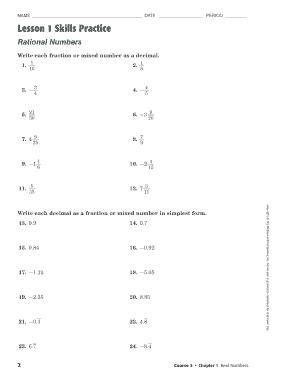
- Move on to 'Lesson 1 Skills Practice.' This section includes tasks where you will convert fractions or mixed numbers into decimal form. Carefully fill out each item by calculating the decimal equivalent.
- Following that, tackle the section where you need to convert decimals back into fractions or mixed numbers. Ensure that you simplify each fraction to its simplest form.
- After completing all sections, review your responses for accuracy and completeness.
- Finally, save your changes, and consider downloading, printing, or sharing the completed form as necessary.
Complete your Course 3 Chapter 1 Real Numbers form online today!
Experience a faster way to fill out and sign forms on the web. Access the most extensive library of templates available.
Related content
At its core, algebra 2 chapter 1 section 1 usually introduces fundamental concepts such as...
The Course 3 Chapter 1 Real Numbers Answer Key serves as a valuable tool for students to...
A differential equation (de) is an equation involving a function and its derivatives. They...
Get answers to your most pressing questions about US Legal Forms API.
What is the formula for real numbers?
There isn't a single formula that defines all real numbers, as they encompass a wide range of values, including integers, fractions, and irrationals. However, you can express specific sets of real numbers through certain equations or inequalities. Engaging with Course 3 Chapter 1 Real Numbers will deepen your understanding of how these values are represented mathematically.
How to find real numbers?
To find real numbers, you can use various methods such as evaluating given equations or expressions, and determining their solutions. For instance, graphing a function can help you visualize where real numbers exist. By utilizing resources available on the uslegalforms platform, you can refine your skills in finding real numbers as you study Course 3 Chapter 1 Real Numbers.
What are the real numbers on the number line?
Real numbers on the number line include all integers, fractions, and irrational numbers, forming a continuous line. Each point corresponds to a unique real number, extending infinitely in both positive and negative directions. When visualizing this concept in Course 3 Chapter 1 Real Numbers, you can see how these numbers fill the gaps between whole numbers.
How to identify the real number?
Identifying a real number involves determining if the number falls within the set of rational or irrational numbers. You can check if a number can be expressed as a fraction, or if it has a non-repeating, non-terminating decimal part. Tools available on the uslegalforms platform can assist you in this process while you study Course 3 Chapter 1 Real Numbers.
Is 0.7777777 a rational number?
Yes, 0.7777777 is a rational number because it can be expressed as a fraction. In this case, it can be written as 7/9, showcasing that it has a repeating decimal form. As you explore Course 3 Chapter 1 Real Numbers, recognizing the distinction between rational and irrational numbers will enhance your understanding.
How to find the set of real numbers?
To find the set of real numbers, start with the collection of all rational and irrational numbers. Rational numbers include integers, fractions, and terminating or repeating decimals, while irrational numbers are non-repeating and non-terminating decimals. An example of irrational numbers is pi or the square root of two. Understanding this set is crucial in Course 3 Chapter 1 Real Numbers.
What is the formula for a real function?
A real function is typically represented as f(x), where f is the function and x is a real number input. In Course 3 Chapter 1 Real Numbers, you will explore how to derive equations that describe real functions and their behavior. Knowing these formulas allows you to predict outcomes and analyze relationships effectively.
How to solve a real number?
To solve for a real number, begin with setting up a mathematical equation or expression. In Course 3 Chapter 1 Real Numbers, you will learn techniques such as isolating variables and applying inverse operations. Mastering these strategies enables you to find solutions efficiently and confidently.
How can we identify real numbers?
You can identify real numbers by checking if they fit within the number line, including fractions, whole numbers, and decimals. In Course 3 Chapter 1 Real Numbers, strategies such as examining properties and number classifications provide clarity on identifying these numbers. Recognizing real numbers is essential in math and everyday applications.
What is the formula for the real numbers?
While there isn't a single formula for real numbers, they encompass a set of values that include both rational and irrational numbers. In Course 3 Chapter 1 Real Numbers, you'll use various equations to express relationships involving real numbers. Familiarizing yourself with these formulas enhances your mathematical skill set.
Use professional pre-built templates to fill in and sign documents online faster. Get access to thousands of forms.
If you believe that this page should be taken down, please follow our DMCA take down process here.