Open form follow the instructions
Easily sign the form with your finger
Send filled & signed form or save
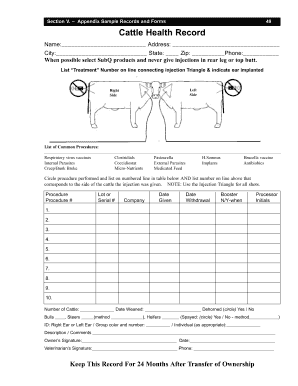
How to fill out the Cattle Vaccine Record Sheet online
Properly documenting cattle vaccinations is essential for maintaining the health of your livestock. This guide provides clear and concise instructions on how to fill out the Cattle Vaccine Record Sheet online, ensuring that all necessary information is accurately recorded.
Follow the steps to complete the Cattle Vaccine Record Sheet effectively.
- Click the ‘Get Form’ button to access the Cattle Vaccine Record Sheet and open it in the online editor.
- Begin by filling in the basic information at the top of the form, including the name, address, city, state, zip code, and phone number of the person responsible for the records.
- Select any treatment numbers and indicate the ear implanted by connecting the injection triangle lines. Ensure to choose SubQ products when possible and avoid injections in the rear leg or top butt.
- From the list of common procedures provided in the form, circle all procedures performed and assign a corresponding number to each in the table below.
- In the table, fill in the procedure number, lot or serial number, the company that provided the treatment, and the date the vaccine was given.
- Record the date of withdrawal and whether a booster is needed by marking 'Y' for yes or 'N' for no.
- Initial next to the processor's name to confirm that the information has been checked for accuracy.
- Complete the section for the total number of cattle, including the date weaned, and whether dehorning was performed.
- Indicate the types of cattle (bulls, steers, heifers) and their respective conditions, circling 'Yes' or 'No' as appropriate.
- Add any additional descriptions or comments that might be relevant to the cattle's health and vaccination.
- Finally, ensure that both the owner's and veterinarian's signatures are included with the corresponding dates.
- After all entries are completed, you can save changes, download, print, or share the completed form as needed.
Complete your Cattle Vaccine Record Sheet online today for accurate and essential livestock management.
Experience a faster way to fill out and sign forms on the web. Access the most extensive library of templates available.
Related content
ALL VACCINATIONS MUST BE PROMPTLY REPORTED. COOPERATIVE STATE-FEDERAL BRUCELLOSIS...
Here is a sample table for keeping vaccination records for the year in the Rancher...
• Provides an ongoing record of vaccinations . DISEASES COVERED BY THE EQUINE ISG: All...
Get answers to your most pressing questions about US Legal Forms API.
What are the annual vaccines for cattle?
Annual vaccines for cattle typically include a range of vaccines aimed at preventing diseases prevalent in cattle. These may cover core vaccinations for clostridia, respiratory viruses, and other specific diseases depending on your region. Recording these vaccinations on a Cattle Vaccine Record Sheet simplifies tracking and ensures your cattle receive timely protection. Proper documentation supports both herd health and regulatory compliance.
What is the MLV vaccine for cattle?
The MLV vaccine, or modified-live virus vaccine, is designed to stimulate a robust immune response in cattle. Unlike killed vaccines, MLV vaccines retain a weakened form of the virus, offering lasting immunity. Utilizing a Cattle Vaccine Record Sheet allows you to monitor the administration of MLV vaccines effectively, ensuring your cattle are well-protected against viral infections. Consistent record-keeping enhances herd health management.
What is the 7 and 1 vaccine for cattle?
The 7 and 1 vaccine for cattle provides protection against several common diseases. Typically, this vaccine combines protection against seven different diseases, including BVD and IBR, along with one Clostridial disease. Keeping a Cattle Vaccine Record Sheet helps you track when your cattle received this important vaccine. By maintaining accurate records, you ensure optimal herd health and compliance with regulations.
How to give vaccines to cattle?
Vaccinating cattle involves choosing the right location for the injection, usually in the neck area, to avoid hitting vital structures. Always follow the proper technique and dosage instructions that come with the vaccine. Keeping accurate records on a Cattle Vaccine Record Sheet helps ensure you monitor what each animal has received, promoting better health management.
What is the 8 way cattle vaccine?
The 8 way cattle vaccine offers protection against eight different diseases, including clostridial infections, which can be fatal. It's an important vaccination that helps farmers maintain herd immunity and reduce loss from disease. Make sure to document these vaccinations on your Cattle Vaccine Record Sheet to keep a clear health history for each animal.
What are the most common vaccines for cattle?
Precalving Vaccination of Cows and Heifers 4-way Viral BRD Vaccine. Pasteurella Bacterin & Leukotoxoid. Haemophilus Bacterin. 5-way Lepto Bacterin. 7-way or 8-way Blackleg Bacterin. Scour Vaccine. Vibrio Bacterin. Trich Vaccine.
What are typical cattle vaccinations?
Cows are generally vaccinated for IBR, BVD, PI3, and BRSV virus, leptospirosis, clostridial, E. coli mastitis, and calf diarrhea diseases during the lactation period and/or the dry period. Modified live virus vaccines may not be able to be used at this time.
Should you vaccinate cows every year?
Adult cows: IBR, BVD, BRSV, PI3, 5way lepto annually. Must use killed vaccine if cows are pregnant. If using natural service, vibryo given 2 weeks prior to breeding. Worm spring and fall; recommend using brand-name dewormers.
What time of year should cattle be vaccinated?
When protecting cows against reproductive diseases, it is often best to vaccinate at least 6 to 8 weeks prior to the breeding season to allow time for development of a protective immune response.
What do cows need to be vaccinated for?
Cows are generally vaccinated for IBR, BVD, PI3, and BRSV virus, leptospirosis, clostridial, E. coli mastitis, and calf diarrhea diseases during the lactation period and/or the dry period. Modified live virus vaccines may not be able to be used at this time.
Use professional pre-built templates to fill in and sign documents online faster. Get access to thousands of forms.
If you believe that this page should be taken down, please follow our DMCA take down process here.