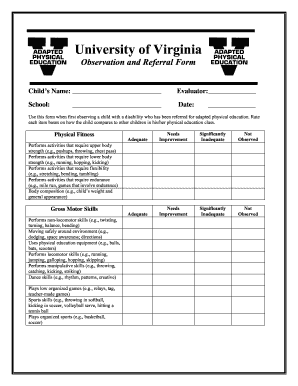
M when first observing a child with a disability who has been referred for adapted physical education. Rate each item bases on how the child compares to other children in his/her physical education class. Physical Fitness Adequate Needs Improvement Significantly Inadequate Not Observed Adequate Needs Improvement Significantly Inadequate Not Observed Performs activities that require upper body strength (e.g., pushups, throwing, chest pass) Performs activities that require lower body str.

How it works
  • Open form

    Open form follow the instructions

  • Easily sign form

    Easily sign the form with your finger

  • Share form

    Send filled & signed form or save

How to fill out the Observation And Referral Form For Adaptive Physical Education online

Completing the Observation And Referral Form For Adaptive Physical Education is an essential step in assessing a child's needs for adapted physical education services. This guide provides a clear and user-friendly walkthrough to help you accurately fill out the form online.

Follow the steps to effectively complete the form.

  1. Click ‘Get Form’ button to access the form and open it in your preferred online editor.
  2. Fill in the child's name in the designated field at the top of the form. Ensure that the spelling is correct to maintain clear communication regarding the child’s observations.
  3. Enter the evaluator's name and the school information. This helps identify who conducted the evaluation and where it took place.
  4. Record the date of the observation. This is essential for tracking the child's progress over time.
  5. In the 'Physical Fitness' section, rate each item based on the child’s performance compared to their peers in physical education class. Use the categories: Adequate, Needs Improvement, Significantly Inadequate, and Not Observed.
  6. Proceed to the 'Gross Motor Skills' section. Similarly, evaluate the child's abilities in this category using the same rating system as above.
  7. In the 'Behavior, Cognitive Abilities, and Social Skills in Physical Education' section, observe the child's behavior and interaction with peers and teachers during physical activities. Rate each item accordingly.
  8. Review all sections on the form to ensure that every field has been filled out accurately and thoughtfully.
  9. Once you have completed the form, save the changes. You can also download, print, or share the form as needed.

Complete the Observation And Referral Form For Adaptive Physical Education online today to support the child’s adaptive needs.

Get form

Experience a faster way to fill out and sign forms on the web. Access the most extensive library of templates available.

Related content

ADAPTED PHYSICAL EDUCATION

Section I provides the requirements and recommendations for the implementa tion of adapted...

Learn more
syllabus - online course - spring 14.doc

You can use the “Initial Observation and Referral Form” on page 85-86 in my book....

Learn more
Molina Medicaid Program Provider Manual

Medicaid Plan. In Illinois, Molina offers two Medicaid health programs as well as a...

Learn more
Questions & Answers

Get answers to your most pressing questions about US Legal Forms API.

Contact support

How do you assess students in physical education?

Assessing students in physical education involves both formal and informal methods, including skill assessments and ongoing observations. Effective assessment considers individual progress over time and focuses on personal goals. Educators should tailor their assessment strategies to meet each student's unique needs. The Observation And Referral Form For Adaptive Physical Education provides a structured approach to documenting and analyzing assessment outcomes.

Observation in physical education refers to the systematic monitoring of students during activities to assess their skills and engagement. This process helps educators understand how students interact with their environment and peers, identifying areas that need support. Regular observations lead to informed decisions on personalization of lessons. The Observation And Referral Form For Adaptive Physical Education can facilitate effective tracking of these observations.

Identifying students for adapted physical education requires a formal referral process, often initiated by parents, teachers, or healthcare professionals. A comprehensive evaluation follows, assessing the student’s abilities and needs in physical activities. Documentation is crucial, and tools like the Observation And Referral Form For Adaptive Physical Education help in capturing essential information to support placement decisions.

Including students with disabilities in physical education can be achieved through appropriate modifications and accommodations. Teachers can adapt lesson plans, use specialized equipment, and create a supportive environment. Collaboration with parents and specialists also enhances inclusivity. The Observation And Referral Form For Adaptive Physical Education can serve as a tool to facilitate these strategies effectively.

Assessment in adapted physical education involves evaluating a student's physical abilities and needs to create an effective program. It covers various domains, including motor skills, social interaction, and fitness levels. This comprehensive evaluation helps educators set realistic goals tailored specifically for the student. To assist with this process, consider using the Observation And Referral Form For Adaptive Physical Education.

To develop effective adapted physical education, principles such as respect, flexibility, and inclusivity must be applied. These principles ensure that programming aligns with each student's strengths and challenges. Engaging students in meaningful activities fosters a positive experience. The Observation And Referral Form For Adaptive Physical Education supports personalized development plans based on these principles.

Yes, adaptive physical education can be a separate component of an Individualized Education Program (IEP). This approach ensures that students receive specialized services designed to meet their unique physical needs. It helps in documenting the student's specific goals and the necessary accommodations. Using the Observation And Referral Form For Adaptive Physical Education can streamline this process.

Adapted physical education includes activities tailored to meet the varied needs of students with disabilities. Examples include wheelchair basketball, modified swimming lessons, and specialized exercise programs. Each activity focuses on inclusion and skill development to ensure all students participate effectively. The Observation And Referral Form For Adaptive Physical Education assists in documenting these tailored activities.

Examples of adaptive activities can include games like modified soccer or activities focusing on balance and coordination using adaptive equipment. These activities help students build skills while enjoying the experience of movement. Implementing the Observation And Referral Form For Adaptive Physical Education can aid in selecting and planning these engaging activities.

Examples of adaptive physical education encompass sports and activities that have been modified for accessibility, such as sitting volleyball or yoga with support equipment. These adaptive practices encourage participation from every student, enhancing physical literacy. The Observation And Referral Form For Adaptive Physical Education plays a crucial role in aligning activities with student needs and capabilities.

Get This Form Now!

Use professional pre-built templates to fill in and sign documents online faster. Get access to thousands of forms.

If you believe that this page should be taken down, please follow our DMCA take down process here.

Get Observation And Referral Form For Adaptive Physical Education