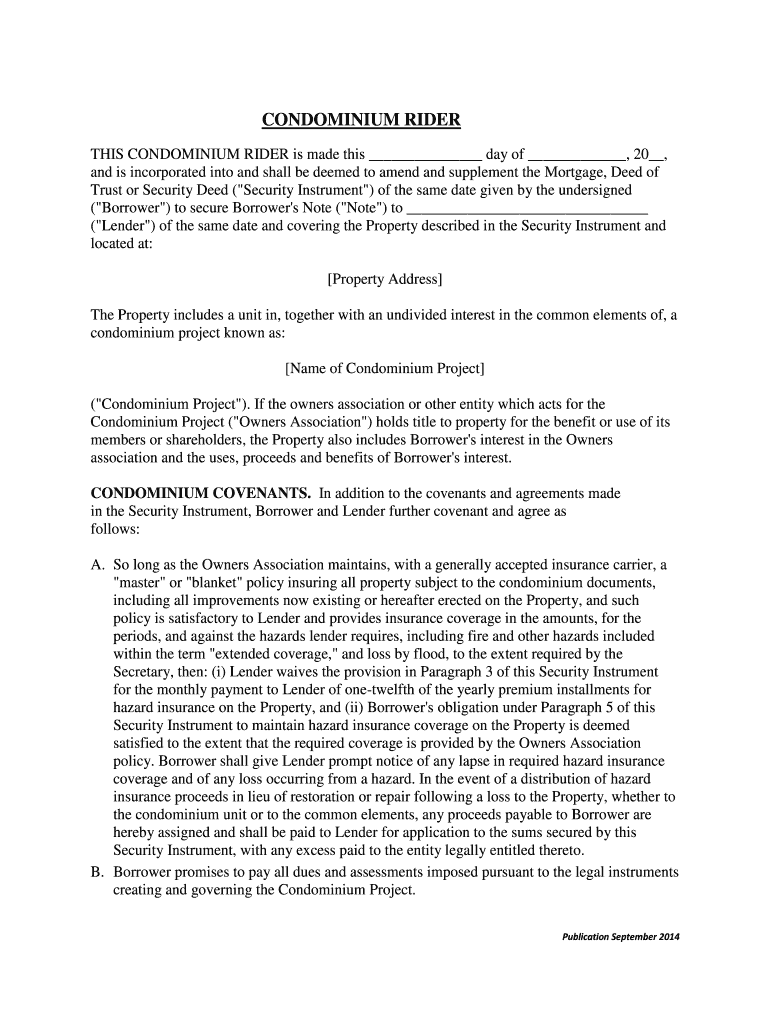
Security Deed ("Security Instrument") of the same date given by the undersigned ("Borrower") to secure Borrower's Note ("Note") to ________________________________ ("Lender") of the same date and covering the Property described in the Security Instrument and located at: [Property Address] The Property includes a unit in, together with an undivided interest in the common elements of, a condominium project known as: [Name of Condominium Project] ("Condominium Project"). If the owners association o.
Loading

Open form follow the instructions

Easily sign the form with your finger

Send filled & signed form or save
How to fill out the HUD Condominium Rider online
The HUD Condominium Rider is an important document that supplements your mortgage and outlines specific agreements related to condominium ownership. This guide will provide a clear, step-by-step approach to completing the HUD Condominium Rider online, making the process user-friendly for everyone.
Follow the steps to complete the HUD Condominium Rider online
- Click ‘Get Form’ button to obtain the form and open it in the editor.
- Fill in the date at the top of the document. Record the date on which the Condominium Rider is being signed.
- In the space provided, enter the name of the lender to whom the mortgage will be secured.
- Complete the 'Property Address' section with the specific address of the condominium unit you are purchasing.
- Fill in the name of the condominium project in the section titled 'Name of Condominium Project.' This is crucial for identifying the community.
- Review the section regarding the Owners Association and confirm the inclusion of your interest and benefits in the association.
- When you reach the covenants section, read through the terms carefully. Pay special attention to insurance obligations and maintenance responsibilities.
- Sign the document where indicated. Ensure all co-borrowers also sign to validate the agreement.
- After completing all sections, you can review the filled-out form for accuracy. Save your changes, download, print, or share the document as required.
Begin filling out the HUD Condominium Rider online today!
Experience a faster way to fill out and sign forms on the web. Access the most extensive library of templates available.
Related content
Condominium Rider. U.S. Department of Housing and Urban Development. Office of Housing...
by DA Whitman · 1977 · Cited by 16 — This article will deal with legal problems...
by S Samarripas · 2017 · Cited by 18 — Nearly 21 million—one in six—households...
Get answers to your most pressing questions about US Legal Forms API.
What does it mean if a condo is not FHA-approved?
If a condo is not FHA-approved, it means that buyers cannot access FHA-backed financing for that property. This can limit options for potential buyers and impact the condo's marketability. Familiarity with the HUD Condominium Rider can help buyers understand their options and navigate financing barriers more effectively.
What is a condominium rider form?
A condominium rider form, specifically the HUD Condominium Rider, is an additional legal document that outlines terms related to condominium financing. This form ensures that the specific requirements of FHA loans are met for condo properties. Integrating this rider into your financing process can simplify your experience.
Why do condos not accept FHA loans?
Some condos do not accept FHA loans due to non-compliance with FHA guidelines or because the condo association has not applied for HUD approval. This can limit financing options for buyers interested in those properties. Understanding the role of the HUD Condominium Rider can provide clarity on financing eligible condos.
Who completes HUD Form 9991?
HUD Form 9991 is typically completed by the mortgage lender, as part of the FHA financing process. This document ensures that all necessary information regarding the condo association and its adherence to guidelines is accurately presented. You can leverage the HUD Condominium Rider to understand how this form impacts your financing journey.
What is a HUD approved condo?
A HUD approved condo refers to a condominium that qualifies under HUD's regulations, making it eligible for Federal Housing Administration (FHA) loans. This approval ensures that the condo meets specific safety, structural, and financial requirements. If you are looking to finance a condo, knowing about the HUD Condominium Rider will be vital.
What is a HUD approved property?
A HUD approved property meets guidelines set by the U.S. Department of Housing and Urban Development. These properties are deemed safe and suitable for financing through specific government-backed programs. Understanding the HUD Condominium Rider can help buyers navigate eligibility and financing options effectively.
What is a HUD-approved condo?
approved condo is a condominium project recognized by the Department of Housing and Urban Development, meaning it meets federal guidelines for safety and living conditions. Being part of a HUDapproved project allows potential buyers access to streamlined financing, as the HUD Condominium Rider sets out the framework for mortgage options. Understanding this designation can greatly enhance your home buying experience.
What is the difference between a PUD rider and a condo rider?
The PUD rider and the condo rider both refer to documents that clarify the terms of ownership in different types of properties. The condo rider aligns with condominium ownership, emphasizing shared spaces and community rules, while the PUD rider focuses on individual property ownership within a planned community. Identifying the differences is crucial, especially when dealing with financing through the HUD Condominium Rider.
How does a condo differ from a PUD?
A condo, or condominium, is a type of property where individuals own their units but share common areas with other residents. In contrast, a Planned Unit Development (PUD) offers more private ownership of land and structures, often including single-family homes. When financing a condo, make sure to understand the HUD Condominium Rider, as it addresses the unique characteristics of condo ownership.
What does a condominium rider mean?
A condominium rider is a legal document that supplements your mortgage agreement, specifically designed for financing a condominium. It outlines the unique aspects of condominium ownership, including the shared rules and regulations applicable to condominium residents. Understanding the HUD Condominium Rider is essential as it ensures compliance with specific federal guidelines that protect both buyers and lenders.
Use professional pre-built templates to fill in and sign documents online faster. Get access to thousands of forms.
If you believe that this page should be taken down, please follow our DMCA take down process here.