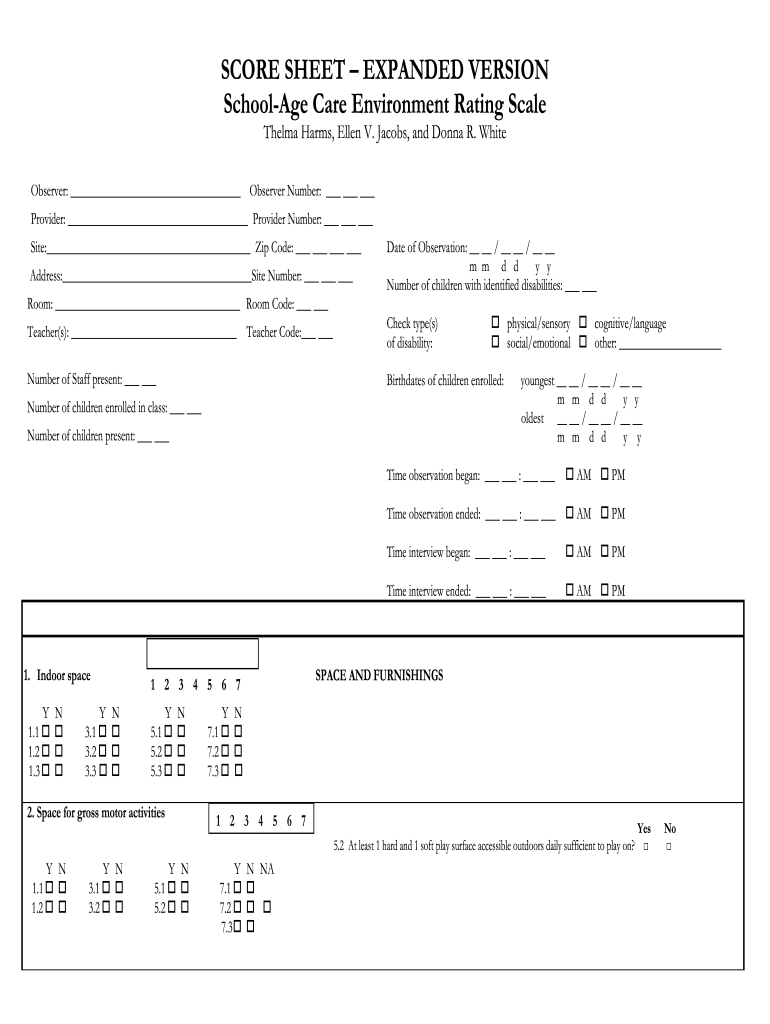
Room Code: Date of Observation: / / m m d d y y Number of children with identified disabilities: Teacher(s): Teacher Code: Check type(s) of disability: Number of Staff present: Birthdates of children enrolled: Number of children enrolled in class: Number of children present: 1. Indoor space Y N 1.1 1.2 1.3 1 Y N 3.1 3.2 3.3 2 3 Y N Y N 3.1 3.2 6 Y N 5.1 5.2 5.3 younge.

Open form follow the instructions

Easily sign the form with your finger

Send filled & signed form or save
How to fill out the Score Sheet - Expanded Version School-Age Care Environment Rating Scale online
Completing the Score Sheet - Expanded Version School-Age Care Environment Rating Scale is essential for evaluating the quality of school-age care environments. This comprehensive guide provides step-by-step instructions to help you navigate the online form efficiently and accurately.
Follow the steps to successfully complete the score sheet online.
- Click ‘Get Form’ button to obtain the form and open it in the editor.
- Begin by filling out the observer information, including your name and observer number, as well as the provider's name and site details.
- Input the date of observation and the number of children with identified disabilities. Make sure to include birthdates of enrolled children and count the total number of children present.
- Review each section carefully. For example, under 'Indoor Space,' answer questions by selecting 'Y' for Yes or 'N' for No, and provide additional details where required.
- Continue through each section, including 'Health and Safety,' 'Activities,' 'Interactions,' 'Program Structure,' and 'Staff Development.' Ensure you read each instruction before scoring items based on observations.
- For sections concerning special needs, be sure to answer questions that pertain specifically to any children with exceptional needs enrolled at your site.
- Once all items are completed, calculate average scores for each section. This may involve dividing total scores by the number of items scored.
- Finally, you can save changes to the form, download it for your records, print it for submission, or share it as needed.
Start filling out your score sheet online today to assess and enhance your school-age care environment.
Experience a faster way to fill out and sign forms on the web. Access the most extensive library of templates available.
Related content
Two additional days of training are provided by SRC for review and practice on ERS...
The School-Age Care Environment Rating Scale is a score sheet with sub-scales for space...
by DP McCarthy · 2009 · Cited by 13 — This study examines the effectiveness of the...
Get answers to your most pressing questions about US Legal Forms API.
What are the four types of rating scales?
The four types of rating scales include the Infant/Toddler Environment Rating Scale (ITERS), the Early Childhood Environment Rating Scale (ECERS), the School-Age Care Environment Rating Scale (SACERS), and the Family Child Care Environment Rating Scale (FCCERS). Each scale has specific criteria tailored to different care settings and age groups. These tools help assess the quality of early education and care environments. For those caring for school-age children, the Score Sheet - Expanded Version School-Age Care Environment Rating Scale is the ideal choice.
Which rating scale is commonly used to assess the preschool classroom environment for children ages 3 to 5?
The Early Childhood Environment Rating Scale (ECERS) is commonly used to assess preschool classroom environments for children ages 3 to 5. This scale examines quality indicators such as interactions, activities, and safety within the learning environment. It helps educators create enriching experiences for young children. If your focus shifts to school-age children, consider utilizing the Score Sheet - Expanded Version School-Age Care Environment Rating Scale for the most effective evaluation.
What are the environmental rating scales?
Environmental rating scales are tools that help evaluate the quality of care and education in various childcare settings. These scales assess numerous factors, from space utilization to relationships between staff and children. Different scales cater to different age groups and environments, ensuring relevant evaluations. If you're focused on school-age care, the Score Sheet - Expanded Version School-Age Care Environment Rating Scale will provide comprehensive insights.
What are the 6 subscales of ECERS?
The 6 subscales of the Early Childhood Environment Rating Scale (ECERS) include Space and Furnishings, Personal Care Routines, Language and Literacy, Learning Activities, Interaction, and Program Structure. Each subscale focuses on different areas essential for fostering a rich learning environment. By understanding these components, you can better implement practices that enhance the quality of care. The Score Sheet - Expanded Version School-Age Care Environment Rating Scale can complement this knowledge for school-age care settings.
What are the big three of the environment rating scales?
The big three of the environment rating scales refer to the ITERS, ECERS, and SACERS, which are widely recognized tools in early childhood education and care. These scales cover a range of aspects including safety, educational materials, and opportunities for interaction. Each scale addresses specific age groups and settings, ensuring a tailored approach. Using the Score Sheet - Expanded Version School-Age Care Environment Rating Scale will help you effectively evaluate environments specifically designed for school-age children.
What are the rating scales for childcare?
Rating scales for childcare are assessment tools that measure the quality of care and educational opportunities in environments for young children. The main scales used include the ITERS, ECERS, SACERS, and FCCERS. Each scale provides a set of items to evaluate various aspects of the childcare environment. Utilizing the Score Sheet - Expanded Version School-Age Care Environment Rating Scale can help providers ensure they meet the standards for school-age care.
What are the four environmental rating scales?
The four environmental rating scales include the Infant/Toddler Environment Rating Scale (ITERS), the Early Childhood Environment Rating Scale (ECERS), the School-Age Care Environment Rating Scale (SACERS), and the Family Child Care Environment Rating Scale (FCCERS). Each of these scales is designed to assess different age groups and types of care environments. The Score Sheet - Expanded Version School-Age Care Environment Rating Scale focuses specifically on school-age children, ensuring you have the right tools for that demographic.
How to score sacers assessment?
Scoring the SACERS assessment involves observing the environment and interactions within the setting. You will need to use the Score Sheet - Expanded Version School-Age Care Environment Rating Scale to record your findings. Each item has specific criteria that help you determine the score based on what you see. Be sure to gather multiple observations to get a comprehensive picture of the environment.
What is the purpose of the environment rating scale?
The environment rating scale evaluates the overall quality of the learning and care environment for children. Specifically, it aligns with the Score Sheet - Expanded Version School-Age Care Environment Rating Scale, measuring aspects such as safety, accessibility, and engagement. This assessment aids in identifying both strengths and weaknesses within a care setting. With the right insights, you can make informed decisions that enhance children's experiences and well-being.
What is the purpose of sacers?
The purpose of SACERS is to provide a comprehensive framework for assessing the quality of school-age care environments. The Score Sheet - Expanded Version School-Age Care Environment Rating Scale focuses on key factors like safety, personal interactions, and play opportunities. By utilizing SACERS, caregivers can identify areas needing improvement and implement best practices. This process ultimately elevates the standard of care delivered to children.
Use professional pre-built templates to fill in and sign documents online faster. Get access to thousands of forms.
If you believe that this page should be taken down, please follow our DMCA take down process here.