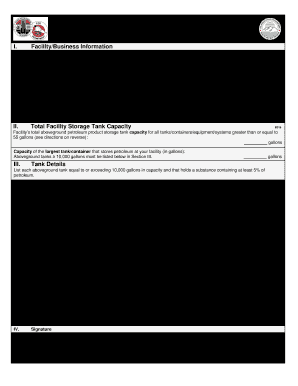
T Email Owner Name 111 103 Owner Mailing Address 113 105 City 114 State Owner Phone 112 SIC Code 3 104 Zip Code Contact Phone Los Angeles Co. Fire Dept Health Haz Mat Division 5825 Rickenbacker Road Commerce, CA 90040 Tel: (323) 890-4000 Fax: (323) 890-4046 www.fire.lacounty.gov 118a 115 Zip Code 116 107 Does facility meet Sec. 25270.4.5 Exemption for SPCC Plan? Yes No 920 ( A tank facility located on a farm, nursery or construction site with no storage tank >20,000 gallons.
Open form follow the instructions
Easily sign the form with your finger
Send filled & signed form or save
How to fill out the CA Aboveground Petroleum Storage Tank Facility Statement Notification/Change in Status online
Filling out the CA Aboveground Petroleum Storage Tank Facility Statement Notification/Change in Status online can be straightforward if you follow the right steps. This guide will provide you with comprehensive instructions to ensure your form is completed accurately.
Follow the steps to successfully complete your facility statement online.
- Click ‘Get Form’ button to obtain the form and open it in the editor.
- Provide your facility ID number. This number is found on your CUPA permit.
- Enter your facility name, ensuring it is the same as your business or DBA for this site.
- Fill in the facility address with the street address where your aboveground storage tank facility is located, avoiding post office box numbers.
- Enter the city or unincorporated area where the facility is located.
- Input the zip code of the facility address, including the extra four-digit code if applicable.
- Provide the Standard Industrial Classification code for your primary business activity, using the provided link if needed.
- Enter the owner's name. If a corporation owns the facility, provide the corporation’s name.
- If the owner's mailing address differs from the facility address, enter it here.
- Fill in the owner's phone number with the area code first, and include any extension.
- Enter the mailing city for the owner's address.
- Provide the state abbreviation for the owner's mailing address.
- Input the zip code for the owner's mailing address, including any extra four digits.
- Enter the contact name for correspondence regarding the aboveground storage tank.
- Fill in the contact phone number, again starting with the area code.
- If applicable, enter the contact's email address.
- Indicate whether the facility meets the exemption criteria by checking 'Yes' or 'No'.
- Declare whether the facility has an SPCC plan by selecting 'Yes' or 'No'. If yes, provide the date of the last revision or review.
- If there is no SPCC plan, indicate if it is in progress and provide the expected completion date if applicable.
- Calculate and enter the total facility storage tank capacity in gallons for all tanks/containers that can hold 55 gallons or more.
- Specify the capacity of the largest tank/container that stores petroleum at your facility.
- For each aboveground tank with a capacity equal to or exceeding 10,000 gallons, fill in the tank ID, contents, capacity, tank location, year installed, tank type, and whether it has secondary containment.
- Once completed, review your entries for accuracy and clarity. You can save your changes, download the filled document, print it, or share it as needed.
Complete your CA Aboveground Petroleum Storage Tank Facility Statement Notification/Change in Status online today for compliance.
Experience a faster way to fill out and sign forms on the web. Access the most extensive library of templates available.
Related content
A statement is required if the facility is subject to oil pollution regulations, has 55+...
(iii) Local permit for aboveground storage tank documenting Temporarily Out-of service...
by M Dunleavy — facility shall maintain and inspect each field-constructed aboveground...
Get answers to your most pressing questions about US Legal Forms API.
How often do above ground storage tanks need to be inspected?
Aboveground storage tanks must be inspected at least once every five years or more frequently, depending on local regulations and storage conditions. Regular inspections assess the tanks' integrity, identify potential leaks, and ensure compliance with the CA Aboveground Petroleum Storage Tank Facility Statement Notification/Change in Status. Keeping a consistent inspection schedule protects the environment and mitigates the risk of spills.
What is the aboveground petroleum Storage Act in California?
The Aboveground Petroleum Storage Act (APSA) in California provides a framework for the regulation of aboveground storage tanks. This act mandates specific requirements, including proper maintenance, inspections, and reporting through the CA Aboveground Petroleum Storage Tank Facility Statement Notification/Change in Status. Understanding the provisions of this act is essential for any business involved in the storage of petroleum products to ensure compliance and environmental protection.
What agency oversees the underground storage tank program in California?
The California State Water Resources Control Board oversees the underground storage tank program in the state. This agency ensures compliance with regulations to protect groundwater quality. While this agency focuses on underground tanks, it’s essential for facilities with aboveground tanks to also consider the CA Aboveground Petroleum Storage Tank Facility Statement Notification/Change in Status. Awareness of both programs helps protect the environment effectively.
What is the Above Ground Storage Act?
The Above Ground Storage Act (APSA) is California legislation designed to regulate aboveground petroleum storage. It aims to prevent hazardous substance spills and protect the environment. Under this act, facilities must comply with guidelines, including the submission of a CA Aboveground Petroleum Storage Tank Facility Statement Notification/Change in Status. Understanding this act is vital for any facility that handles petroleum products.
What needs to be reported to CERS?
Facilities must report specific information to the California Environmental Reporting System (CERS), including the volume of petroleum stored and the type of storage systems in use. Also, any changes in status or operational conditions should be submitted, particularly if they affect compliance. This reporting is crucial for maintaining accurate records and adhering to the CA Aboveground Petroleum Storage Tank Facility Statement Notification/Change in Status. Keeping up-to-date ensures regulatory compliance.
What is conditionally exempt from APSA?
Certain facilities may be conditionally exempt from APSA regulations, such as those storing less than 1,320 gallons of oil. Additionally, facilities that meet specific criteria related to storage type and use may also qualify. It’s essential to verify these conditions, as they dictate whether you must submit the CA Aboveground Petroleum Storage Tank Facility Statement Notification/Change in Status. Always consult the regulations applicable to your unique situation.
Is my facility regulated under APSA?
Your facility may be regulated under the APSA if it stores more than 1,320 gallons of petroleum in aboveground tanks. To determine your facility's status, consider the type and amount of petroleum stored. If regulated, you must submit a CA Aboveground Petroleum Storage Tank Facility Statement Notification/Change in Status. Compliance helps maintain environmental safety and avoids potential fines.
Are above ground storage tanks regulated?
Yes, above ground storage tanks (ASTs) are regulated to prevent spills and protect the environment. In California, these regulations fall under the Aboveground Petroleum Storage Act (APSA). Facilities must comply with local, state, and federal regulations, including submitting the CA Aboveground Petroleum Storage Tank Facility Statement Notification/Change in Status. Proper adherence ensures the safe handling of petroleum products.
What is the above ground petroleum Storage Act?
The Aboveground Petroleum Storage Act (APSA) is California legislation that regulates the storage of petroleum in aboveground tanks to minimize environmental risks. This act outlines requirements for facility assessments, emergency response plans, and regular inspections. To ensure you're meeting all responsibilities under APSA, including submitting the CA Aboveground Petroleum Storage Tank Facility Statement Notification/Change in Status, consider utilizing resources like USLegalForms for guidance.
What is considered an above ground storage tank?
An above ground storage tank is any tank that stores petroleum products and is situated above the ground. These tanks come in various sizes and are used for different purposes across multiple industries. Understanding what qualifies as an above ground storage tank is important for determining your obligations under the CA Aboveground Petroleum Storage Tank Facility Statement Notification/Change in Status.
Use professional pre-built templates to fill in and sign documents online faster. Get access to thousands of forms.
If you believe that this page should be taken down, please follow our DMCA take down process here.