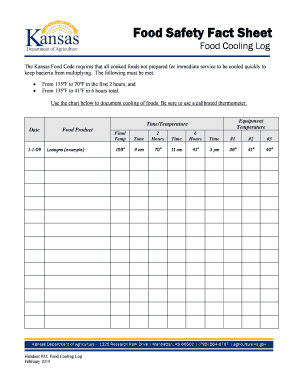
Food Safety Fact Sheet Food Cooling Log The Kansas Food Code requires that all cooked foods not prepared for immediate service to be cooled quickly to keep bacteria from multiplying. The following.
Loading
Open form follow the instructions
Easily sign the form with your finger
Send filled & signed form or save
How to fill out the KS Food Safety Fact Sheet online
This guide aims to assist users in completing the KS Food Safety Fact Sheet online, focusing on the Food Cooling Log section. It is essential to understand the proper procedure for documenting food cooling to maintain safety and compliance.
Follow the steps to complete your Food Cooling Log accurately.
- Click ‘Get Form’ button to obtain the form and open it in the editor.
- Begin by entering the date when the food item was cooked. Ensure that this date is accurate to maintain your records correctly.
- Document the food product being cooled. Write the specific name of the item, such as 'Lasagna', in the designated field.
- Using a calibrated thermometer, measure the highest temperature of the food item. Record this temperature in the 'Final Temp' section.
- Indicate the time when the food reached 135ºF. Ensure that you note this time accurately, as it is crucial for food safety compliance.
- Next, document the time when the temperature of the food drops to 70ºF within the first 2 hours. This is the first critical cooling milestone.
- Finally, record the time when the temperature reaches 41ºF within 6 hours in the respective section. This step completes your cooling log.
- Once all fields are filled in, ensure to review all entries for accuracy. After reviewing, you can save the changes, download, print, or share the completed form as needed.
Complete your KS Food Safety Fact Sheet online today to ensure safe food handling practices.
Experience a faster way to fill out and sign forms on the web. Access the most extensive library of templates available.
Related content
The Kansas Department of Agriculture provides food safety materials including books, fact...
To minimize contamination risks, this fact sheet outlines good practices for growing...
States reporting illnesses linked to the outbreak include: Arizona, California,. Colorado...
Get answers to your most pressing questions about US Legal Forms API.
What is the website for food safety Kansas?
The Kansas Department of Agriculture's website is a premier resource for food safety information in the state. You can find the KS Food Safety Fact Sheet there, along with other educational materials and current regulations. This website is a useful tool for anyone looking to enhance their knowledge about food safety and compliance in Kansas.
What is the Kansas food code?
The Kansas food code outlines the laws and regulations governing food safety in the state. It covers everything from food handling to preparation and storage. For those interested in selling food, reviewing the Kansas food code is essential for understanding your responsibilities. The KS Food Safety Fact Sheet serves as an excellent starting point to navigate these guidelines effectively.
Do I need a license to sell food from home in Kansas?
Yes, you typically need a license to sell food from home in Kansas, especially for items not classified as cottage foods. The KS Food Safety Fact Sheet details what types of foods can be sold without a license and what procedures to follow to obtain one. Ensuring you have the proper licenses not only keeps you compliant but also builds trust with your customers.
How to learn about food safety?
Learning about food safety is crucial for anyone involved in food production or sales. Start by reviewing the KS Food Safety Fact Sheet, which includes valuable tips and standards to follow. Additionally, consider attending workshops, online courses, or local health department classes that cover food safety best practices. These resources will empower you to make safe food decisions.
Do I need a license to sell homemade food in Kansas?
In Kansas, selling homemade food usually requires a license, particularly if you're selling items like baked goods or canned foods. The KS Food Safety Fact Sheet offers detailed information on what qualifies as homemade food and any licensing requirements you must follow. To ensure compliance, familiarize yourself with local health regulations and consider using platforms that can guide you through this process.
Can you sell homemade vanilla extract in Kansas?
Yes, you can sell homemade vanilla extract in Kansas, but it's essential to follow state guidelines. The KS Food Safety Fact Sheet provides crucial insights into labeling and safety standards that you must adhere to. Always ensure that your product meets the regulations to avoid any legal issues. For a comprehensive overview, consider checking out resources that outline these requirements.
What is the website for food safety in Kansas?
The official website for food safety in Kansas is managed by the Kansas Department of Agriculture. You can find comprehensive resources, including the KS Food Safety Fact Sheet, which covers everything from regulations to best practices. This website is a key tool for anyone seeking information about food safety in Kansas, whether you own a food business or are simply curious about food safety standards.
What is a correct food safety practice?
A correct food safety practice includes proper food handling, storage, and cooking techniques to minimize the risk of foodborne illness. This involves washing hands frequently, cooking food to safe temperatures, and storing food at the right temperatures. The KS Food Safety Fact Sheet outlines these practices and highlights their importance for both home cooks and restaurant operations. Utilizing this information can enhance your approach to food safety.
Who inspects restaurants in Kansas?
In Kansas, local health departments are responsible for inspecting restaurants. These inspections ensure that establishments follow food safety guidelines and maintain hygiene standards. When you review the KS Food Safety Fact Sheet, you will find essential information about inspection processes and the criteria used by inspectors. This sheet is a valuable resource for both restaurant owners and patrons.
What are the 5 basic food safety?
The five basic food safety principles focus on cleanliness, cooking, chilling, separation, and monitoring. These principles guide individuals in maintaining safe food handling practices. Adhering to these principles helps protect against foodborne diseases. For a deeper understanding, you can refer to the KS Food Safety Fact Sheet.
Use professional pre-built templates to fill in and sign documents online faster. Get access to thousands of forms.
If you believe that this page should be taken down, please follow our DMCA take down process here.