Ty-five (45) days after receipt of this form, the designating body may determine whether or not the property owner has substantially complied with the Statement of Benefits (Form SB-1/Real Property). 2. If the property owner is found NOT to be in substantial compliance, the designating body shall send the property owner written notice. The notice must include the reasons for the determination and the date, time and place of a hearing to be conducted by the designating body. The date of this hear.
Open form follow the instructions
Easily sign the form with your finger
Send filled & signed form or save
How to fill out the IN Form 51766 online
This guide provides a clear and supportive approach to filling out the IN Form 51766 online. Whether you are a property owner preparing for a compliance review or a user unfamiliar with legal forms, this step-by-step guide will help you navigate the process efficiently.
Follow the steps to complete the form accurately online.
- Press the ‘Get Form’ button to access the IN Form 51766 and open it in your browser for editing.
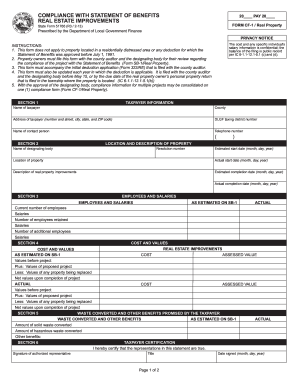
- In Section 1, enter your taxpayer information, including your name, county, address (number and street, city, state, and ZIP code), DLGF taxing district number, contact person's name, and their telephone number.
- Proceed to Section 2, where you will provide the location and description of the property. Fill out the name of the designating body, resolution number, estimated start date, actual start date, description of real property improvements, estimated completion date, and actual completion date.
- In Section 3, input information about employees and salaries. Include the current number of employees, their salaries, number of employees retained, their salaries, number of additional employees, and their respective salaries.
- Next, complete Section 4 by entering the cost and values as estimated on Form SB-1. Provide values before the project, values of the proposed project, values of any property being replaced, and net values upon completion of the project.
- Continue to Section 5 to report waste converted and other benefits promised by the taxpayer. Fill in the amounts for solid waste and hazardous waste converted along with any other benefits.
- In Section 6, the authorized representative must sign and certify that the information provided is true. Include their title and the date signed.
- Once you have filled out all sections, review the form for accuracy. Save your changes, and download or print the completed form for submission.
Take action now and complete your IN Form 51766 online for a smooth filing experience.
Experience a faster way to fill out and sign forms on the web. Access the most extensive library of templates available.
Related content
State Form 51766 (R6 / 4-23). Prescribed by the Department of Local Government Finance...
The department has prescribed the following CF-1 forms for taxpayers to submit information...
LUKAS-ERZETT Vereinigte Schleif- und Fräswerkzeugfabriken GmbH & Co. KG...
Get answers to your most pressing questions about US Legal Forms API.
What is state form 53569?
State Form 53569 is specifically used for personal property assessment in Indiana. This form supports property owners in reporting their business personal property, which is essential for accurate tax levies. If you are dealing with property taxes, also consider the IN Form 51766 as part of your overall strategy. For clarity on how to utilize these forms, turn to uslegalforms for assistance in your property tax filings.
How do I get tax exempt status in Indiana?
To obtain tax exempt status in Indiana, you must first establish your eligibility according to state laws, which often includes filling out the IN Form 51766. This form collects pertinent information to determine your qualifying criteria. After submission, the county assessor will review your application and decide on your tax-exempt status. Using uslegalforms can aid in streamlining this process and ensuring all requirements are met.
Is $80,000 a personal property tax exemption in Indiana?
No, $80,000 is not a personal property tax exemption in Indiana. The exemption amount typically varies based on property type and ownership conditions. However, the IN Form 51766 may allow you to apply for exemptions based on different aspects of your property assessed value. For accurate information and guidance, consult uslegalforms to help navigate your tax exemptions.
At what age do seniors stop paying property taxes in Indiana?
In Indiana, seniors can qualify for a property tax exemption at the age of 65. There is no specific age at which seniors stop paying property taxes altogether, but they may become eligible for various reductions. Submitting the IN Form 51766 can help seniors access these exemptions and benefits. For detailed steps, you can rely on uslegalforms to guide you through the application process.
How do I apply for property tax exemption in Indiana?
Applying for a property tax exemption in Indiana involves obtaining and filling out the IN Form 51766. You will need to provide information regarding your property and your eligibility for the exemption. Once you have filled out the form, submit it to your county assessor for review. Consider using uslegalforms to assist you in ensuring that your application is complete and correct.
How to file property tax exemption in Indiana?
To file for a property tax exemption in Indiana, you need to complete the IN Form 51766. This form requires relevant details about your property and its ownership. After filling out the form, submit it to your local county assessor's office by the designated deadline. Utilizing platforms like uslegalforms can simplify the process of gathering the necessary documents and submitting the form.
How to fill out employee's withholding allowance certificate CA?
Filling out the employee's withholding allowance certificate in California involves providing your personal details and selecting the appropriate number of allowances. Consider factors like your income, marital status, and dependents when making your selections. For additional assistance or to ensure compliance, check the IN Form 51766 to review any state-specific considerations.
How to fill out an EZ tax form?
To fill out an EZ tax form, you will need to gather your income information, deductions, and tax credits. This simplified form allows you to report basic income and claim standard deductions without much detailed information. For further clarification on any specific details, the IN Form 51766 can offer guidance tailored to your situation.
Is it better to claim 1 or 0?
Whether to claim 1 or 0 on your withholding depends on your financial situation and tax strategy. Claiming 0 will lead to higher withholding, potentially resulting in a larger tax refund, while claiming 1 could result in a lower refund or a tax bill. Examine the guidelines in the IN Form 51766 to find the right balance that suits your needs.
How to fill out a 15 H form?
Filling out a 15 H form involves providing details regarding your tax situation, including your age and income levels. This form is typically used for claiming a reduction or exemption from withholding. For personalized assistance in completing this form, consider checking the IN Form 51766 for relevant instructions.
Use professional pre-built templates to fill in and sign documents online faster. Get access to thousands of forms.
If you believe that this page should be taken down, please follow our DMCA take down process here.