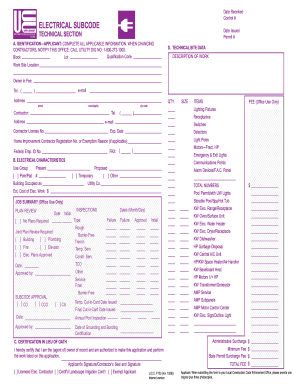
CALL UTILITY DIG NO: 1-800-272-1000. Qualification Code Block Lot D. TECHNICAL SITE DATA DESCRIPTION OF WORK Work Site Location Owner in Fee: Tel. ( e-mail ) Address street municipality Contractor: Tel. Address QTY. zip code ( ) Switches Detectors Light Poles Motors—Fract. HP Home Improvement Contractor Registration No. or Exemption Reason (if applicable): FAX: ( ) Emergency & Exit Lights Communications Points B. ELECTRICAL CHARACTERISTICS Use Group Present [ ] Pole/Pad # .

How it works
  • Open form

    Open form follow the instructions

  • Easily sign form

    Easily sign the form with your finger

  • Share form

    Send filled & signed form or save

How to fill out the NJ U.C.C. F120 online

Filling out the NJ U.C.C. F120 form online is a straightforward process that enables you to submit your application for electrical work efficiently. This guide will walk you through each section of the form, ensuring you understand how to complete the information required.

Follow the steps to complete your NJ U.C.C. F120 form online.

  1. Click the 'Get Form' button to access the NJ U.C.C. F120 form and open it in the online editor.
  2. In section A, identification—applicant: Fill in all applicable information regarding the applicant, including contact information and any necessary qualification codes. If you are changing contractors, ensure to notify the office as required.
  3. In section D, technical site data: Provide a detailed description of the work to be performed. Include the work site location, ownership details, and contact information, including phone and email addresses.
  4. In section B, electrical characteristics: Indicate the use group and specify whether the building is occupied or if it is a temporary service. Provide all necessary electrical details such as pole/pad numbers and items being installed.
  5. Ensure to list all relevant quantities of items in the electrical characteristics section. Include details on lighting fixtures, alarm devices, and necessary electrical amp services.
  6. For the certification section, provide the applicant's signature or the contractor's seal and signature. Confirm the applicant's qualifications and authorization to complete the application.
  7. Once all information is entered and verified, you can save your changes, download the form, or print it for submission. Ensure you keep a copy for your records.

Complete your NJ U.C.C. F120 form online today to expedite your electrical work application!

Get form

Experience a faster way to fill out and sign forms on the web. Access the most extensive library of templates available.

Related content

Electrical Subcode

... this form to your Local Construction Code Enforcement Office, please provide one...

Learn more
N.J. Admin. Code § 5:23-4.5 - Municipal enforcing...

F120, Electrical Subcode Technical Section. F130, Plumbing Subcode Technical Section...

Learn more
File Info : application/pdf, 90 Pages, 12.43MB

1969 DATA Book Discontinued Transistors Edition 5 msr D.A.T.A.BOOK DISCONTINUED...

Learn more
Questions & Answers

Get answers to your most pressing questions about US Legal Forms API.

Contact support

What home renovations require a permit in NJ?

Many significant home renovations in New Jersey require a permit. This includes major structural changes, electrical work, plumbing, and additions as specified by the NJ U.C.C. F120. Not obtaining a permit could lead to complications or fines later. It's best to consult with local authorities or use resources like uslegalforms for accurate information.

In New Jersey, you generally need a permit to possess a firearm in your home. The regulations are strict and fall under gun ownership laws, not the NJ U.C.C. F120. Understanding these laws is crucial for responsible ownership and compliance. Always check state guidelines and local requirements regarding gun ownership.

The time to obtain a building permit in New Jersey can vary depending on the municipality and the complexity of your project. Generally, you can expect a timeframe from a few weeks to several months. Under the NJ U.C.C. F120 regulations, timely submission of your complete application helps speed up the process. Consider using platforms like uslegalforms for a streamlined application experience.

In New Jersey, you might be able to build certain structures, such as small sheds or fences under specific height limits, without a permit. However, it's essential to refer to the NJ U.C.C. F120 guidelines to understand what is permissible. Construction without a permit can lead to fines or required removal of work. Checking local regulations is always a good practice.

Homeowners in New Jersey can perform certain small projects without obtaining a permit. Typical examples include minor interior renovations, like painting or flooring, and limited repair work. However, major alterations usually fall under the NJ U.C.C. F120, necessitating a permit. Always verify with local authorities before starting any work.

The Uniform Construction Code (UCC) in New Jersey sets the standard for construction and building safety. The NJ U.C.C. F120 outlines regulations that all construction projects must follow to ensure public safety and health. This code covers everything from building permits to inspection processes. Compliance with the UCC is crucial for all builders and homeowners.

In New Jersey, minor electrical work such as replacing outlets, switches, or light fixtures can often be done without a permit. However, more extensive changes, like adding new circuits, usually require a permit under the NJ U.C.C. F120 guidelines. It's advisable to consult local codes to ensure compliance. When in doubt, obtaining a permit is a wise choice.

Yes, in New Jersey, a construction permit generally refers to the same concept as a building permit. Both are essential for ensuring that construction projects comply with the NJ U.C.C. F120 standards. They help maintain safety and structural integrity. Always check with your local municipality for specific requirements.

Homeowners can perform certain types of electrical work in New Jersey, including tasks like installing lighting and replacing switches. However, more complex electrical work often requires a licensed electrician due to NJ U.C.C. F120 regulations. It's always best to assess whether your project aligns with local requirements and safety standards. Consulting the NJ U.C.C. F120 can also guide your decisions.

Yes, homeowners in New Jersey can pull a building permit for their projects. However, it may involve submitting the required applications and paying relevant fees to the local building department. Understanding the NJ U.C.C. F120 is crucial as it outlines the necessary documentation and procedural steps. This knowledge can simplify the permitting process and enhance compliance.

Get This Form Now!

Use professional pre-built templates to fill in and sign documents online faster. Get access to thousands of forms.

If you believe that this page should be taken down, please follow our DMCA take down process here.

Get NJ U.C.C. F120