Loading
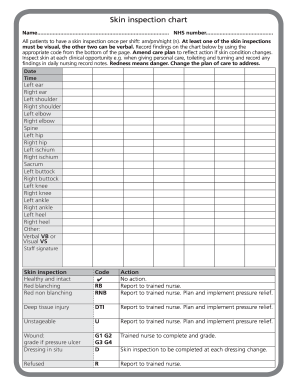
Get Uk Skin Inspection Chart
How it works
-

Open form follow the instructions
-

Easily sign the form with your finger
-

Send filled & signed form or save
How to fill out the UK Skin Inspection Chart online
The UK Skin Inspection Chart is an essential document used for monitoring the skin condition of patients. This guide provides clear, step-by-step instructions for filling out the chart accurately online, ensuring that your documentation is comprehensive and effective.
Follow the steps to complete the skin inspection chart online
- Press the ‘Get Form’ button to obtain the document and open it in your chosen online editor.
- Begin by entering the patient's name and NHS number at the top of the form. This information is crucial for identifying the patient and ensuring accurate medical records.
- Document the date and time of the skin inspection. It is important to note that all patients should have a skin inspection during each shift: morning, afternoon, or night. Ensure clarity on which shift is being documented.
- Proceed to inspect the areas listed on the chart, including both ears, shoulders, elbows, spine, hips, ischia, sacrum, buttocks, knees, ankles, and heels. Mark any observations using the appropriate codes provided at the bottom of the form.
- For each inspected area, indicate whether the inspection was verbal or visual by selecting 'VB' for verbal or 'VS' for visual. Staff signature is required to validate the chart.
- Assess the condition of the skin and apply the corresponding code: healthy and intact (4), red blanching (RB), red non-blanching (RNB), deep tissue injury (DTI), or unstageable (U). Document any actions taken based on the findings.
- If any changes to the skin condition are noted, amend the care plan to reflect the necessary actions, including pressure relief measures as warranted.
- Finally, review all entries for accuracy. Save changes, then download, print, or share the form as necessary to complete the documentation process.
Complete your skin inspection forms online to ensure accurate and timely patient care.
Related links form
To check the skin for pressure damage, inspect areas usually under pressure, like heels, elbows, and the tailbone. Look for redness, swelling, or sores, and use tools such as the UK Skin Inspection Chart for guidance. Documenting these observations helps in making informed decisions about necessary interventions.