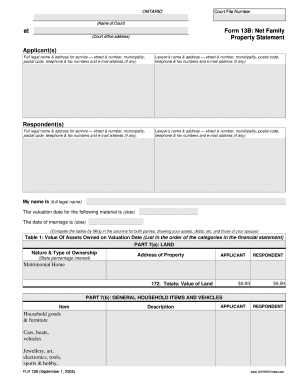
E & address for service — street & number, municipality, postal code, telephone & fax numbers and e-mail address (if any). Lawyer’s name & address — street & number, municipality, postal code, telephone & fax numbers and e-mail address (if any). Respondent(s) Full legal name & address for service — street & number, municipality, postal code, telephone & fax numbers and e-mail address (if any). Lawyer’s name & address — street & number, municipality, postal code, telephone & fax nu.
Open form follow the instructions
Easily sign the form with your finger
Send filled & signed form or save
How to fill out the Canada FLR-13-E online
This guide provides comprehensive instructions for filling out the Canada FLR-13-E form online. By following these steps, users of all backgrounds can ensure they complete the form accurately and efficiently.
Follow the steps to successfully complete the form online.
- Click ‘Get Form’ button to obtain the form and open it in the online editor.
- Enter your court file number at the top of the form to identify your case.
- Provide the full legal name and address for service of the applicant and, if applicable, their lawyer.
- Fill in the respondent's full legal name and address for service, along with their lawyer's information, if they have one.
- State your full legal name, the valuation date of the property, and the date of your marriage.
- Complete the tables that ask for details about assets and debts for both parties, ensuring you accurately list all relevant items.
- For each category, such as land, vehicles, and bank accounts, provide specific values and details as requested in the form.
- After filling out all sections, review the form for accuracy and completeness.
- Once satisfied with the information provided, you can save the changes, download, print, or share the completed form.
Complete your Canada FLR-13-E online today to move forward with your process.
Experience a faster way to fill out and sign forms on the web. Access the most extensive library of templates available.
Related content
Jun 22, 2021 — Under applicable Canadian rules, the Offer must be held open for at least...
Form F-10 is used for registration of securities under the Securities Act of 1933 by...
Oct 30, 2024 — The Canadian Centre for Cyber Security's National Cyber Threat Assessment...
Get answers to your most pressing questions about US Legal Forms API.
What is the 90% rule for newcomers to Canada?
The 90% rule for newcomers in Canada indicates that to maintain your residency status, you must establish significant ties to the country. This means that at least 90% of your income should be sourced from Canadian earnings. This guideline is essential for newcomers and is relevant when filling out the Canada FLR-13-E to declare residency correctly.
What is 13 tax in Canada?
The term 13 tax in Canada usually identifies the HST, a tax imposed in various provinces at a rate of 13%. This tax affects your purchases and could impact your overall financial planning. If you are uncertain about how this tax affects your financial status upon your return, filling out the Canada FLR-13-E can clarify your residency and obligations.
What is 13% tax in Canada?
The 13% tax in Canada often refers to the Harmonized Sales Tax (HST) levied in certain provinces. This tax combines both federal and provincial sales taxes, providing a streamlined approach to taxing goods and services. Understanding this tax is vital for both consumers and businesses, especially if you are navigating tax forms like the Canada FLR-13-E.
What is line 13 on tax return Canada?
Line 13 on a tax return in Canada represents the total income earned from all sources. It is important to report this information accurately as it influences your overall tax calculations. If you have made any changes to your residency status, such as through the Canada FLR-13-E, it is crucial to reflect that in your filings.
What is line 13 on a tax return in Canada?
On a Canadian tax return, line 13 usually captures your total income from various sources before deductions. This includes salaries, self-employment income, and investment earnings. Familiarizing yourself with line 13 ensures comprehensive reporting on your tax obligations, particularly when filling out related forms like the Canada FLR-13-E.
What is line 13 on taxes?
Line 13 on taxes typically refers to specific income reported on a tax return. In Canada, this line is often associated with total income from various sources. Knowing how this line is applied can help you accurately report your earnings and obligations, which includes the Canada FLR-13-E form when affecting your residency status.
What form do I need to fill out when returning to Canada?
When returning to Canada, you need to complete the Canada FLR-13-E form. This form serves as a Customs declaration that helps border services understand your status and any items you are bringing back. Ensuring you have this form filled out accurately can streamline your re-entry process and minimize delays.
How much income is untaxed in Canada?
In Canada, untaxed income can vary depending on the source and any applicable exemptions. For instance, certain government benefits may not be taxable. To get a clear understanding of untaxed income, referencing Canada FLR-13-E can provide essential insights tailored to your financial situation.
What is the minimum income to report in Canada?
The minimum income that must be reported in Canada is not set in stone but generally revolves around $3,000 for most individuals. If your income exceeds this threshold, it's advisable to report it to avoid any penalties. Leveraging Canada FLR-13-E can ensure you comply with all income regulations seamlessly.
Under what amount do you not have to report income?
In Canada, if your income from one source is below a certain threshold, you may not need to report it. Specifically, if your total annual income is below $3,000, you may not have to file a tax return. However, to navigate these nuances effectively, referencing Canada FLR-13-E will provide valuable guidance.
Use professional pre-built templates to fill in and sign documents online faster. Get access to thousands of forms.
If you believe that this page should be taken down, please follow our DMCA take down process here.