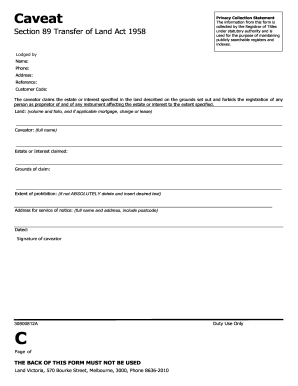
E of maintaining publicly searchable registers and indexes. Lodged by Name: Phone: Address: Reference: Customer Code: The caveator claims the estate or interest specified in the land described on the grounds set out and forbids the registration of any person as proprietor of and of any instrument affecting the estate or interest to the extent specified. Land: (volume and folio, and if applicable mortgage, charge or lease) Caveator: (full name) Estate or Interest claimed: Grounds of claim: E.
Open form follow the instructions
Easily sign the form with your finger
Send filled & signed form or save
How to fill out the AU Caveat Section 89 online
Filling out the AU Caveat Section 89 form is a crucial step in asserting your claim regarding a particular estate or interest in the land. This guide provides clear instructions for users, regardless of their legal experience, to complete the form accurately and efficiently online.
Follow the steps to complete the form with ease.
- Click the ‘Get Form’ button to access the AU Caveat Section 89 form and open it for editing.
- Fill in the 'Lodged by' section. Provide your full name, phone number, address, reference, and customer code as applicable. This information identifies the person submitting the caveat.
- In the 'Land' section, input the volume and folio numbers of the land. If there is an applicable mortgage, charge, or lease, include that information as well to clarify your interest.
- Complete the 'Caveator' section by stating your full name. This identifies who is claiming the estate or interest.
- In the 'Estate or Interest claimed' field, clearly describe the type of estate or interest you are asserting, ensuring all details are accurate.
- Provide the 'Grounds of claim,' which explains the basis of your interest in the estate. This is critical as it supports the legitimacy of your caveat.
- In the 'Extent of prohibition' field, specify the limits of your claim. If you do not require an absolute prohibition, delete that portion and write in your desired text.
- Fill in the 'Address for service of notice' with your full name and address, including postcodes. This is where any official communications will be sent.
- Enter the date at which you are submitting the caveat in the 'Dated' field. This is important for processing your application.
- Sign the form in the 'Signature of caveator' field to validate your claim. Ensure your signature matches the name provided earlier in the form.
- After completing the form, review all sections for accuracy and completeness. You can then save changes, download a copy, print, or share the completed form as needed.
Submit your AU Caveat Section 89 form online today to protect your interests in the property.
Experience a faster way to fill out and sign forms on the web. Access the most extensive library of templates available.
Related content
by CAP Board · Cited by 4 — The Policy features modular sections enabling more frequent...
Section 89(1) of Victoria's Transfer of Land Act 1958 has no provisions regarding an...
by J Aitchison · Cited by 128 — Compositional data are vectors of proportions or...
Get answers to your most pressing questions about US Legal Forms API.
Is a caveat a limitation?
Yes, a caveat acts as a limitation on a property’s title, notifying others of existing claims. It serves to protect the claimant’s interests and requires attention from anyone looking to make decisions involving the property. Under AU Caveat Section 89, this limitation is legally recognized. Being aware of its implications can help you avoid potential legal disputes as you navigate property transactions.
How long do caveats last in Victoria?
Caveats generally last until they are removed, either voluntarily or by a court decision. Their duration will depend on the underlying claim and the specific circumstances, as specified in AU Caveat Section 89. Staying informed about the status of any caveat can save property owners from unexpected challenges. Regular communication with legal advisors can help manage these situations effectively.
Does a caveat prevent registration of a mortgage in Victoria?
Yes, a caveat can prevent the registration of a new mortgage on a property in Victoria. The existence of a caveat indicates that there are claims over the property, which can complicate the priorities of creditors. Under AU Caveat Section 89, understanding these implications is crucial for anyone involved in real estate transactions. Seeking professional advice can provide clarity on your rights.
How do I remove a caveat from my property in Victoria?
To remove a caveat from your property in Victoria, you must submit a request to the relevant authority. This process is generally governed by AU Caveat Section 89, which stipulates the necessary steps. Depending on the situation, it may involve negotiating with the party who registered the caveat or seeking a court order. Consulting experts familiar with caveat procedures can ease this process.
Can a property be sold if it has a caveat in Victoria?
While a property can technically be sold with a caveat, it often requires careful management of the caveat’s implications. Buyers will want assurance that their investment is secure. Failure to resolve the caveat can lead to disputes post-sale, which is why understanding AU Caveat Section 89 is vital for both sellers and buyers. Legal advice is recommended to navigate these waters.
Can you sell a house with a caveat on it in Victoria?
You can sell a house with a caveat attached, but doing so may complicate the transaction. Potential buyers may hesitate due to the existing claim on the property. It is essential to address this issue beforehand to ensure a smoother process, especially under AU Caveat Section 89. Consult with a legal professional to explore your options for dealing with caveats.
What does caveat mean in real estate?
A caveat in real estate serves as a notice to other parties that someone claims an interest in a property. This legal document, as outlined in AU Caveat Section 89, protects the claimant's rights from being overlooked. It essentially acts as a warning that the property may have encumbrances. Understanding this can help you navigate your real estate transactions more confidently.
How long does a caveat on a house last for in Victoria?
In Victoria, a caveat can last for an indefinite period, but it typically remains effective until the relevant court or authority removes it. AU Caveat Section 89 governs the duration and process for caveats. It is crucial for property owners to monitor the status of any registered caveats. Keeping track can help you manage your property rights effectively.
How long does a caveat last in Victoria?
Non-urgent If no claim is brought, the caveat will automatically lapse after 30 days and the titles office will process that lapse during approximately the 14 days that follow. This removes the caveat from your title.
Do caveats expire Victoria?
The caveat will automatically lapse if no proceedings have been commenced within 30 days, and subsequent dealings can then be registered. The timing of lodging a caveat is crucial, as any dealings lodged at Land Victoria before the caveat is lodged will take priority.
Use professional pre-built templates to fill in and sign documents online faster. Get access to thousands of forms.
If you believe that this page should be taken down, please follow our DMCA take down process here.