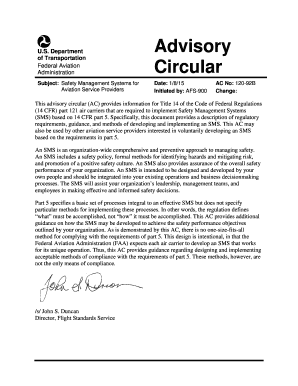
120-92B Change: This advisory circular (AC) provides information for Title 14 of the Code of Federal Regulations (14 CFR) part 121 air carriers that are required to implement Safety Management Systems (SMS) based on 14 CFR part 5. Specifically, this document provides a description of regulatory requirements, guidance, and methods of developing and implementing an SMS. This AC may also be used by other aviation service providers interested in voluntarily developing an SMS based on the requirem.
Open form follow the instructions
Easily sign the form with your finger
Send filled & signed form or save
How to fill out the AC 120-92B online
This guide provides a comprehensive walkthrough for users looking to fill out the AC 120-92B form online. Whether you are a seasoned professional in aviation or a newcomer to the field, this guide will assist you in ensuring that you meet all necessary requirements for documenting your Safety Management System.
Follow the steps to successfully complete AC 120-92B.
- Click ‘Get Form’ button to obtain the AC 120-92B form and open it in the editor.
- Begin filling out the necessary fields in the form. Ensure that you provide accurate and comprehensive information in each section, including organizational details, safety policies, and risk management processes.
- Review Section 1: Introduction and Purpose. Familiarize yourself with the goals and expectations of the AC 120-92B as it outlines the importance of Safety Management Systems in aviation.
- Progress to Section 2 and complete the Foundations of the Safety Management System. Document the essential safety culture and management principles relevant to your organization.
- Continue to Section 3, detailing each component of your Safety Management System. This includes safety policy, risk management procedures, assurance processes, and promotion strategies.
- Move on to Section 4, which outlines the implementation strategies for your Safety Management System. Describe your phased implementation plan effectively.
- Finally, ensure that all information is accurate and complete. Check for any errors or missing information before finalizing the form.
- Once completed, you can save your changes, download a copy of the filled form, print it for records, or share it as needed.
Take the next step in improving your organization’s safety management by completing the AC 120-92B online today.
Experience a faster way to fill out and sign forms on the web. Access the most extensive library of templates available.
Related content
Jan 8, 2015 — This document provides a description of regulatory requirements, guidance...
In 2015, the FAA published AC 120-92B to provide guidance material for certificate holders...
FltPlan SMS provides flight departments with the tools needed to comply with the SMS...
Get answers to your most pressing questions about US Legal Forms API.
In what FAA advisory circular can information on SMS be found?
You can find detailed information about Safety Management Systems in AC 120-92B, which serves as the primary guide for SMS implementation in aviation. This advisory circular outlines the necessary steps and considerations for establishing a robust safety culture. By referring to AC 120-92B, you can access vital resources for enhancing safety in your aviation practices.
What is the SMS regulatory requirement in aviation?
The regulatory requirement for SMS in aviation mandates that certain operators establish a Safety Management System to actively manage safety risks. AC 120-92B outlines these requirements and details the essential components of an effective SMS. Meeting these regulations helps ensure that aviation operations are conducted safely and efficiently.
What advisory circular provides information for SMS for aviation service providers?
AC 120-92B is the advisory circular specifically designed to provide guidance on the implementation of Safety Management Systems for aviation service providers. It highlights the framework necessary to assess and improve safety performance. By following its principles, organizations can better manage risks and enhance operational safety.
What is the AC 91 57 advisory circular?
AC 91 57 is an advisory circular that addresses model aircraft operations and outlines safety measures for small unmanned aircraft systems. While AC 91 57 focuses on a specific area, AC 120-92B encompasses broader aspects of Safety Management Systems applicable to various aviation sectors. Both circulars contribute to enhancing safety in their respective domains.
Who is responsible for SMS in aviation?
The responsibility for implementing and managing SMS in aviation lies with the organizational leadership and management. According to AC 120-92B, it is essential for these leaders to foster a culture of safety and accountability. Effective SMS requires engagement at all levels, ensuring that every team member understands their role in promoting safety.
Where can I get FAA advisory circulars?
You can access FAA advisory circulars online through the FAA's official website. The site provides a comprehensive database where you can find circulars, including AC 120-92B, for various aviation topics. This resource allows you to stay informed about the latest regulatory updates and guidelines that affect aviation operations.
What are advisory circles?
Advisory circles, often referred to as advisory circulars, provide guidance and information on regulatory compliance and best practices in aviation. They serve as a valuable resource for understanding safety protocols and are essential for operators striving to meet the standards set by AC 120-92B. These circulars aid in clarifying the nuances of implementing effective safety management systems.
Is SMS required by the FAA?
Yes, the FAA mandates that certain organizations implement Safety Management Systems (SMS) to ensure safety in aviation operations. AC 120-92B outlines the requirements for these systems, promoting a proactive approach to safety. By adhering to the guidelines in AC 120-92B, aviation service providers can create a safer environment for all stakeholders.
Who controls the FAA?
Control of the FAA lies with the federal government, specifically under the jurisdiction of the Department of Transportation. The President appoints the Administrator, who then manages the FAA’s various programs and initiatives, including those outlined in AC 120-92B. This structure ensures that aviation safety and regulatory compliance remain priorities at a national level. Consequently, understanding how these elements interact helps aviation professionals navigate FAA protocols effectively.
Who has final authority in the FAA?
The Federal Aviation Administration, or FAA, operates under the authority of the United States Department of Transportation. The Administrator of the FAA holds the highest position, wielding significant influence over aviation regulations, policies, and safety standards. Specifically, the regulations set forth in AC 120-92B guide the FAA's operations and ensure adherence to aviation safety laws. Thus, the Administrator is key to the effective implementation of these regulations.
Use professional pre-built templates to fill in and sign documents online faster. Get access to thousands of forms.
If you believe that this page should be taken down, please follow our DMCA take down process here.